
Fake Tweet Buster: Combatting Visual Misinformation with Hybrid Verification
Fake tweet buster: a webtool to identify users promoting fake news ontwitter
The paper introduces "Fake Tweet Buster" (FTB), a specialized web tool designed to detect malicious users and deceptive images in news-related tweets. It utilizes a hybrid approach combining reverse image searching, user metadata analysis, and crowdsourced validation to assign credibility scores.
TL;DR
"Fake Tweet Buster" (FTB) is a pioneering web application focused on identifying users who promote fake news by recycling old images in new, misleading contexts. By combining automated reverse image searches with user behavioral analysis and crowdsourced intelligence, the tool provides a comprehensive credibility score to help users distinguish between naive resharing and deliberate manipulation.
Problem & Motivation: The Digital Battlefield
In the modern social media landscape, Twitter has become a primary battlefield for political confrontation. A particularly effective "dirty trick" employed by malicious actors is the use of re-contextualized imagery. This involves taking a legitimate photo from an old event and presenting it as a live update from a different location to delegitimize opponents or inflate perceived support.
The difficulty lies in the context: users following international conflicts often lack the local knowledge to realize a photo is years old or from a different continent. FTB was conceived to bridge this information gap, targeting both the malicious "fakers" and the naive "believers" who unintentionally amplify misinformation.
Methodology: The Three Pillars of Credibility
The FTB engine operates on a three-step verification pipeline that moves from metadata to visual history and finally to human judgment.
1. Reverse Image Search (The Visual Truth)
This is the core innovation of the tool. By querying Google Images and TinEye, FTB can extract:
- Best Guess Label: A textual description of what the image actually depicts.
- Initial Discovery Date: The true age of the photo. If a tweet from 2024 claims to show a protest in Country A, but the reverse search reveals the image was first indexed in 2012 in Country B, the tool flags a high probability of deception.
2. User Analysis
The system leverages the Twitter API to evaluate the "Inductive Bias" of the account. Key metrics include:
- Account Maturity: Newer accounts are statistically more likely to be disposable bot accounts.
- Network Reach: A low follower-to-following ratio combined with high frequency of controversial posts flags suspicious behavior.
3. Crowdsourcing (Human-in-the-Loop)
Recognizing that AI could not yet catch every nuance of political satire or context in 2014, FTB allows its community to tag accounts as "Fake" or "Legitimate," creating a self-correcting database that improves the tool's accuracy over time.
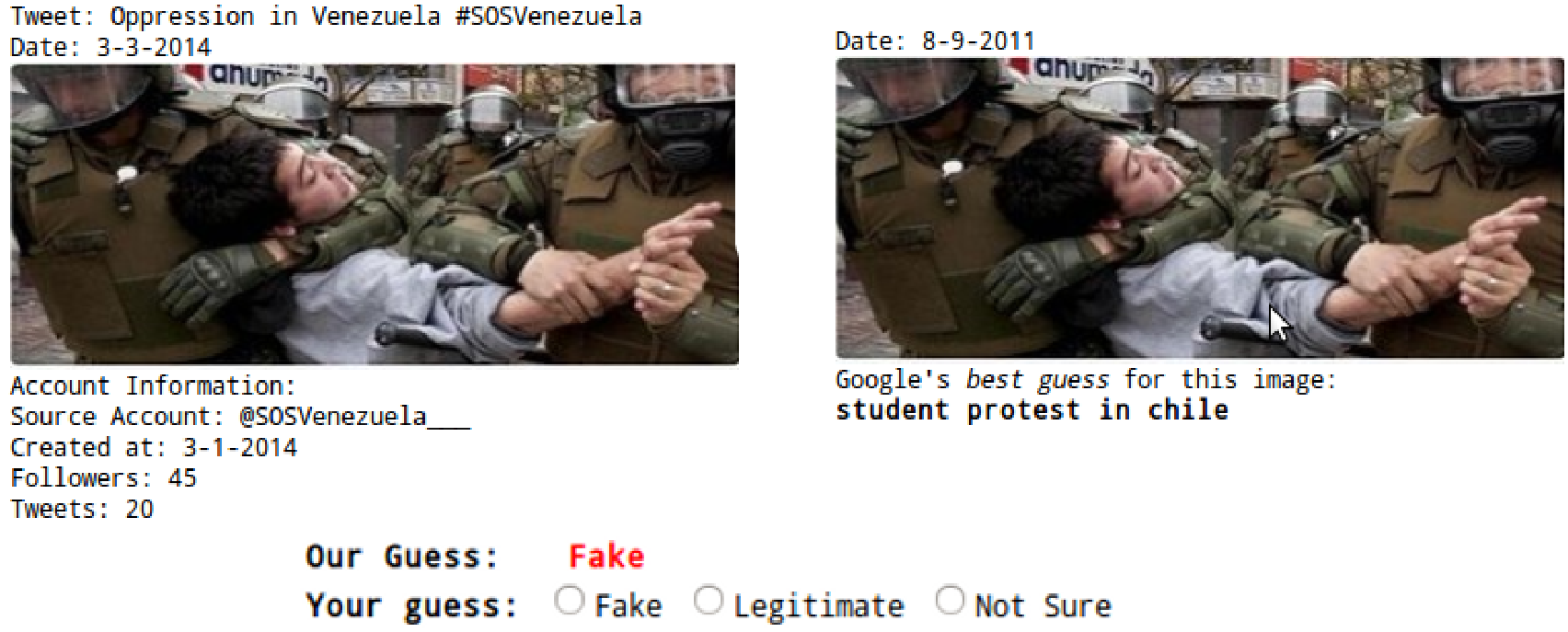 Figure 1: A textbook example of visual misinformation where a 2011 protest in Chile was misrepresented as a 2014 event in Venezuela.
Experiments & Real-World Impact
The tool was showcased at the ACM Conference on Hypertext and Social Media, highlighting its ability to track how rumors propagate differently than actual news. FTB's interface effectively aggregates disparate data points—image history, account age, and community trust—into a single "Decision Support" panel.
By exposing the original source of viral images, FTB demonstrated that many "breaking news" photos published even by mainstream newspapers were actually recycled content, proving the necessity of programmatic verification tools for journalists and the general public alike.
Critical Analysis & Future Outlook
Takeaway
FTB proved that "image-to-text" discrepancies are the most reliable indicators of social media fraud. The integration of reverse search APIs into a single user interface significantly lowers the barrier for average users to perform high-quality fact-checking.
Limitations & Future Work
The 2014 iteration of this tool relied heavily on third-party search engines (Google/TinEye) and manual crowdsourcing. Subsequent research (as noted by the authors) aims to implement more sophisticated text-based credibility classifiers and automate the detection of "posting behaviors" such as bot-driven bursts. In the current era of Generative AI (DALL-E/Midjourney), the next generation of FTB would need to move beyond reverse searching for existing photos to detecting AI-generated artifacts.