
Debugging Through the Lens of Information: Generalized Entropies for Fault Localization
A family of generalized entropies and its application to software fault localization
This paper introduces a novel automated Fault Localization (FL) framework that treats the identification of buggy code as a machine learning feature selection task. By leveraging a new family of generalized entropies and linearized Mutual Information (MI), the authors present a uniform information-theoretic approach that achieves SOTA performance on the Siemens Test Suite.
TL;DR
Locating a bug in a massive codebase is like finding a needle in a haystack. This paper argues that instead of just looking for "suspicious" code, we should look for code that provides the most Information Gain. By using a family of generalized entropies (including Renyi and Harvda-Charvat), the authors transform Fault Localization (FL) into a machine learning feature selection problem, outperforming classic benchmarks like Tarantula.
Perspective: FL as Feature Selection
In machine learning, Feature Selection aims to find a subset of data that preserves structure while minimizing accuracy loss. The author's key insight is that in software debugging:
- The Dataset is the program source code.
- The Features are program constructs (statements, branches).
- Each execution (Passing or Failing) is a data point.
The "Faulty Line" is essentially the feature that has the highest Mutual Information (MI) with the program's outcome.
Methodology: The Entropy Generator
Existing techniques use empirical formulas like Tarantula or Ochiai. This work elevates the field by introducing a formal mathematical framework: a functional generator for entropies.
The proposed generator is defined as:
Depending on the choice of and , this formula can collapse into the standard Shannon entropy or more exotic forms like Renyi or Harvda-Charvat. This allows researchers to explore different "shapes" of information measurement to see which best captures the nature of software bugs.
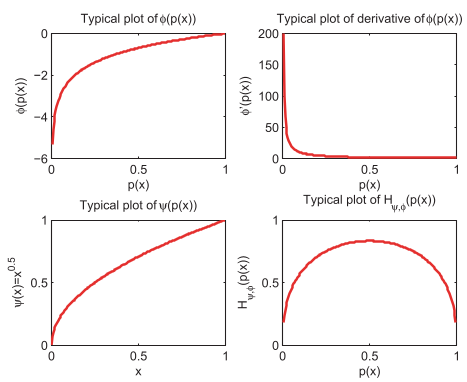 Fig 1: Typical plots of the functional generator and its derivatives used to define the family of entropies.
To make this computationally feasible for real codebases, the authors utilize a linearized Burbea-Rao Mutual Information , which approximates the actual MI in a way that is easier to calculate.
Experimental Evidence
The methodology was tested on the Siemens Test Suite, a classic benchmark for automated debugging.
Convergence of Information
A fascinating visualization in the paper shows how MI evolves as more test cases are added. In a "Middle Number" program (Example mid()), as the number of test cases increases from 2 to 6, the MI "peaks" sharply at line 7—the actual location of the bug.
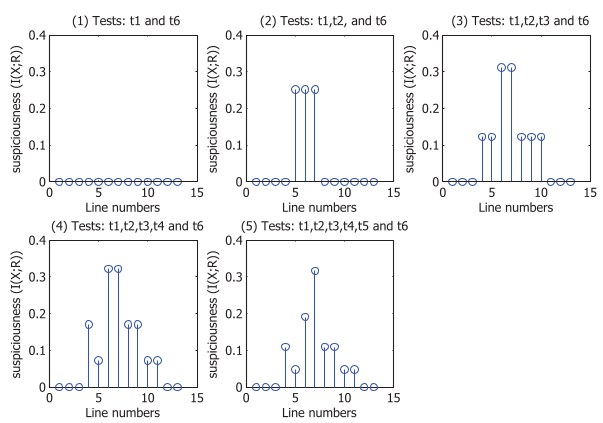 Fig 2: As more test cases (passing and failing) are integrated, the Mutual Information converges on the faulty statement (Line 7).
Performance vs. SOTA
The results show a clear win for the information-theoretic approach. By examining only 20% of the code (ranked by MI), developers can find approximately 90% of the defects.
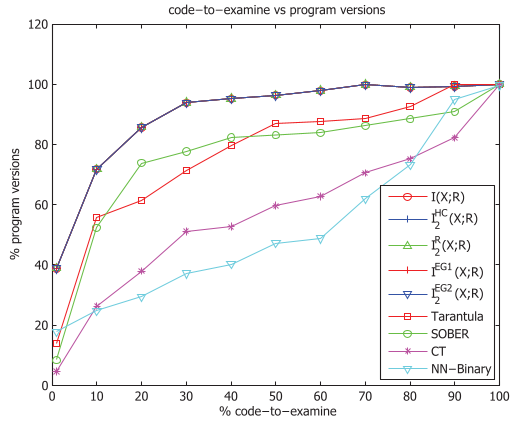 Fig 3: The "Score" (code not examined) vs. the percentage of faults found. The Generalized MI curves consistently sit above traditional baselines like Tarantula and SOBER.
Critical Insight & Conclusion
One of the most striking "negative" findings in this paper is that the specific type of entropy doesn't matter much. Whether you use Shannon, Renyi, or others, the performance is remarkably similar.
The real value lies in the switch from Similarity Metrics to Mutual Information. This suggests that Fault Localization is fundamentally a problem of uncertainty reduction. The primary contribution here isn't just a new tool; it's a theoretical bridge between Information Theory and Software Engineering, opening the door for more sophisticated ML-driven debugging tools.
Limitations: The study focuses on relatively small C programs. Future work must investigate if these high-entropic signals remain clean in massive, multi-threaded, or distributed systems where the noise-to-signal ratio is significantly higher.