
Decoding the DNA of AGE-Generated Malware: A Tree-Based Structural Approach
Family Identification of AGE-Generated Android Malware Using Tree-Based Feature
This paper introduces a novel tree-based feature extraction method for identifying families of Android malware generated by Application Generation Engines (AGE). By constructing and normalizing "Smali Trees" based on package directory structures, the authors achieve high-accuracy malware family classification using traditional machine learning algorithms like Random Forest.
TL;DR
With the rise of Application Generation Engines (AGE), attackers can now "auto-generate" Android malware en masse. This paper presents a specialized identification framework that extracts a "Smali Tree" from an app's directory structure. By normalizing this tree and extracting class-level semantic features, the authors achieve a near-perfect 99.51% accuracy in classifying malware families, even in the presence of code obfuscation.
Problem & Motivation: The AGE Threat
The democratization of app development via Application Generation Engines (AGE) has a dark side. While it helps non-programmers build apps using boilerplate code, it allows malicious actors to flood the ecosystem with thousands of similar malware samples.
Current detection systems face two major hurdles:
- Obfuscation Vulnerability: Most static tools look for specific strings (API calls, permissions). If an attacker renames classes or uses reflection, these tools fail.
- Structural Ignorance: Many models treat an APK as a flat list of features, ignoring the rich hierarchical information embedded in how the code is organized.
The authors' core insight is that AGE-generated malware within the same family shares a common skeleton. Even if the labels (names) change, the structure of the "Smali" directory tree remains largely consistent.
Methodology: Building and Normalizing the Smali Tree
The proposed pipeline moves beyond simple keyword matching and focuses on the topology of the application.
1. Smali Tree Construction
When an APK is decompiled, its classes are organized into folders representing package names (e.g., com/android/support). The authors perform a breadth-first traversal to turn this directory into a tree where:
- Nodes represent package segments.
- Leaves represent actual
.smalifiles (equivalent to Java classes).
2. Overcoming Obfuscation via Normalization
To prevent "renaming obfuscation" from breaking the tree, the authors recode and sort the tree:
- Recoding: Original names are replaced with numeric identifiers based on their path from the root.
- Normalization: Nodes at the same level are sorted by the number of their children. This ensures that the most "complex" branches (likely containing the core logic) are always processed first.
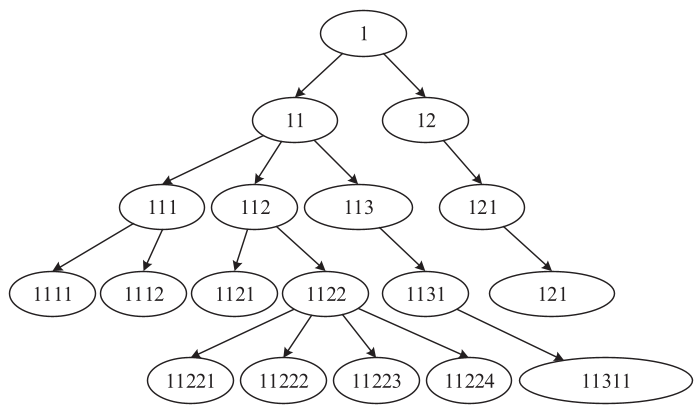 Figure: The process of transforming a directory structure into an encoded, standardized tree.
3. Multi-Dimensional Feature Extraction
For each leaf node (class), the authors extract 22 features across three categories:
- Internal Attributes: Depth in the tree, count of system/custom APIs, and reflection usage.
- Invocations: How often this class calls others or is called.
- References: How variables are shared across the class boundary.
Experiments: Performance at Scale
The model was tested against a dataset of 1,230 AGE-generated samples belonging to 17 diverse families (Trojans, PornWare, etc.).
Algorithm Performance
The researchers compared four machine learning backbones. Random Forest emerged as the winner, likely due to its inherent ability to perform feature selection across the 440-dimensional input vector (22 features per class × top 20 classes).
| Algorithm | Accuracy | F1-Score |
|---|---|---|
| Random Forest | 99.51% | 0.9943 |
| SVM | 99.02% | 0.9901 |
| Decision Tree | 99.10% | 0.9904 |
| Naive Bayes | 96.25% | 0.9272 |
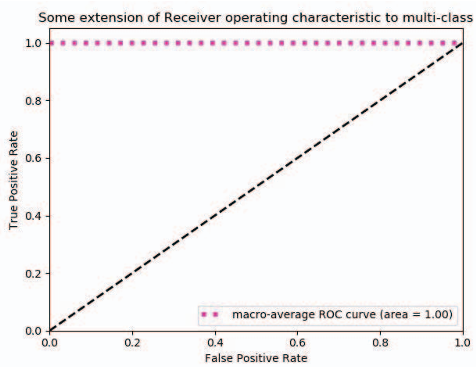 Figure: The ROC curve demonstrates the high precision and recall of the Random Forest classifier.
The Power of Fusion
A critical takeaway from the ablation study was the importance of all three feature types. Removing either the invocation (B) or reference (C) data points significantly dropped the performance (Accuracy falling from 99.8% to ~88%), proving that the "interaction" between classes is as important as the code inside them.
Critical Analysis & Conclusion
Summary: This research successfully identifies a "structural signature" for AGE-malware. By focusing on the Smali Tree, the authors created a classifier that is robust against common anti-analysis tricks.
Limitations:
- Breadth Depth: The study limited feature extraction to the first 20 leaf nodes. While sufficient for simple AGE apps, complex manual malware might require a deeper traversal.
- Dynamic Loading: No method can fully stop advanced malware that downloads its core logic at runtime, as the Smali tree would only show the "loader" part.
Future Outlook: The success of this structural approach suggests that the next generation of malware scanners should treat APKs not as text, but as graphs. Integrating these tree-based features into Deep Learning architectures like Graph Convolutional Networks (GCNs) could provide even more robust defenses against the evolving landscape of automated malware generation.