
Decoding the Shopping Basket: Estimating Family Structure via Machine Learning
Family Structure Attribute Estimation Method for Product Recommendation System
This paper introduces a family-structure estimation method for product recommendation systems that infers consumer attributes directly from POS purchasing behavior. Utilizing Random Forest and Naïve Bayes on a large-scale consumer panel dataset, the method achieves high precision in identifying family size and the presence of children, specifically reaching 85.0% accuracy for infants.
TL;DR
Researchers have developed a method to predict your family size and the ages of your children simply by looking at your receipts. By applying Random Forest algorithms to a massive dataset of 4.5 million transactions, the system can identify households with infants with a staggering 85% accuracy, enabling hyper-personalized product recommendations without ever asking the user for a single personal detail.
The Demographics Dilemma
In the world of retail, knowing who the customer is is half the battle. Are they a single professional? A parent of three? Or part of a multi-generational household? These attributes, known as Family Structure, dictate purchasing needs.
The industry faces a paradox: while recommendations require data, customers are increasingly resistant to questionnaires due to "survey fatigue" and privacy concerns. The authors of this paper suggest a "behavior-first" approach: instead of asking who you are, they look at what you buy.
Methodology: From Goods to Groups
The proposed system bridges the gap between raw POS data and user profiles through an Estimation Module.
1. Feature Engineering
The researchers didn't just look at the total bill. They extracted 661 dimensions of data, including:
- Temporal Patterns: Day of the week and hour of purchase.
- Retail Geography: 24 categories of shop groups (Subway stations, Drug stores, 100-yen shops).
- Product Granularity: Quantities and prices for 295 specific product types (from "Rice" to "Disposable Diapers").
2. Model Architecture
The system utilizes a training process where Random Forest (RF) and Naïve Bayes (NB) models are pitted against each other. The RF model consistently emerged as the winner, capable of capturing the non-linear relationships between "buying snacks" and "having an elementary schooler."
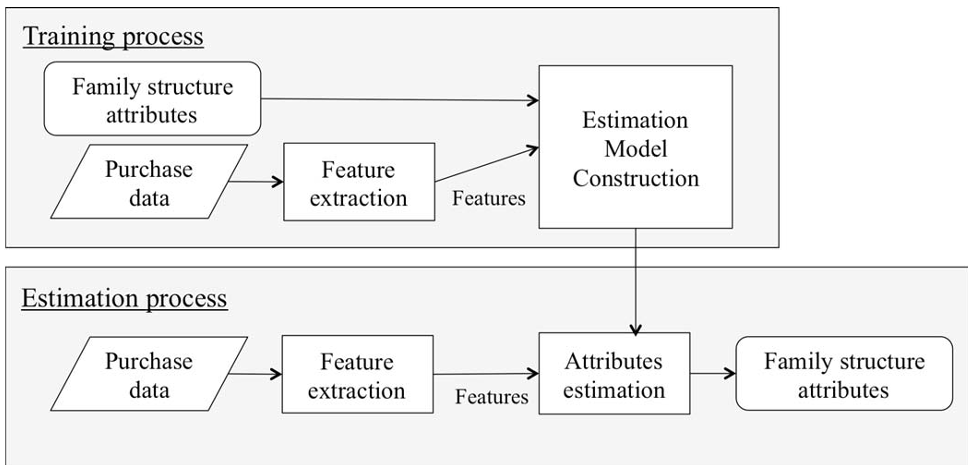 Figure 1: The two-stage training and estimation workflow used to derive family attributes.
Key Insights: What Your Basket Reveals
The experimental results, validated via 10-fold cross-validation on the i-SSP dataset, provide fascinating insights into consumer behavior:
- The "Single" Signature: Living alone is the easiest attribute to predict. Features like total quantity of "Laundry detergent" and "Rice" (a staple in the Japanese study context) are strong indicators of household scale.
- The Baby Trail: Predicting an infant's presence achieved the highest F-measure. The Information Gain was dominated by "Disposable diapers" and "Baby food," but also by the specific frequency of visits to "Baby goods stores."
- The Junior High Difficulty: Estimating junior high students proved difficult. Why? Because teenagers' consumption habits (food, hygiene products) begin to blend seamlessly with those of adults, leading to low Information Gain.
 Table 1: Top features for estimating infants. "Disposable diapers" shows a high Information Gain of 0.37.
Strategic Impact & Critical Analysis
This work represents a shift from Declared Data (what users say) to Observed Data (what users do). By achieving high accuracy in detecting vulnerable or specific life stages (like infancy), retailers can implement "Smart Recommendations" that evolve as the family matures.
Limitations: While effective, the model relies on high-resolution POS data which might not capture cash transactions or fragmented shopping across multiple retailers. Furthermore, the "Junior High" bottleneck suggests that as children grow, different feature types—perhaps digital signal or media consumption—might be required to maintain accuracy.
Conclusion
The ability to infer that a customer has moved from "Single" to "Parent" purely through the purchase of "Wet tissues" and "Snacks" opens a new frontier for CRM. It turns every transaction into a diagnostic tool, ensuring that the right product finds the right family at the right time.
Reference Content: Doi et al., "Family Structure Attribute Estimation Method for Product Recommendation System," NTT DOCOMO Research.