
Snowballing Insights: Leveraging Twitter for Real-Time Crisis Decision Support
Fast and Effective Decision Support for Crisis Management by the Analysis of People’s Reactions Collected from Twitter
The paper introduces a real-time decision support platform specialized for crisis management by mining human behavioral data from Twitter. It utilizes a combination of NLP-based sentiment analysis, graph theory for user influence, and Multi-Criteria Decision Modeling (MCDM) to rank emergency response actions.
TL;DR
In the chaos of a disaster, human behavior is the ultimate "wild card." This paper introduces a comprehensive platform that transforms chaotic Twitter streams into actionable intelligence. By blending real-time sentiment analysis, social network graph theory, and a Multi-Criteria Decision Support System (DSS), the research provides emergency managers with a ranked list of intervention strategies to mitigate cascading effects.
Background: The Social Sensor Network
During a crisis, official reports often lag behind the ground reality. However, people involved in the event tweet instantly. This work identifies social media users as "distributed sensors." The challenge lies in the sheer volume and noise of this data, which the "Snowball" project addresses through a robust Big Data architecture and sophisticated decision algorithms.
The Pain Point: Why Information Isn't Enough
Emergency managers don't just need to know what is happening; they need to know what to do. Existing systems often fail because:
- They ignore the "human factor" (panic, rumors, or local heroism).
- They cannot process the "Big Data" burst of Twitter in the first few minutes of a crisis.
- They lack a framework to evaluate the trade-offs between different rescue actions (e.g., speed vs. cost vs. social impact).
Methodology: From Tweets to Decisions
1. The Data Pipeline (ETL & ELDB)
The system utilizes the Apache Hadoop Distributed File System (HDFS) to store JSON-based messages following the EDXL-DE standard. This ensures that social media data is structured similarly to official emergency alerts, allowing for seamless integration.
2. The Twitter Mining Engine
The mining process is divided into three sophisticated layers:
- Filtering & Geolocation: Using geographical dictionaries to map the exact impact zone.
- Event Detection: A 3-level dictionary-based approach (Keywords -> Refinement -> Dangerousness Scoring).
- Graph Modeling: Utilizing NodeXL to identify "Influencers" and "Bridges," ensuring that a tweet from a credible source carries more weight in the decision model than an isolated bot.
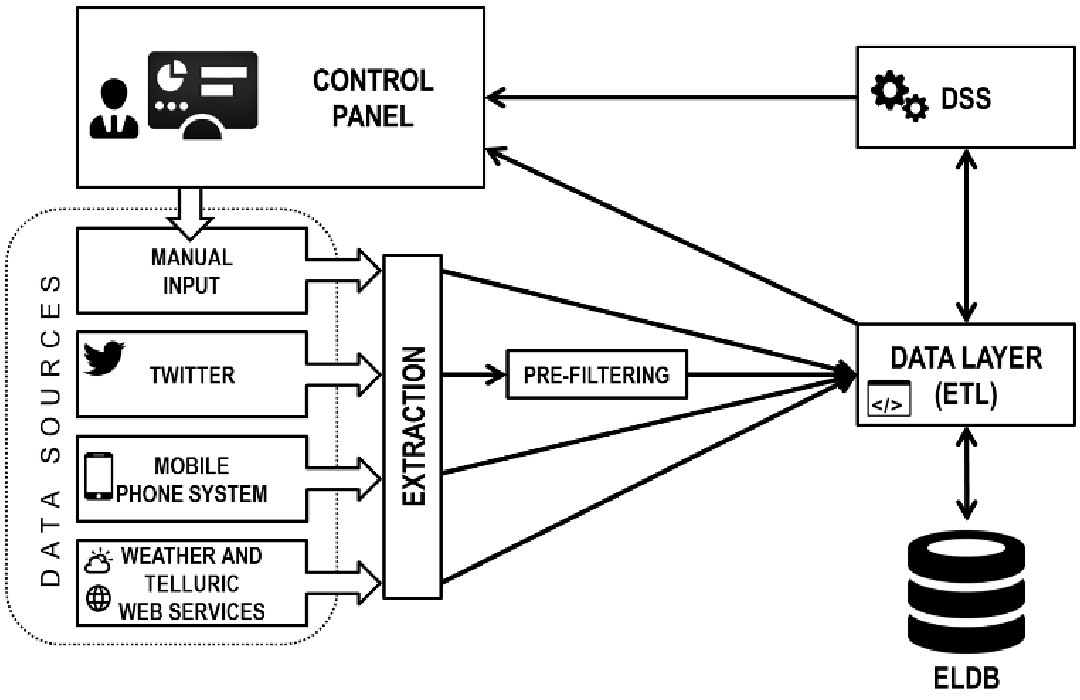 Figure 1: The Snowball Platform Architecture, showing the flow from social sensors to the Decision Support System.
3. The Decision Support System (DSS)
This is the "brain" of the platform. It uses the ELECTRE method—a Multi-Criteria Decision Modeling (MCDM) technique. It doesn't just give a single answer; it ranks alternative actions based on user-defined weights. It balances:
- Contextual data (population density, road networks).
- Historical data (how people reacted during past floods).
- Real-time sentiment (is the population calm or rioting?).
Experiments: Validating the Model
The authors validated their approach using data from significant past events:
- Storms in Finland and Poland.
- Volcanic Eruptions in Santorini.
- Flooding of the Danube in Hungary.
By simulating these scenarios, the team proved that the platform could distinguish between "noise" and "critical alerts," effectively tagging data using the AIDR (Artificial Intelligence for Disaster Response) framework, which combines human tagging with machine classifiers.
Note: The system leverages historical cascading effects to predict future outcomes in these specific geographic scenarios.
Critical Insight: The "Cascade" Effect
The most significant contribution of this work is its focus on Cascading Effects. A flood isn't just water; it's a power outage, followed by a telecom failure, followed by public panic. By monitoring Twitter, the DSS can detect the "vibe" of these secondary failures before they appear in official sensor data.
Conclusion and Limitations
While the system is powerful, its reliance on specific dictionaries for different crisis types suggests a need for more adaptive NLP models (like modern Transformers). Furthermore, Twitter's API changes and the shift in user demographics toward other platforms like TikTok or Telegram present a challenge for future-proofing this architecture.
However, as a framework for integrating Human Behavior into Operational Logistics, the Snowball project sets a high standard for 21st-century emergency management.