
LBFRS: Accelerating Social Routing via Geographic Check-in Intelligence
Fast Routing in Location-Based Social Networks Leveraging Check-in Data
The paper introduces LBFRS (Location-Based Fast Routing System), a novel framework for accelerating shortest-path discovery in large-scale Location-Based Social Networks (LBSN). By leveraging check-in data and a "friendship-inverse-geography" property, it achieves up to 82x faster routing compared to Dijkstra's algorithm while maintaining high accuracy.
TL;DR
Finding the "shortest path" between two people in a massive social network is a classic problem. While we've all heard of "Six Degrees of Separation," practically finding those six hops in a graph with millions of active users is computationally expensive. LBFRS solves this by using your check-in history to predict your location and then using that location as a "GPS" to guide a search algorithm (A*) through the social web, beating standard industrial methods (Dijkstra) by up to 82 times.
The Problem: The Snail-paced Search for Social Connections
In the context of Location-Based Social Networks (LBSNs) like Foursquare or Gowalla, the "routing problem" involves finding the minimum cost path (either physical distance or number of social hops) between two individuals.
Current solutions face a "Goldilocks" dilemma:
- Dijkstra’s Algorithm: Too slow. It blindly explores the graph in all directions, crashing when millions of users and dynamic edges are involved.
- GEOGREEDY Routing: Too inaccurate. It simply moves to the neighbor geographically closest to the target. In the authors' tests on the Gowalla dataset, it reached the exact target a miserable 1.9% of the time.
The missing link? A way to use spatial intuition to guide the graph search without losing the guarantee of finding the right path.
Methodology: Social "GPS" through Check-ins
The authors' core insight is the Friendship-Inverse-Geography Property. By analyzing Gowalla and Brightkite data, they proved that the probability of two people being friends is inversely proportional to the geographical "layer" they reside in relative to each other.
1. OLPCA: Mapping the Dark Nodes
Most users don't share their exact home addresses. To fix this, the Online Location Prediction Clustering Algorithm (OLPCA) uses two stages:
- For Check-in Users: Clusters their various check-in points (malls, offices, cafes) to estimate a "home" coordinate.
- For Non-Check-in Users: Estimates their location by clustering the predicted locations of their friends.
2. LBDA*: The Heuristic Engine
With a coordinate system (DLCS) in place, the authors implemented LBDA* (Location-Based Dynamic A*). Unlike Dijkstra, which treats every neighbor equally, LBDA* uses a heuristic function . It estimates the remaining cost to the target based on geographical distance.
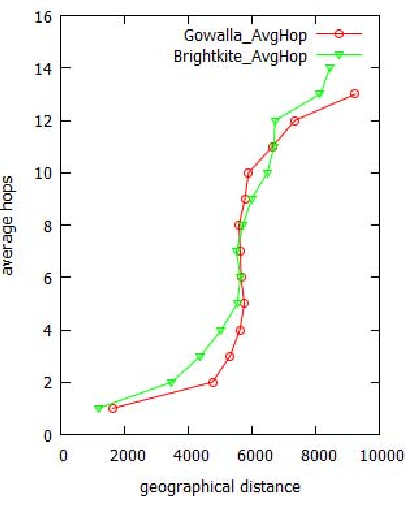 Figure: The relationship between geographical distance and social hops—the foundation for the heuristic.
Experimental Results: Breaking the Speed Limit
The authors tested LBFRS against Dijkstra on two real-world datasets. The performance gains were staggering:
- P-RMD (Min-Distance): LBDA* found the exact same optimal path as Dijkstra but was 8 times faster in Gowalla.
- P-RMH (Min-Hops): By using a logarithmic heuristic (), LBDA* achieved a 82x speedup with an average error of only 1.37 hops.
 Table: LBDA vs Dijkstra—The speedup ratio () reaches peak efficiency in hop-based routing.*
Critical Insights & Future Outlook
The success of LBFRS hinges on the Small World Phenomenon. Because social networks have "hubs" and short average paths, a tiny bit of geographical guidance goes a long way in pruning the search tree.
Limitations:
- Privacy: Relying on check-in clustering assumes users' "home" locations can be inferred, which raises significant privacy concerns.
- Static vs. Dynamic: While the algorithm handles dynamic friendship changes efficiently, extreme mobility (users traveling across continents) might temporarily confuse the OLPCA module.
Conclusion: LBFRS bridges the gap between pure geography and pure social topology. For developers building recommendation engines or social discovery tools, this proves that contextual metadata (where you are) is just as important as the graph structure (who you know).