
Autonomous WiFi AP Localization: Building Self-Healing Indoor Maps via Crowdsourcing
Fast WiFi access point localization and autonomous crowdsourcing
The paper presents a novel autonomous crowdsourcing system for WiFi Access Point (AP) localization and Propagation Parameter (PP) estimation. By leveraging the Trusted Portable Navigator (T-PN) for high-accuracy background tracking, the system achieves an average AP localization error of less than 6 meters without requiring manual site surveys.
TL;DR
Researchers have developed a system that automatically maps the locations of WiFi Access Points (APs) and calculates signal propagation parameters just by having users walk around with a smartphone. By combining an advanced inertial navigation engine (T-PN) with Nonlinear Weighted Least Squares (LSQ), the system eliminates the need for manual "fingerprinting" and maintains an accuracy of sub-6 meters.
The Problem: The High Cost of "Knowing Where You Are"
In the world of indoor positioning, the "propagation model" is the holy grail of simplicity: if you know where the AP is and how the signal fades (the path-loss exponent), you can calculate distance. However, the real world is messy. APs are moved, building layouts change, and manual site surveys—where a technician measures signals at every corner—are prohibitively expensive and quickly become obsolete.
Previous attempts to automate this (multilateration or signal gradients) often failed because they assumed the propagation parameters were constant or struggled with the "noisy" nature of indoor Radio Frequency (RF) environments.
Methodology: The "T-PN" and Nonlinear LSQ Synergy
The core innovation lies in the Trusted Portable Navigator (T-PN). Instead of relying on messy WiFi for the initial location, the system uses T-PN—a sophisticated sensor fusion engine—to provide a high-accuracy background position using accelerometers, gyroscopes, and magnetometers.
1. Adaptive Propagation Modeling
Rather than assuming a fixed signal decay rate, the system treats (path-loss exponent) and (system constant) as unknowns. It solves for the AP's coordinates and the signal parameters simultaneously using the model:
2. Intelligent Filtering and DOP
Not all data is good data. The system employs Dilution of Precision (DOP)—a concept borrowed from GPS—to evaluate the geometry of the user's path. If a user only walks in a straight line, the AP location estimate is mathematically weak. The system only records results when the DOP is less than 4.0.
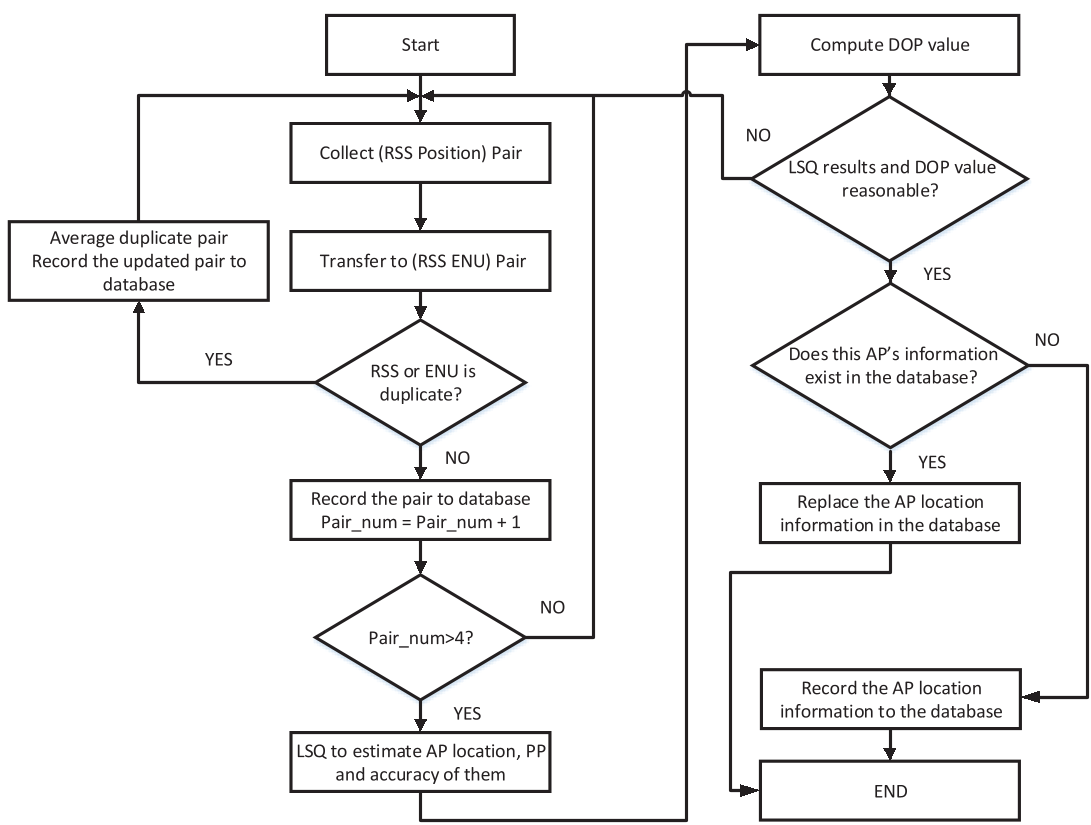 Fig 1. The autonomous workflow: from raw RSS/Inertial data to a refined AP database.
Experiments: Real-World Validation
The system was tested in two environments: a technology center (ARTC) and a university building (EEEL).
Key Findings:
- Convergence: As more users traverse an area (increasing the number of "trajectories"), the localization error consistently drops.
- Robustness: The system successfully estimated AP locations even when the path-loss exponent varied significantly between buildings.
- Self-Awareness: One of the most critical results was the system's ability to estimate its own error. The "Accuracy Estimation Error" was low, meaning when the system says an AP location is accurate within 3 meters, it actually is.
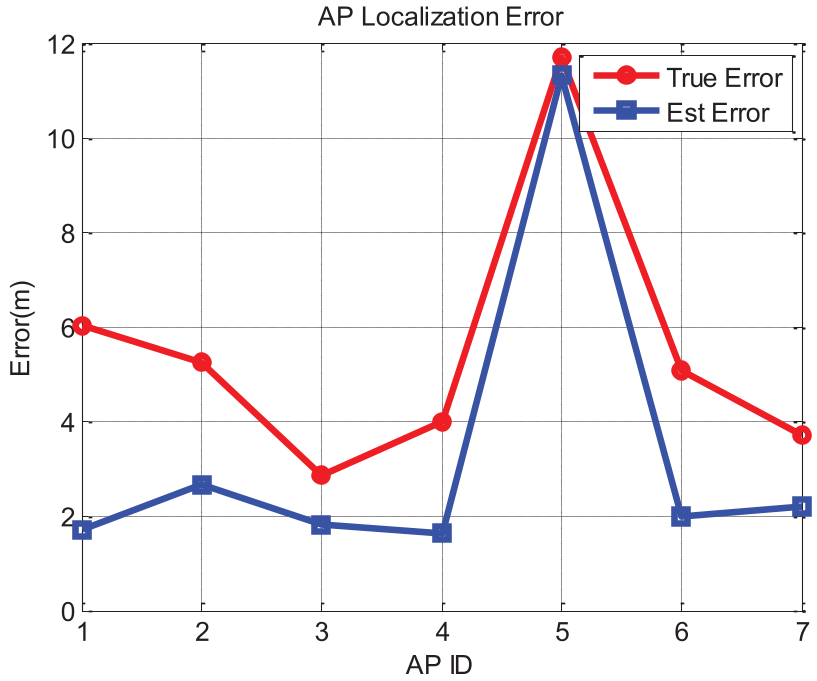 Fig 2. Comparison between true and estimated errors in the ARTC building.
Critical Insight: Why This Matters
The shift from Batch Processing (handling all data at once) to Sequential Processing (updating as users walk) allows this system to run in the background of any smartphone. It transforms every person in a building into a "passive surveyor."
Limitations & Future Work
While the system is robust, it still relies on an initial "good" position from T-PN to start the process. Future iterations could explore the "cold start" scenario where no initial location is available, possibly through decentralized SLAM (Simultaneous Localization and Mapping) techniques.
Conclusion
By treating the indoor environment as a dynamic, ever-changing entity rather than a static map, this paper provides a blueprint for "self-healing" positioning systems. With an average error of under 6 meters, the dream of zero-configuration indoor navigation is becoming a reality.