
FATE: Deciphering the Trio of Friendship, Action, and Time in User Engagement
Knowing your FATE: Friendship, Action and Temporal Explanations for User Engagement Prediction on Social Apps
The paper introduces FATE (Friendship, Action, and Temporal Explanations), an end-to-end neural framework for explainable user engagement prediction on social media apps. It leverages tensor-based GCNs and LSTMs to jointly model social network structures, user actions, and temporal dynamics, achieving state-of-the-art accuracy on large-scale Snapchat datasets.
TL;DR
Predicting user engagement on social apps is no longer just about accuracy; it's about transparency. Researchers from Penn State and Snap Inc. have developed FATE, a framework that predicts engagement using a flexible, expectation-based metric while providing granular explanations. By using "tensor-based" neural components, FATE achieves 10% lower error and 20% faster inference than previous SOTA models.
The "Black Box" Problem in Social Apps
Why does a user suddenly stop using an app? Is it because their friends left, because a specific feature became boring, or simply a shift in their daily routine? Traditional models like XGBoost or standard LSTMs might predict that a user will churn, but they rarely tell you why.
Existing literature often missed three critical components:
- Friendship Dependencies: Engagement is contagious; your friends' activity influences your own.
- Rigid Metrics: Business needs change (e.g., focusing on "Snap Sends" vs. "Session Time"), but models are often hard-coded.
- Lack of Interpretability: Stakeholders need to know which features drive growth globally versus which users need personalized interventions.
Methodology: The Power of Tensorization
FATE stands for Friendship, Action, and Temporal Explanations. Its core innovation lies in its "tensor-based" architecture.
1. Friendship Module (tGCN)
Unlike a standard GCN that aggregates all neighbor features into a single mixed vector, the tensor-based GCN (tGCN) maintains separate parameter matrices for different action categories (e.g., Chatting vs. Viewing Stories). This prevents "feature interference" and allows the model to calculate exactly how much a specific friend's specific action influenced the target user.
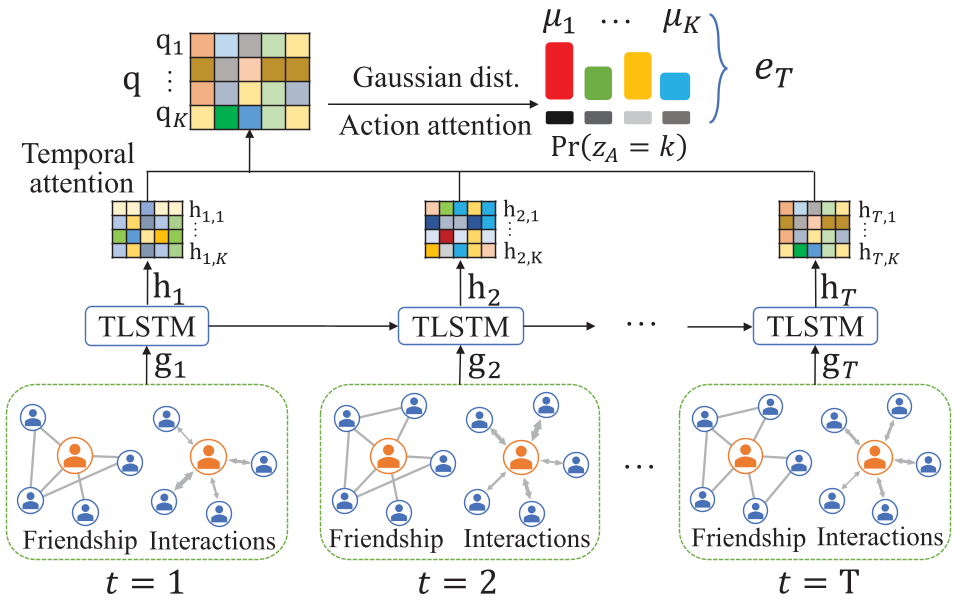 Figure 1: The FATE framework, showing the flow from temporal user graphs to explainable engagement scores.
2. Temporal Module (tLSTM)
User behavior is periodic. FATE uses a tLSTM to capture temporal dynamics. By treating each action category as a distinct dimension in the tensor, the model can identify which actions have "long-term" influence versus those that are "short-term" spikes.
3. Mixture of Attentions
The model uses a three-tier attention mechanism (Friendship, Action, and Temporal) to assign weights. These weights serve as the "explanations."
Experimental Results: Faster and More Accurate
The authors tested FATE on two large-scale datasets from Snapchat across different geographical regions.
- Accuracy: FATE consistently outperformed baselines (LR, XGBoost, TGLSTM) in predicting session time and snap-related activities.
- Efficiency: Thanks to the tensor-based design which reduces network complexity (as proven in the paper's Theorem 4.1), FATE is roughly 20% faster in training and inference.
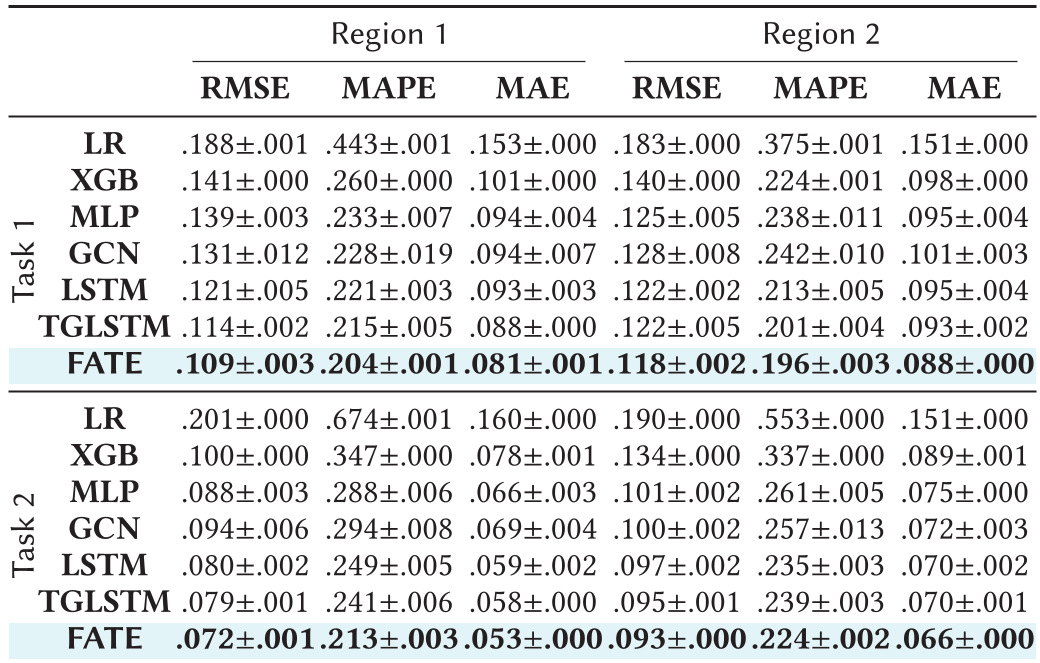 Table 1: FATE vs. SOTA baselines. Note the consistent reduction in RMSE and MAE.
Professional Insight: Why It Works
The "magic" of FATE is its ability to extract Local vs. Global insights.
- Global Insight: On a macro level, the model identifies that "SnapSent" is a stronger predictor of engagement than "SnapView" because sending is an active, generative behavior.
- Local Insight: For an individual user, the model might find that they are a "Chatter" rather than a "Story Viewer," allowing for personalized UI/UX adjustments.
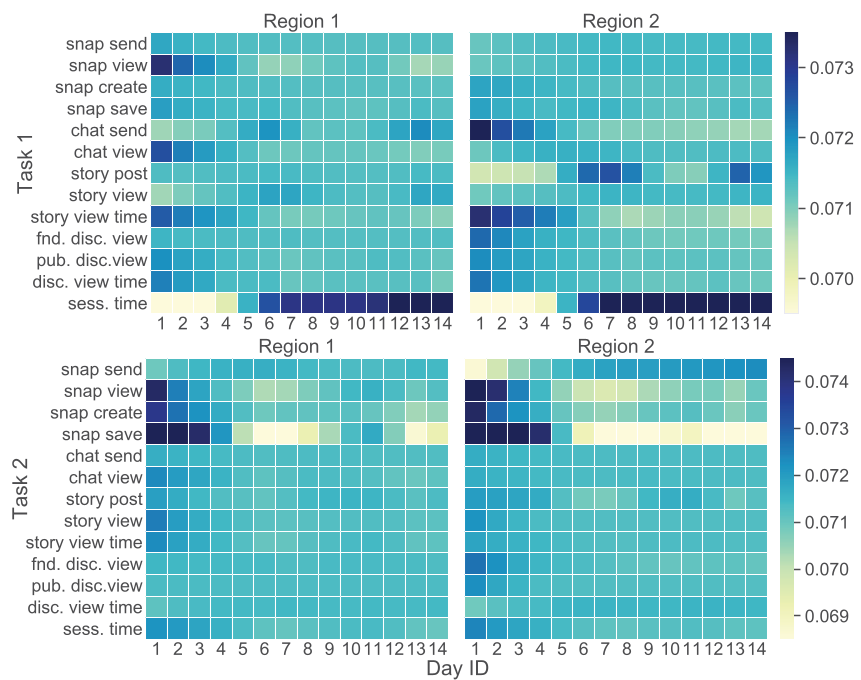 Figure 2: Heatmaps showing how FATE captures temporal periodicity (e.g., weekend usage spikes) for specific actions.
Conclusion & Future Look
FATE proves that interpretability doesn't have to come at the cost of performance. By structuring the neural architecture to reflect the physical reality of social interactions (distinct actions, distinct friends, distinct time), the authors created a model that is both a powerful predictor and a diagnostic tool.
Limitations: While efficient, the model still relies on GNNs, which face scaling challenges for multi-billion node graphs. Future work on GNN scalability will be crucial for taking FATE from city-scale to planet-scale.