
FB2vec: Rethinking Social Representation via Forwarding Behavior Triads
FB2vec: A Novel Representation Learning Model for Forwarding Behaviors on Online Social Networks
FB2vec is a novel representation learning framework specifically designed for forwarding behaviors in online social networks. By categorizing users as generators, forwarders, and receivers, it employs a multi-modal autoencoder and a Siamese network to capture interactions, achieving state-of-the-art performance in behavior prediction and similar user detection.
TL;DR
FB2vec moves beyond simple "friendship" links to model the dynamic process of information dissemination. By treating forwarding as a triadic relationship (Generator-Forwarder-Receiver), and leveraging an economic utility-based intensity function, it creates superior user embeddings for behavior prediction and similarity detection.
Background: The Sparsity Trap
Most social network embedding models (like DeepWalk or LINE) focus on the topological friendship graph. However, friendship networks are notoriously sparse. People often interact with content from strangers or via group forwards—behaviors that reveal deep interest patterns but are ignored by traditional models. FB2vec addresses this by focusing on the "Forwarding Behavior," which provides a much denser data source for learning user representations.
Motivation: Why a Triple Relationship?
Information dissemination isn't just about User A following User B. It involves:
- The Generator (): The source of the content.
- The Forwarder (): The bridge who shares it.
- The Receiver (): The final target who consumes it.
The motivation is that a receiver's action depends on both Content Influence (interest in the generator's topic) and Social Influence (trust in the forwarder). Traditional binary models cannot decouple these factors.
Methodology: The Core of FB2vec
1. Multi-Modal Attribute Preservation
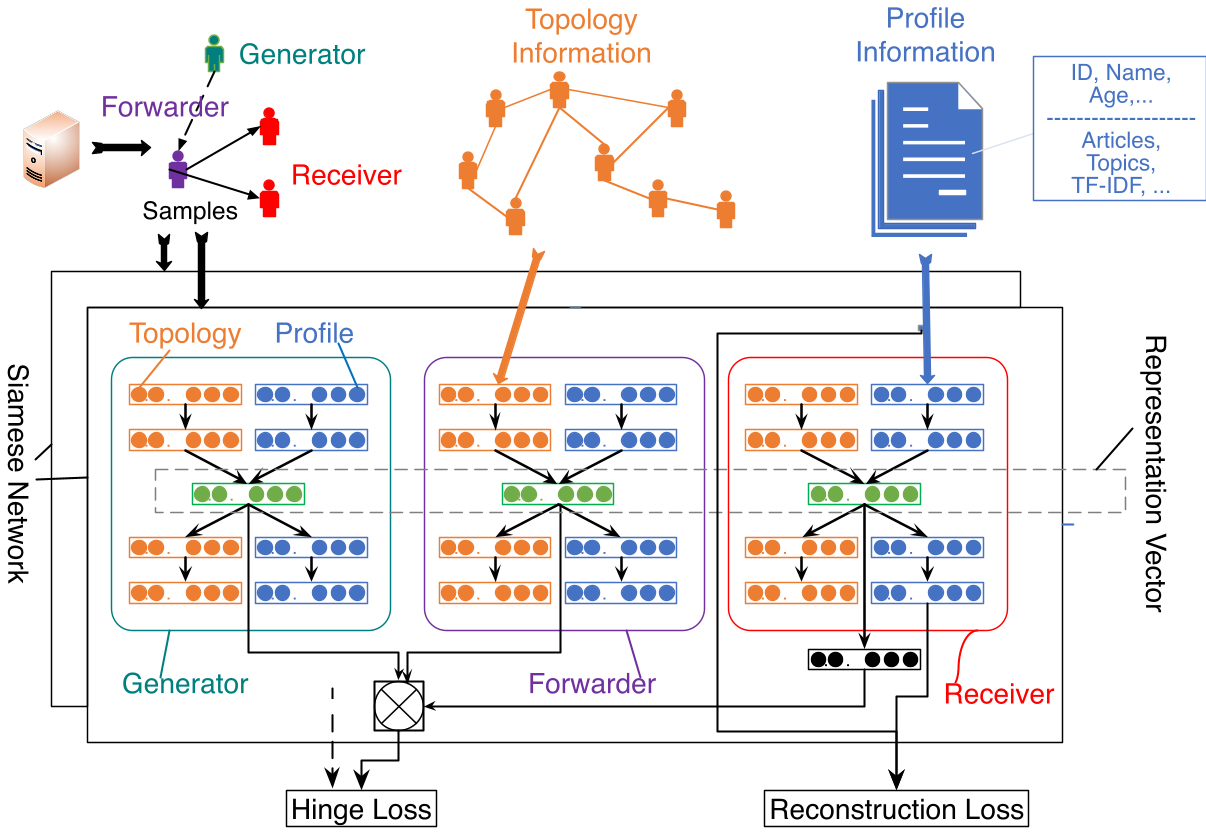
FB2vec uses a multi-modal autoencoder to process two distinct inputs for every user:
- Topological Features: Pre-computed embeddings (e.g., from DeepWalk) representing the user's position in the graph.
- Profile Features: Metadata such as gender, age, or article categories.
2. Information Intensity Function
The breakthrough is the requirement aggregating function and the intensity function : This formula, inspired by the Cobb-Douglas utility function, balances the influence of the generator and the forwarder. The parameter acts as a "preference weight" for the receiver, indicating whether they care more about who wrote the content or who shared it.
3. Training via Siamese Network
Because we only know the order of intensity (e.g., a "real" forward is stronger than a "sampled" non-forward), FB2vec uses a Siamese network with a large-margin loss. This forces the model to rank valid dissemination paths higher than negative samples.
Experiments & Results
The model was tested on two massive datasets: WeChat Article (Official accounts) and Sina Weibo (Retweets).
Performance Boost
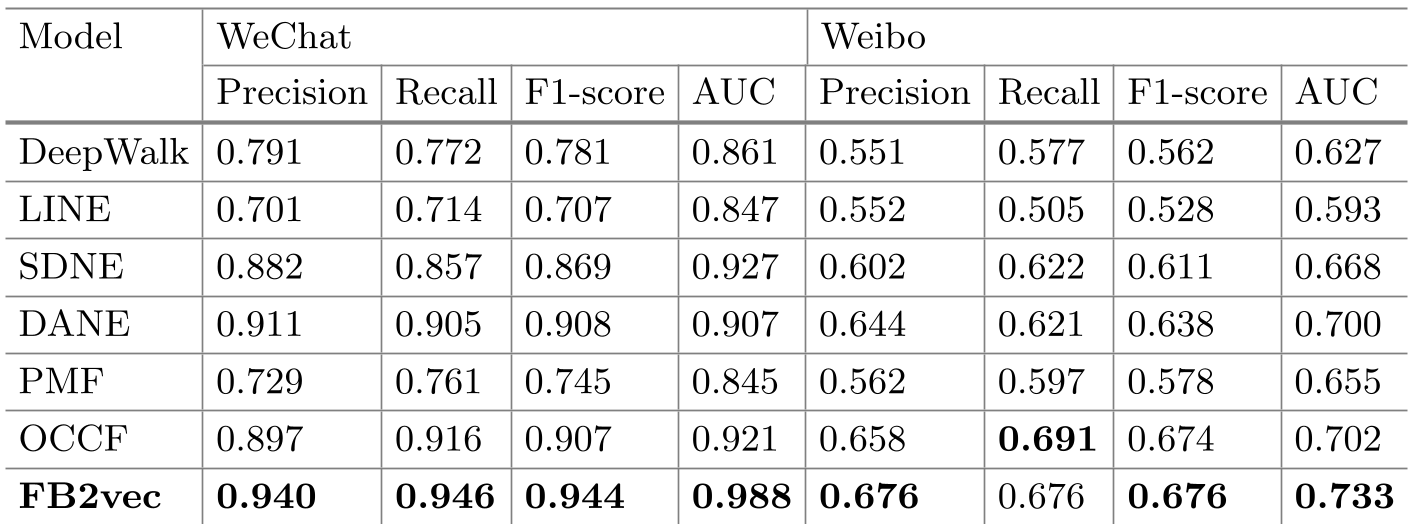
On the WeChat dataset, FB2vec achieved an AUC of 0.988 for behavior prediction, outperforming traditional graph models like SDNE and node2vec by a substantial margin.
Visualizing Preferences
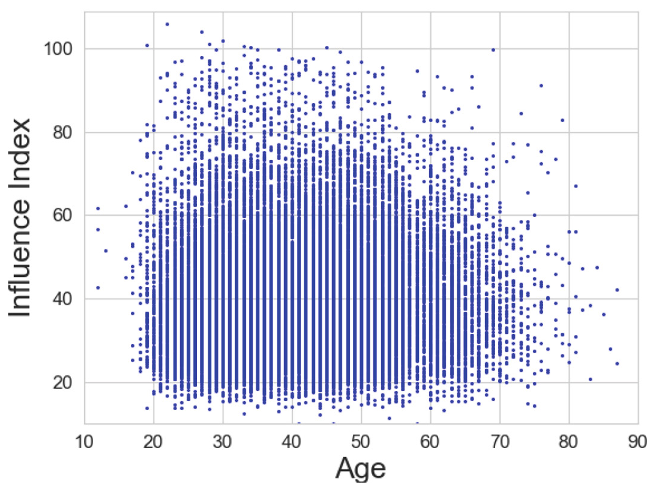
One of the most interesting results is the user profile visualization. For instance, the "Military Account" showed much higher information intensity (lower numerical index) for older male users, while "Entertainment Accounts" skewed towards younger female users. This confirms that the embeddings successfully captured demographic-specific interests.
Critical Insight & Conclusion
FB2vec shifts the paradigm from "Who do you know?" to "How does information reach you?". Its ability to model the latent preference of receivers () provides a more granular view of social influence than ever before.
Limitations: The current model relies on pre-computed topological features (DeepWalk) as input. A future end-to-end Graph Neural Network (GNN) implementation could potentially learn these structural features and behavioral features simultaneously for even higher efficiency.
Takeaway: For practitioners in recommendation systems, FB2vec highlights that the "messenger" (forwarder) is often as important as the "source" (generator) in driving engagement.