
Digital Diplomacy and Duty: Analyzing the FBI's Social Media Recruitment Engine
17174_Assessing e-Recruiting on Social Media FBI Case Study.
This study investigates the recruitment strategies and digital engagement of the Federal Bureau of Investigation (FBI) on social media, specifically Twitter. It employs topic modeling and time-series analysis to identify core recruitment themes and the impact of external news "spikes" on public interaction with the Bureau's digital presence.
Executive Summary
In an era where the digital town square dictates brand perception, even the most prestigious federal agencies must fight for "mindshare." This paper provides a deep dive into the FBI's Twitter-based recruitment strategy. By analyzing over 17,000 tweets, the study reveals how the Bureau leverages specific themes—diversity, technical expertise, and career longevity—to attract a new generation of Special Agents. It positions the FBI not just as a law enforcement entity, but as a digital communicator navigating a complex landscape of political noise and organic engagement.
The Core Challenge: Recruitment in a High-Noise Environment
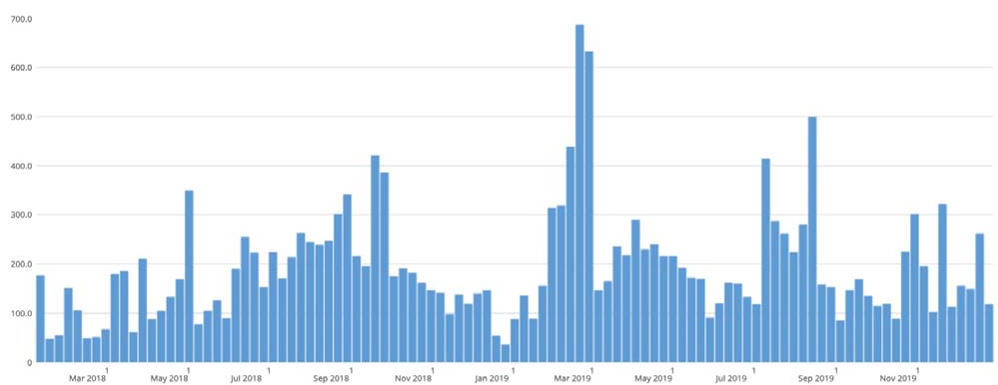
The FBI faces a unique "Inductive Bias" in public perception: the agency is often viewed through the lens of high-profile investigations and political controversy. The authors identify a critical pain point: How can a federal agency maintain a consistent recruitment narrative when external news "spikes"—such as the Michael Cohen raid or document investigations—threaten to hijack the digital conversation?
The study suggests that recruitment content often fights an uphill battle against "event-driven" traffic, necessitating a more robust understanding of which topics actually resonate with the public beyond the headlines.
Methodology: High-Level Topic Modeling and Engagement Tracking
The researchers categorized the data into 15 distinct buckets to see what "sticks." The methodology relies on identifying patterns in high-frequency keywords and correlating them with engagement metrics (Retweets and Likes).
Architecture of Public Engagement
The study breaks down interactions into four primary categories:
- Original FBI Tweets: Direct messaging.
- Original Non-FBI Tweets: Public mentions.
- Official Retweets: Amplification by FBI field offices.
- Public Retweets: The lifeblood of virality (accounting for 77.41% of total volume).
Key Findings: What Drives the Conversation?
The results provide a fascinating look at the "Top 15" topics that capture public interest regarding an FBI career.
| Topic | Percentage of Volume |
|---|---|
| Career at the FBI | 18% |
| Agents at the FBI | 17% |
| FBI Special Agent (Direct) | 13% |
| Diversity Agent Recruitment | 5% |
The "Diversity Agent Recruitment" and "Women Special Agents" categories, while smaller in volume (5% and 2% respectively), represent targeted strategic efforts to shift the demographic of the Bureau.
The "Spike" Effect: News vs. Narrative
One of the most compelling parts of the analysis is the correlation between search/engagement spikes and real-world events. The data shows that the FBI's digital footprint is often reactive:
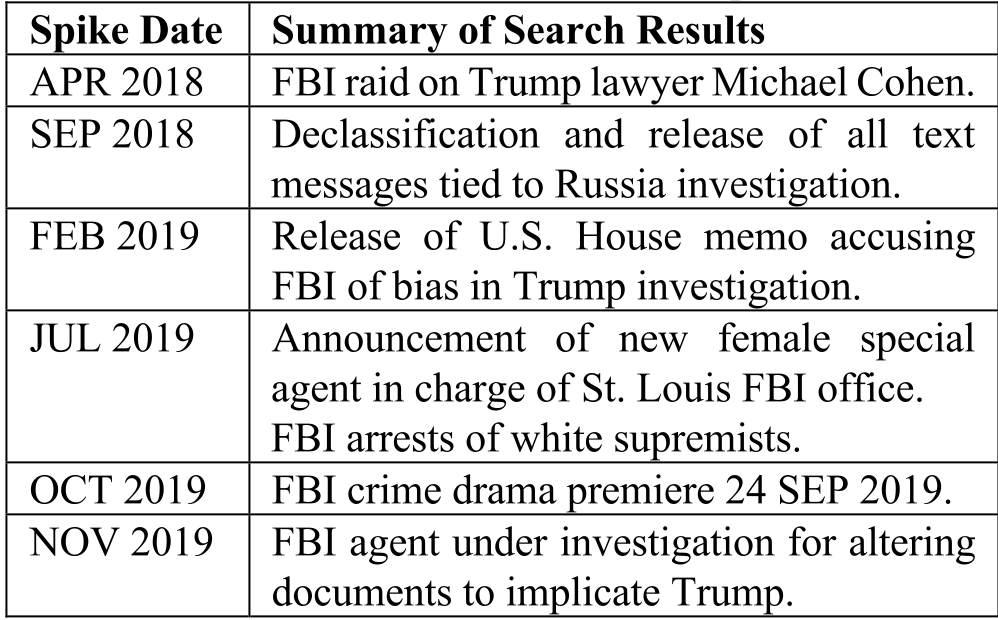
From the Michael Cohen raid (Apr 2018) to the premiere of an FBI crime drama (Oct 2019), external media and legal events act as "force multipliers" for digital visibility, though not always in ways the agency can control for recruitment purposes.
Critical Insight & Conclusion
Why it Works
The FBI’s strategy succeeds because it leverages Organic Secondary Amplification. With over 77% of engagement coming from non-FBI accounts, the agency has managed to create a "community-driven" signal where the public does the heavy lifting of distributing recruitment calls.
Limitations
A significant limitation noted is the Sentiment Gap. High engagement (Retweets) does not always correlate with positive sentiment. A tweet about an FBI raid might get 10,000 retweets, but the "recruitment value" of that engagement might be net-negative or neutral.
Final Takeaway
For any large-scale organization, this research proves that social media isn't just a megaphone—it's an ecosystem. The FBI’s shift toward topics like "Special Agent Skills" and "Diversity" reflects a move toward brand-building that seeks to transcend the daily news cycle, even if the data shows they are still heavily influenced by it. Future recruitment efforts will likely need to focus on decoupling these "career narratives" from "political news cycles" to ensure a steady pipeline of applicants.