
Mapping the Internet from Your Pocket: The Power of Smartphone Crowdsourcing
On the Feasibility of Measuring the Internet Through Smartphone-based Crowdsourcing
This paper explores the feasibility of mapping Internet topology using smartphone-based crowdsourcing. It presents a client-server framework where mobile devices act as active monitors, implementing a specialized traceroute-like tool for the Android platform to discover peripheral network links.
TL;DR
Researchers have successfully demonstrated that the billions of smartphones worldwide can be turned into a massive, distributed "telescope" for the Internet. By bypassing Android's OS limitations and using energy-efficient probing, this framework reveals the hidden "peripheral" structure of the web that traditional ISP-side monitoring misses.
Background: Why the Core is Blind to the Edges
For decades, mapping the Internet has been a "top-down" affair. Researchers relied on Border Gateway Protocol (BGP) tables and a handful of static servers (vantage points) located in data centers.
However, this approach has two fatal flaws:
- Visibility Gap: Core monitors often cannot see the complex links at the "edges" where users actually connect.
- Scale: A few thousand static probes cannot keep up with the dynamic, multi-pathed reality of modern ISP routing.
The authors propose a bottom-up paradigm. By turning a user's phone into a "mobile monitoring node," we can discover the Internet's structure from the outside in.
Methodology: Engineering Around Android's Walls
The core technical challenge was simple: Android does not allow raw sockets. This means standard traceroute (which uses ICMP packets) usually requires "rooting" the phone—a dealbreaker for crowdsourcing.
The IP_RECVERR Workaround
To solve this, the authors exploited the IP_RECVERR option in BSD sockets. When a UDP packet's Time-To-Live (TTL) expires, the router sends an ICMP error. By using a specific Linux kernel feature, the app can "catch" these errors from a standard UDP socket without needing special permissions.
Handling Multipath Routing (MDA)
Modern routers use load balancing. If you send two identical packets, they might take different paths. The authors implemented a Breadth/Depth Explorer mechanism:
- Depth Explorers: Parallel threads that send probes with varying flow IDs (source ports) to trigger different paths in load-balanced routers.
- Breadth Explorers: Aggregators that stitch these paths together into a coherent graph.
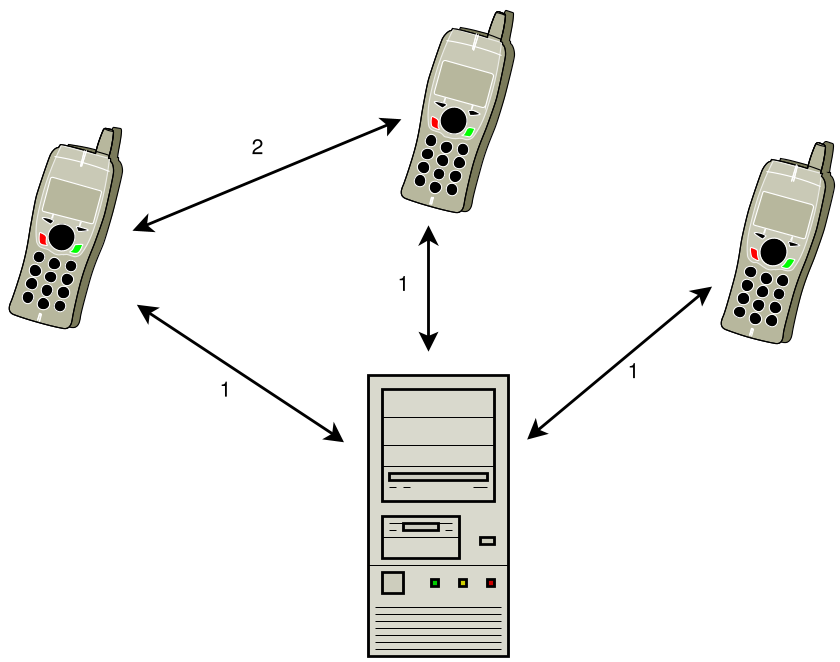 Fig 1: The Client-Server Architecture for coordinated measurement campaigns.
Experiments: Precision without the Penalty
The authors tested the app against the GARR network (Italian Research Network) and compared results with the gold-standard tool, Paris Traceroute.
1. Accuracy
The tool discovered the exact same interfaces as professional-grade Linux tools. Interestingly, it found interfaces that the famous CAIDA (Archipelago) infrastructure missed, simply because the smartphone was looking at the link from a different direction—proving the "vantage point" theory.
2. Efficiency: The Green Metric
Crowdsourcing only works if users don't delete the app. The study found:
- Battery Impact: Less than 1% battery drop during active measurement phases.
- Data Usage: Only 3.16 MB for over 100,000 probes.
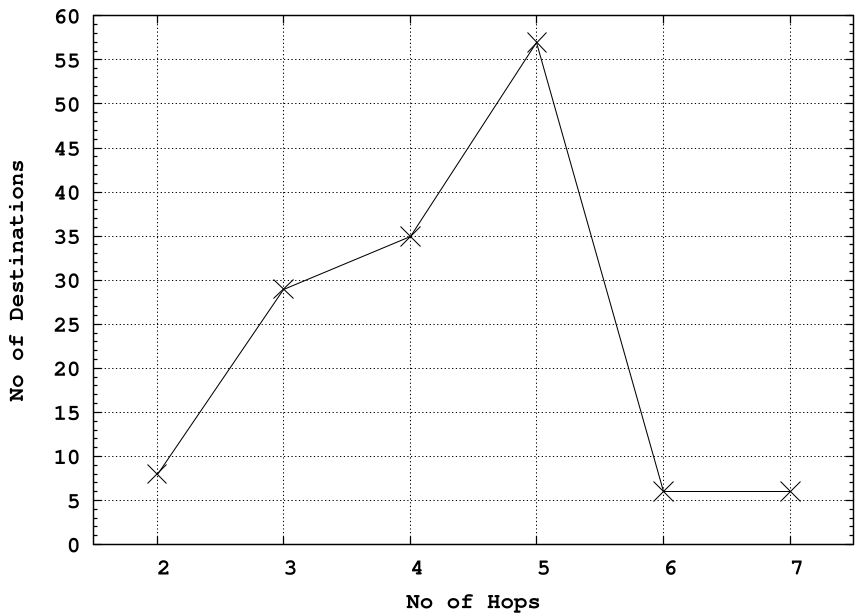 Fig 2: Distribution of hop counts in the testbed—highlighting the local "edge" perspective.
Critical Insight & Future Outlook
This work shifts the focus of network research from the "Backbone" to the "User Experience." The ability to geo-reference network performance (e.g., seeing how latency changes as a user moves from 5G to Wi-Fi) is invaluable for both ISPs and researchers.
Limitations: The main bottleneck is "De-aliasing"—the ability to realize that two different IP addresses belong to the same physical router. While Android limits this on-device, the authors suggest offloading this complex processing to the server-side "Data Refiner."
Takeaway
The Internet is no longer a static map; it’s a living entity. Crowdsourcing isn't just about more data; it's about shifting the perspective to the edge, where the "Dark Matter" of the Internet hides.