
Beyond the Core: Evaluating Centrality Measures in Loosely Structured Criminal Networks
Feasibility Study of Social Network Analysis on Loosely Structured Communication Networks
This study evaluates the feasibility of using graph-based centrality measures (Degree, Betweenness, Closeness, and Eigenvector) to identify key individuals within a large, loosely structured cybercriminal network using a leaked dataset from the Nulled.IO forum. The research aims to support law enforcement in effectively disrupting Crime-as-a-Service (CaaS) ecosystems.
TL;DR
This paper investigates whether classic Social Network Analysis (SNA) can effectively pin down "high-value targets" in modern, messy cybercriminal forums. By analyzing a massive leak from Nulled.IO, the study reveals that while measures like Degree and Betweenness can find active users, they often fail to distinguish between a forum moderator and a sophisticated cybercriminal without additional context and data refinement.
Background: The Shift to Crime-as-a-Service (CaaS)
Law enforcement agencies face a daunting challenge: the "Crime-as-a-Service" model allows low-skill actors to launch sophisticated attacks by purchasing tools from a technical elite. Disrupting these networks requires targeting the few individuals providing these specialized services. Traditionally, SNA has been the go-to tool for this, but most existing literature relies on small, clean datasets like the Enron email corpus (30–150 nodes). This paper asks: Do these metrics hold up when the network grows to 600,000 users?
Methodology: Mapping Nulled.IO
The researchers utilized a 9.45 GB leak from the Nulled.IO forum, encompassing nearly 3.5 million public posts and 800,000 private messages. They modeled the data into two distinct graphs:
- Public Communication: Edges based on thread participation.
- Private Communication: Edges based on direct messages between users.
They tested four fundamental centrality measures:
- Degree: Simple activity count.
- Betweenness: The "brokerage" score; who sits on the shortest paths?
- Closeness: How fast can a user reach everyone else?
- Eigenvector: Influence based on who your friends are.
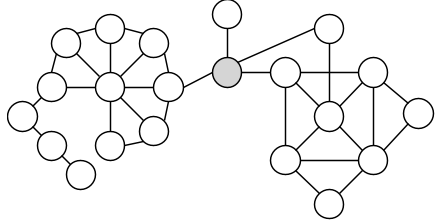 Figure: The visualization of Betweenness Centrality illustrating how "brokers" are identified in a network.
The "Admin Trap": Key Experimental Findings
The results demonstrated a significant concentration of power. User ID 1 (Administrator) and User ID 15398 consistently topped the charts.
- The Hub Problem: In the private message graph, the top user had a Betweenness score nearly 3 times higher than the runner-up.
- The Closeness Paradox: The "Closeness" scores were remarkably uniform across the top 100 users, suggesting that these forums are small-world networks where everyone is roughly the same "distance" from each other, making Closeness a poor discriminator for importance.
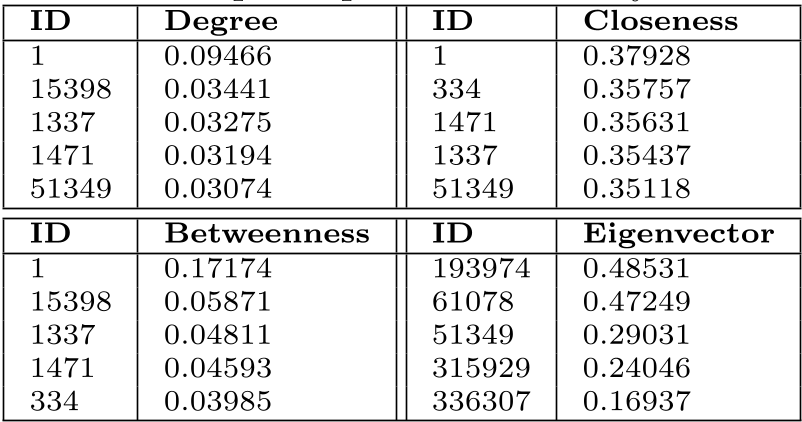 Table: Top users ranked by different centrality measures in the public communication graph.
The most striking insight was that Eigenvector Centrality was the only metric to highlight different types of users—specifically those selling currency conversion services (IDs 193974 and 61078)—who were otherwise buried in the noise of administrative activity.
Critical Analysis: Why Simple SNA Isn't Enough
The authors conclude that while centrality measures identify visible nodes, they struggle with "loosely structured" networks where:
- Administrative Noise: Moddens and admins naturally accumulate high centrality due to their role, not necessarily their criminal expertise.
- Lack of Directionality: By treating graphs as undirected, the study missed out on the distinction between "popular" users (high in-degree) and "outreach" users (high out-degree).
- Removal Impact: Simply removing a high-centrality node (like an admin) might not disrupt the criminal economy if the service providers (the technical elite) remain untouched.
Conclusion & Future Outlook
This feasibility study serves as a cautionary tale for digital investigators. Tools like IBM i2 Analyst’s Notebook provide these metrics, but using them blindly leads to the "Silk Road Effect"—where removing a visible leader only results in a dozen more marketplaces spawning.
For future research, the authors suggest:
- Pre-filtering: Removing "leaf nodes" (users with only 1 connection) to refine Betweenness results.
- Directed Analysis: Moving to directed graphs to identify distinct sender/receiver roles.
- Content-Aware SNA: Integrating Natural Language Processing (NLP) to weight edges based on the intent of communication rather than just the volume.
Final Takeaway: In the world of cybercrime forensics, the loudest person in the room (highest degree) is rarely the most dangerous person in the network.