
Feature-Based TSA: Masterfully Handling the Nuances of Negation
Feature-Based Twitter Sentiment Analysis With Improved Negation Handling
The paper introduces a feature-based Twitter Sentiment Analysis (TSA) system that integrates advanced negation handling and exception rules. By combining morphological, POS-based, and lexicon features with an SVM classifier, it achieves state-of-the-art performance on the SemEval-2013 dataset.
TL;DR
Twitter sentiment analysis is often tripped up by the word "not." Most systems either ignore it or simply flip the sentiment score. This paper introduces a sophisticated Feature-Based TSA system that excels by identifying Negation Exceptions—cases where "not" doesn't actually mean "no." By combining linguistic rules with statistical lexicons, the proposed SVM model outperformed the previous state-of-the-art on the SemEval-2013 benchmark.
Background: The Hidden Complexity of "Not"
In the world of microblogging, sentiment isn't just about keywords. A single word like "not" or "never" creates a Polarity Shift.
- Simple Negation: "This movie is good" (+) vs "This movie is not good" (-).
- The Trap: "This is not only a great phone, but also cheap." Here, "not" doesn't make the sentence negative.
Current SOTA systems often struggle with these nuances, either over-correcting or failing to catch the subtle shift in sentiment strength.
The Core Innovation: Negation Exception Algorithm
The authors argue that the biggest gains in accuracy don't come from better classifiers, but from better Feature Engineering regarding negation scope and exceptions.
1. Beyond "Reverse Polarity"
Instead of simply turning a to a , the system uses automatic lexicons (S140 and NRC-Hashtag) that provide separate scores for words in affirmative vs. negated contexts. This accounts for the fact that "not excellent" isn't the same as "bad."
2. The Exception Engine
The heart of the paper is an algorithm (see Figure 2) that filters out "False Negations":
- Case 1 (Negation Phrases): Detecting idioms like "not just," "no one," or "by no means" where the cue is part of a non-negating fixed expression.
- Case 2 (Rhetoric Questions): Recognizing patterns like "isn't that bright enough?" where the sense is actually affirmative.
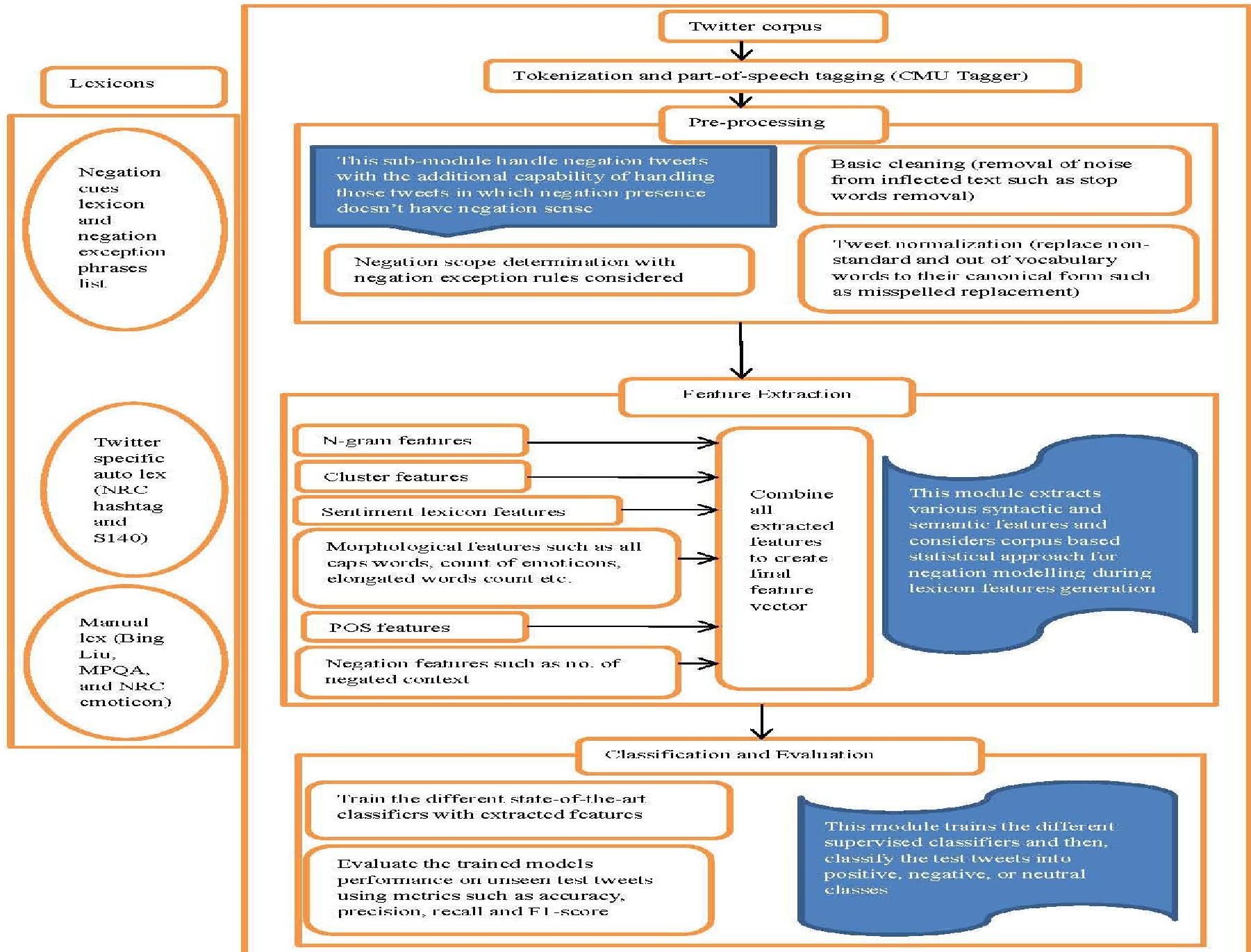 Figure 1: The overall workflow of the proposed TSA system, highlighting the Preprocessing and Negation Handling modules.
Methodology: A Multi-Layered Feature Approach
The system extracts a massive 100+ dimensional feature vector including:
- N-Grams: Unigrams and bigrams weighted via Chi-squared selection.
- Clusters: Utilizing 1,000 Brown clusters from the CMU Twitter NLP tool to handle slang and misspellings.
- Linguistic Features: POS tags, hashtags, elongated words ("coooool"), and emoticons.
The team tested three heavyweights: SVM, Naive Bayes (NB), and Decision Trees (DTC). SVM emerged as the winner, specifically because it can handle the high-dimensional, sparse nature of Twitter data more effectively than the others.
Experimental Results: Breaking the SOTA
The results on the SemEval-2013 Task 2 dataset were decisive.
| System | Macro avg. F1 Score |
|---|---|
| Baseline (Majority) | 28.9 |
| Official SOTA (NRC-Canada) | 69.02 |
| Our System (SVM + Exceptions) | 69.50 |
The "Ablation" Insight
The researchers performed ablation studies to see what actually mattered. They found that:
- Lexicon features are the most influential, providing an 8%+ boost.
- Negation exception rules alone added 2% to the F1 score. This proves that high-level linguistic rules still have a vital place alongside statistical learning.
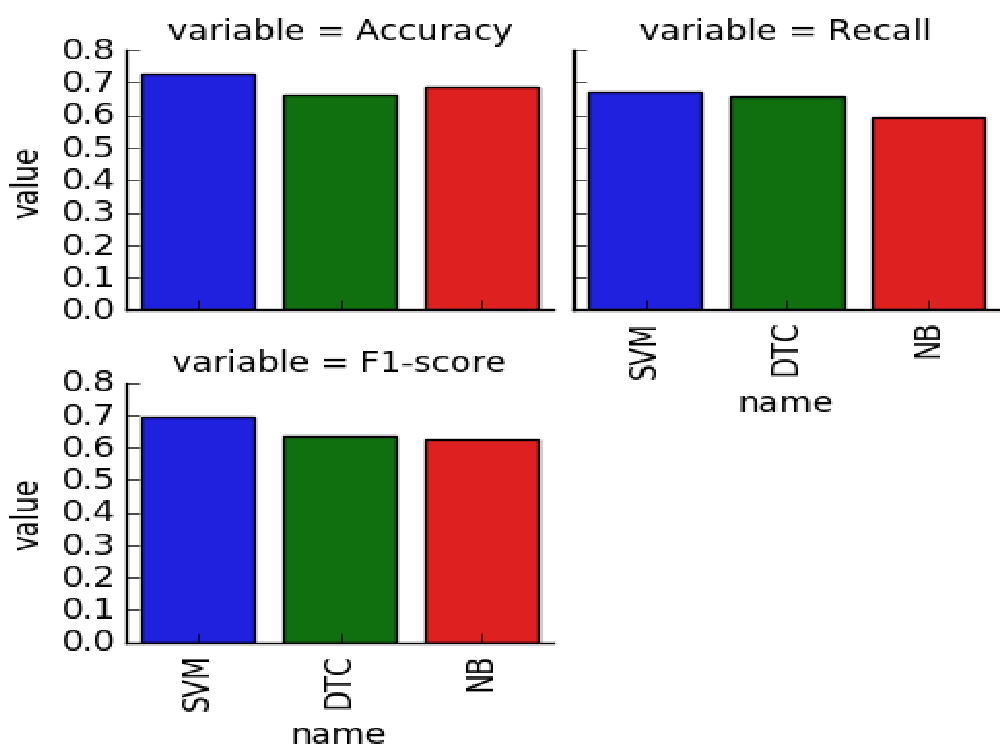 Figure 3: SVM consistently outperforms NB and DTC across Accuracy, Recall, and F1 metrics.
Critical Insight & Future Outlook
While Deep Learning (LSTMs, Transformers) currently dominates the hype, this paper is a reminder of the power of Inductive Bias through linguistic rules. By manually identifying the "Negation Exceptions," the authors solved a logic problem that models often fail to learn purely from data.
Limitations: The system relies heavily on manual lists for negation phrases and POS tagging accuracy. If the CMU Tagger fails on a particularly messy tweet, the whole exception logic might collapse.
Takeaway: For researchers and developers, the message is clear: don't just throw more data at a model. Understanding the "why" behind misclassifications—like the trickiness of negation—is the fastest path to outperforming the SOTA.