
What Strikes the Strings of Your Heart? Mining the Emotional DNA of Music
What Strikes the Strings of Your Heart?—Feature Mining for Music Emotion Analysis
This paper presents a systematic and quantitative framework for Music Emotion Analysis (MEA). The authors propose Multi-Emotion Similarity Preserving Embedding (ME-SPE) and its bilinear extension (BME-SPE) to map high-dimensional music signals into an emotionally-aware low-dimensional subspace, achieving SOTA performance on standard datasets.
TL;DR
Music isn't just "organized sound"; it's a vehicle for complex emotion. This paper moves beyond subjective impressions to offer a systematic, quantitative framework called Multi-Emotion Similarity Preserving Embedding (ME-SPE). By treating music emotion as a multi-label dimensionality reduction problem, the authors successfully identified the specific acoustic "strings"—like spectral flux and rhythm peaks—that trigger human emotional responses.
Why Computational Music Emotion Analysis is Hard
For decades, psychologists have theorized about how harmony and melody evoke feelings. However, translating this into a machine learning model faces three major hurdles:
- Multi-Label Complexity: A single song can be simultaneously "sad" and "calming." Traditional single-label models fail to capture these overlaps.
- The Curse of Dimensionality: Raw audio features are massive and redundant. Finding the "signal" of emotion within the "noise" of binary data is a needle-in-a-haystack problem.
- Loss of Structure: Audio is naturally represented as a 2D time-frequency spectrogram. Standard ML algorithms flatten this into a 1D vector, destroying the critical relationship between time and pitch.
Methodology: Preserving the "Emotional Similarity"
The authors propose a novel algorithm, ME-SPE, based on a simple but powerful intuition: If two songs evoke similar emotions, their latent feature representations should be close to each other in a mathematical subspace.
1. Label Correlation Mining
Instead of treating "Happy" and "Sad" as independent bits, ME-SPE uses the inner product of label vectors to build a similarity matrix. This allows the model to understand that "Quiet" and "Sad" are highly correlated, whereas "Amazed" and "Quiet" are virtually unrelated.
2. Bilinear Extension (BME-SPE)
To stop the "destruction" of data structure caused by vectorization, the authors developed BME-SPE. It treats the STFT (Short-Time Fourier Transform) magnitude as a second-order tensor. By using an alternating optimization strategy, it learns two transformation matrices that project the spectrogram into a compact 2D latent space.
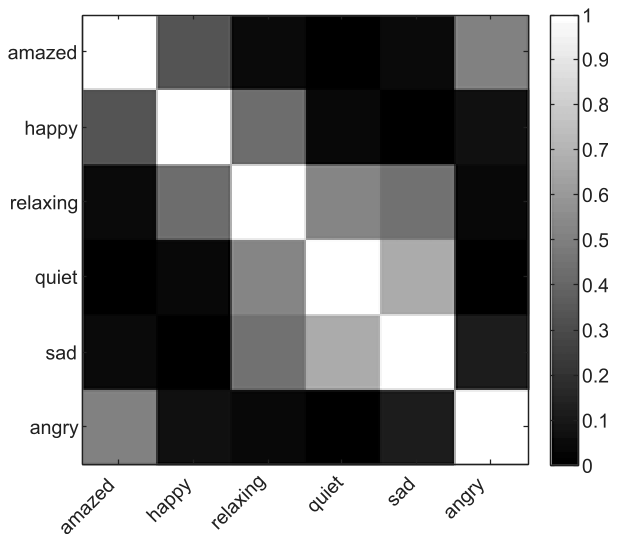 Figure: Comparison between PCA and ME-SPE. Notice how ME-SPE (right) clearly separates "Amazed" from "Quiet" while overlapping "Quiet" and "Sad," matching human psychological reality.
Feature Mining: What actually matters?
One of the most exciting parts of this research is the Feature Contribution Analysis. By looking at the eigenvectors of the learned subspace, the authors identified the "Top 5" most contributing features for emotion:
- Spectral Flux (Mean & Std): Measures how fast the pitch changes. This triggers the brain's perception of rhythm and melody.
- MFCC-0 (Mean): Represents the overall loudness of the signal.
- Beat Histogram Peaks: Reflects the tempo and rhythm of the track.
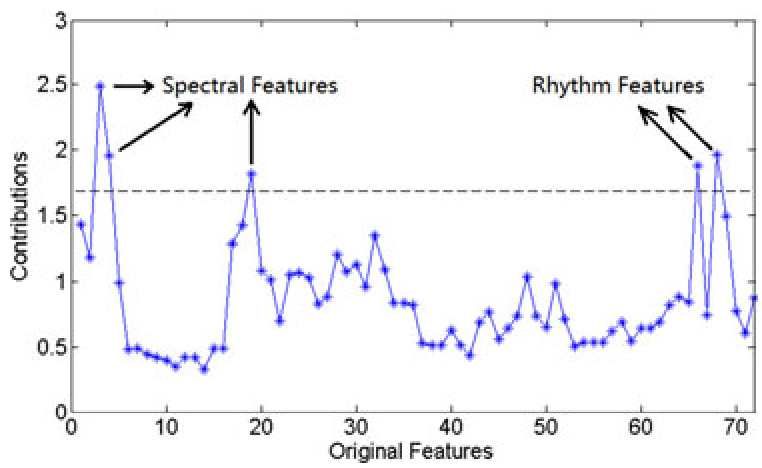 Experimental Result: Statistical contribution of various audio features. Dimensions 3, 4, 19, 66, and 68 emerge as the "Emotional DNA" of the signal.
Experimental Results
The framework was tested on the EMOTIONS and CAL-500 datasets.
- Superior Accuracy: ME-SPE consistently outperformed shared-subspace methods and standard PCA across all metrics (F1 Score, Precision, and Hamming Loss).
- Bilinear Advantage: On the CAL-500 dataset, BME-SPE proved that keeping the "matrix form" of music signals results in significantly better emotion recognition than vector-based methods.
Critical Analysis & Future Outlook
This paper provides a rare bridge between signal processing and psychology. It proves that the features identified by computational models are largely consistent with what psychologists have theorized for years (e.g., the importance of loudness and rhythm).
Limitations: Currently, the model handles static features. Future work could benefit from exploring dynamic/temporal modeling (how emotion changes within a song) or incorporating deep learning architectures as the "backbone" for ME-SPE's similarity-preserving objective.
Takeaway: For developers in music tech, this research suggests that we don't need more features; we need smarter dimensionality reduction that respects the multi-label and structural nature of music.