
Deciphering the Cinematic Soul: Multimodal Fusion for Emotion Estimation in Movies
Feature Selection and Multimodal Fusion for Estimating Emotions Evoked by Movie Clips
This paper presents a multimodal framework for estimating valence, arousal, and fear evoked by movie clips using the LIRIS-ACCEDE dataset. The authors propose two distinct pipelines—one focusing on dimensionality reduction with Fisher Vector encoding and Extreme Learning Machines, and another utilizing high-dimensional cinematographic cues and facial geometric features—achieving state-of-the-art results in Mean Squared Error (MSE) for arousal prediction.
TL;DR
How do you teach a machine to feel the tension of a thriller or the joy of a rom-com? Researchers from Bogazici University and their collaborators have developed a robust multimodal framework to estimate the Valence (positivity), Arousal (intensity), and Fear evoked by movie clips. By blending deep learning features with traditional signal processing and cinematographic "stylistic" cues, they achieved top-tier performance in the MediaEval 2017 challenge.
Problem & Motivation: Beyond Pixels and Decibels
Analyzing professional movie content is a unique challenge. Unlike natural user-generated videos, movies are engineered products designed to evoke specific moods through carefully curated lighting, camera angles, and soundscapes.
Current SOTA methods often face two hurdles:
- Feature Complexity: Simple visual descriptors can't capture the "narrative power" of a close-up shot versus a wide landscape.
- Subjectivity: Human emotional response is noisy; what is "scary" to one viewer may be "tense" to another, leading to high variance in ground-truth labels.
The authors' central insight was that fusion is mandatory. Much like a director uses multiple redundant cues (music + lighting + acting) to ensure an audience feels an emotion, a machine must fuse multiple data streams to accurately predict that response.
Methodology: A Two-Pronged Attack
The researchers contrasted two sophisticated pipelines to see which methodology captures the "affective essence" of film more effectively.
Approach 1: Dimensionality Reduction & Encoding
This pipeline focused on efficiency and statistical representation:
- Audio: MFCCs (0-12) with derivatives.
- Visual: Hue Saturation Histograms (HSH), Dense SIFT, and VGG16 features.
- The Secret Sauce: They used Fisher Vector (FV) encoding to measure how features deviate from a background probability model (GMM), followed by an Extreme Learning Machine (ELM) for fast, non-linear regression.
Approach 2: Stylistic & Deep Cues
This pipeline leaned into the "Art of Film":
- Faces: Using
dlibto detect characters and derive "shot scale" (e.g., is the camera close to the face?). - Cinematography: Measuring Luminance and Visual Activity (via Gaussian Mixture background subtraction).
- Regression: Leveraging Support Vector Regressors (SVR) and Random Forests, followed by Holt-Winters smoothing to account for the temporal "flow" of emotions.
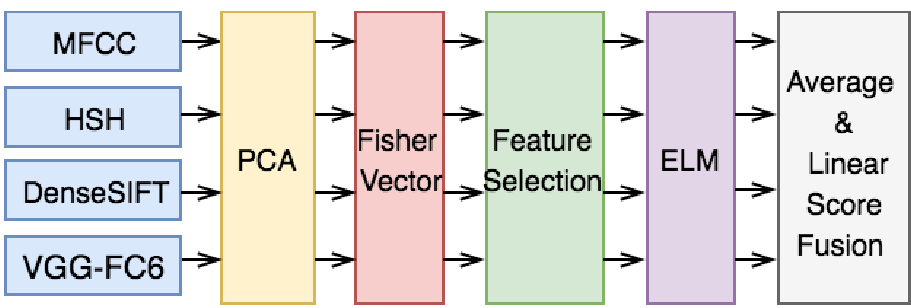 Figure 1: The dual audiovisual pipeline combining statistical encoding and deep feature extraction.
Experiments & Results: The Power of Fusion
The results confirm a long-standing intuition in Affective Computing: Dynamic smoothing and multimodal fusion are non-negotiable.
- Arousal Success: The system achieved its best performance in Arousal (MSE: 0.113), largely thanks to the temporal smoothing which filtered out frame-by-frame noise.
- Valence Challenges: Meaning (Valence) proved harder to capture than intensity (Arousal). However, deep features (VGG FC6) provided a significantly higher Pearson Correlation (0.339) than traditional low-level features.
- The Fear Factor: Predicting "Fear" remains the "Final Boss" of this task due to class imbalance, though audio features (MFCC) showed the most promise in detecting the sudden sonic shifts typical of scary scenes.
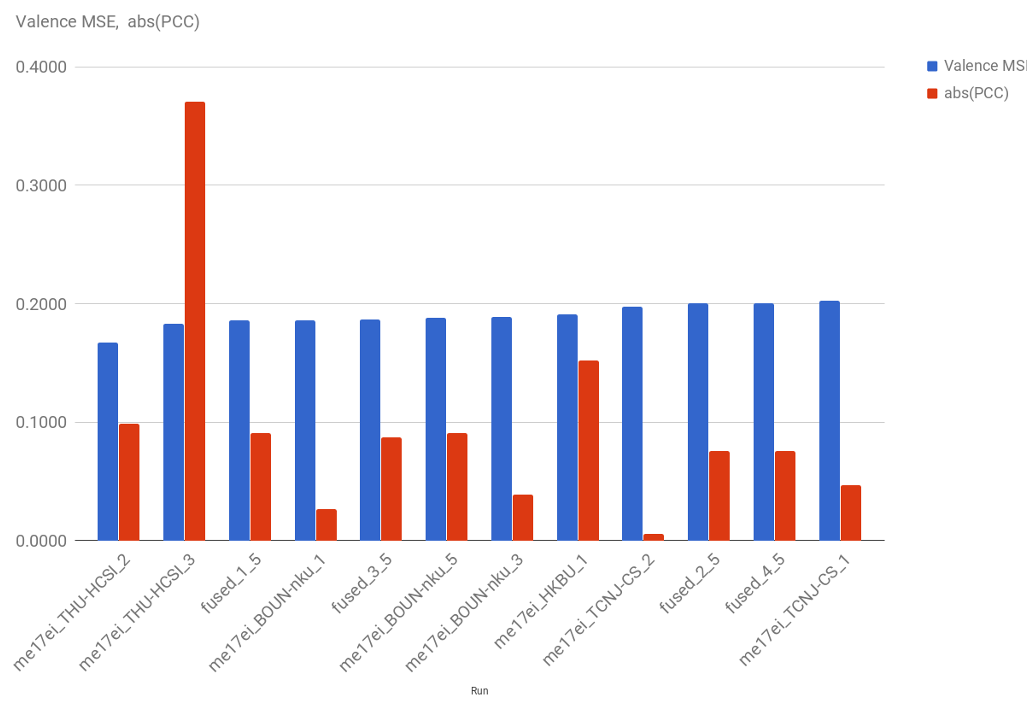 Figure 2: Benchmark results vs other MediaEval 2017 participants. The authors' models (designated as BOUN-NKU) consistently sit in the top-performing cluster.
Deep Insights: Why It Works
The study highlights that Faces of Characters are semiotic powerhouses. While the face geometry alone didn't beat deep CNNs, its combination with other features improved the model. The authors noted that when a face is detected from the back (e.g., the movie "Island"), traditional models fail, suggesting a need for "human-presence" detectors rather than just "face" detectors.
Furthermore, the Holt-Winters smoothing mimics the human "emotional inertia"—the fact that we don't switch from "terrified" to "happy" in a single frame; our psychological states have a decay and a momentum.
Conclusion & Future Outlook
This work demonstrates that estimating emotions from movies requires a "hybrid" mindset. We need the raw power of Deep Learning (VGG) to handle complex visuals, but we also need Domain Knowledge (Cinematographic features) to understand how movies are made.
The ultimate takeaway? The future of media retrieval lies in "Affective Search"—where you don't search for "Action Movie," but rather for a film that satisfies a specific "Positive Valence, High Arousal" mood.
Limitations
- Face occlusion: Failure to detect faces from profile or rear angles hamperscinematographic analysis.
- Subjectivity: The model is bound by the variance of the human annotators.