
Targeting the Blind Spot: Effective Recognition of Artificial Pornographic Images in Social Networks
Appropriate Feature Selection and Post-processing for the Recognition of Artificial Pornographic Images in Social Networks
The paper proposes a novel feature selection and post-processing framework specifically designed for the recognition of artificial (computer-generated/game-based) pornographic images in social networks. By combining seven types of traditional computer vision features with feature expansion and rapid extraction techniques, the method aims to improve detection accuracy and real-time performance.
TL;DR
As automated detection for real-world pornographic images improves, criminals are shifting toward artificial pornographic images (e.g., erotic game content) to bypass filters. This paper introduces a specialized feature selection and post-processing pipeline that achieves a 20x speedup in extraction while maintaining high sensitivity to the unique textures of computer-generated erotic content.
Context: The Rise of "Artificial" Harmful Content
In the landscape of online safety, artificial pornographic images pose a unique challenge. Unlike natural photos, these images are generated by software, resulting in different color histograms, smoother textures, and exaggerated erotic elements. Current SOTA methods designed for real human anatomy often fail or are too computationally expensive for the real-time demands of social networks.
Why Traditional Methods Fail
The authors identify two primary bottlenecks:
- Feature Mismatch: Real-world body structure models and skin-tone detectors aren't optimized for the standardized, often "perfected" or exaggerated textures of artificial images.
- Computational Latency: Processing high-resolution images in social networks leads to a "detection lag," allowing harmful content to spread before being flagged.
The Proposed Solution: Multi-Feature Synthesis & Rapid Processing
1. The 888-Dimensional Feature Suite
The methodology relies on a diverse set of seven feature categories to capture the "digital signature" of artificial images:
- Geometric features: Image size, aspect ratios, and pixel counts.
- Color & Skin: YCbCr color space conversion for specialized skin region extraction.
- Texture & Pattern: Using Gray Level Co-occurrence Matrix (GLCM) and Local Binary Patterns (LBP) to detect the unnatural smoothness of rendered graphics compared to natural noise in real photos.
2. Feature Expansion & Spatial Awareness
To increase generalization, the authors divide images into sub-blocks (e.g., quadrants). By extracting features from each block, the model gains spatial distribution information, helping it distinguish between a random skin-colored object and an erotic composition.
3. The 20x Speedup Secret: Size Invariance
The most impactful contribution is the Rapid Feature Extraction logic. The authors demonstrate that texture (LBP/GLCM) and color histograms are largely invariant to scale.
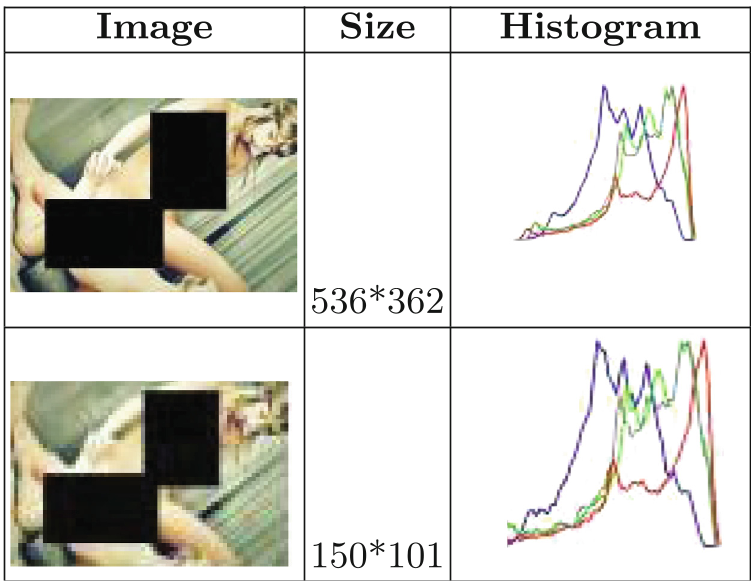
By scaling a 536x362 image down to 150x101 before extraction, the computational load drops drastically while the "histogram signature" remains nearly identical.
Experimental Performance
The system was tested on a Core i5, 4GB RAM environment (representative of standard server nodes):
- Original Extraction: 588.08 ms / image
- Scaled Extraction: 25.94 ms / image
- Dataset: 9,808 images from Baidu Post Bar.

This 22.6x improvement is critical for social networks where thousands of images are uploaded every second.
Critical Insight & Conclusion
While the paper focuses on "traditional" CV features, its core insight—that computer-generated artifacts have distinct texture signatures detectable in lower resolutions—is highly relevant today. As we move into the era of AI-generated content (Stable Diffusion/Midjourney), the principles of identifying "rendered" vs. "natural" textures using LBP and GLCM provide a foundational layer for multi-modal safety filters.
Future Outlook: The authors suggest that combining these refined features with tree-based models (like XGBoost or LightGBM) will further enhance the classification accuracy on unbalanced real-world data.