
Elevating Recommendations: Learning Human Intuition through Social Network Analysis
Feature weighting in content based recommendation system using social network analysis
This paper introduces a hybrid recommendation approach that enhances Content-Based Filtering (CBF) by integrating social network signals. The core method utilizes linear regression to derive optimal feature weights from a collaborative graph of item similarities, outperforming standard CBF on the IMDB movie dataset.
TL;DR
Most recommendation engines struggle to balance the "logic" of item attributes with the "messiness" of human preference. This paper presents a methodology to bridge that gap by using Social Network Analysis (SNA) to learn which features actually matter to users. By solving linear regression equations derived from co-occurrence data in social networks, the authors move beyond the "equal-weight" fallacy of traditional content-based systems, specifically improving movie recommendation recall by 20% over unweighted baselines.
Problem & Motivation: The "Equal Weight" Fallacy
In a standard Content-Based (CB) system, if two cameras are being compared, the algorithm might treat the "Body Color" and "Price" as equally important metrics for similarity. However, we know intuitively that users value price significantly more.
The challenge is that these Feature Weights are usually unknown and subjective. While Collaborative Filtering (CF) captures these patterns, it fails when data is sparse. The authors' insight is to use the collective intelligence of a social network—specifically, how many people interacted with both items—as a gold standard for similarity. They then "back-calculate" which content features contribute most to that observed social behavior.
Methodology: Regression on the Social Graph
The paper proposes a hybridization where item similarity is defined as:
1. Constructing the Social Network
The authors utilize the IMDB database to build a graph where:
- Nodes: Movies.
- Edges: Number of reviewers who have reviewed both movies.
- Normalization: The edge weights are normalized to represent "Human Judgment Similarity."
2. Solving for Weights
By setting the content-based similarity equal to the social network edge weights, the authors create a system of linear equations.

This allows them to solve for , identifying which attributes (like Director, Genre, or Cast) are the true drivers of user interest.
Experiments & Results
The authors tested 13 features from IMDB, including release year, rating, genre, and cast.
Feature Stability
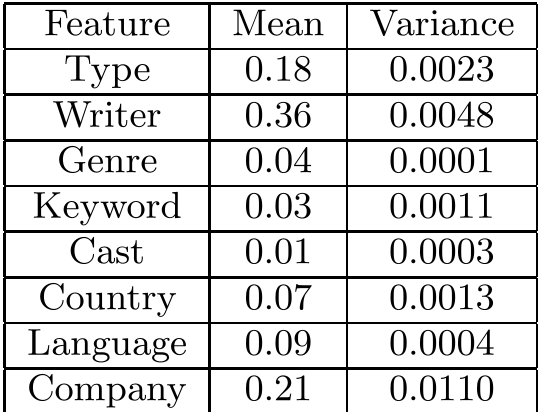
A critical part of the study was determining which features provided "noise" vs. "signal." Interestingly, some features like "Director" and "Rating" showed unstable or even negative weights in certain subsets, leading the authors to prune the model down to 8 stable features.
Performance Benchmarking
When compared against a pure content-based approach (where all ), the proposed method showed a clear advantage:
- Weighted CB (Proposed): 0.29 Recall
- Unweighted CB: 0.24 Recall
This confirms that the "Writer" and "Production Company" of a movie (the highest weighted features in their findings) are far more predictive markers of similarity than just "Genre" or "Cast" alone.
Deep Insights & Conclusion
The "Writer" Over "Director" Surprise
One of the most intriguing takeaways from this research is the high weight assigned to the Writer (0.36) compared to other features. In recommendation system design, we often over-index on "Directors" as a proxy for style, but this data suggests that for the IMDB user base in 2008, the screenplay author was a more consistent indicator of shared interest.
Limitations & Future Work
While effective, the linear regression model assumes a linear relationship between feature distances and social similarity, which may not capture complex non-linear preferences. Furthermore, the reliance on co-reviewers as a proxy for similarity might include "hate-watching" or popular-culture trends that don't necessarily imply item similarity.
In the modern context, this work lays the conceptual groundwork for Graph Neural Networks (GNNs) and Attention Mechanisms, which essentially perform a more sophisticated version of this feature weighting by learning latent representations in high-dimensional space.
Takeaway: If you aren't weighting your features based on actual social behavior, your content-based recommender is likely leaving significant accuracy on the table.