
FRL-IDS: Securing Healthcare IoT through Federated Reinforcement Learning
Federated Reinforcement Learning-Supported IDS for IoT-steered Healthcare Systems
This paper proposes FRL-IDS, a Federated Reinforcement Learning-based Intrusion Detection System tailored for IoT-steered healthcare environments. By combining Q-Learning with decentralized Federated Learning (FedAvg), the system achieves a state-of-the-art accuracy of 98.5% and a detection rate of 96.5% on the CICIDS2017 dataset.
Executive Summary
TL;DR: This paper introduces FRL-IDS, a decentralized Intrusion Detection System that leverages Federated Learning (FL) for privacy and Reinforcement Learning (RL) for intelligent detection. Designed for the high-stakes world of healthcare IoT, it achieves a remarkable 98.5% accuracy, significantly outperforming traditional supervised models like SVM while keeping sensitive patient data on local devices.
Positioning: This work represents a significant step in the "Decentralized AI" space, moving away from static, centralized classification toward adaptive, privacy-preserving agents in complex networked environments.
Problem & Motivation: The Healthcare Security Debt
Modern healthcare relies on a massive influx of IoT devices—from glucose monitors to ingestible sensors. This creates two critical challenges:
- Privacy: Medical data cannot be easily moved to a central server for analysis without risking data leaks and violating regulations.
- Complexity: IoT devices use disparate protocols, making it difficult for standard IDSs to detect sophisticated, multi-protocol attacks.
The authors identified that existing solutions often choose between security (centralized ML) and privacy (decentralized storage). They propose that Federated Learning provides the privacy "shield," while Reinforcement Learning provides the "brain" to navigate dynamic network states.
Methodology: Privacy Meets Intelligence
The FRL-IDS framework is built on two pillars:
1. The Federated Learning Wrapper
Instead of sending raw traffic data to a central server, each healthcare node (client) trains a local model. Only the model parameters (weights) are sent to a central server, which aggregates them using the Federated Averaging (FedAvg) algorithm to form a global collaborative defense.
2. The Q-Learning Brain
Within each node, the IDS acts as an agent.
- State (): The current network traffic features.
- Action (): Classifying traffic as "Normal" or "Malicious."
- Reward (): A positive reward for correct classification and a penalty () for False Positives/Negatives.
The core of this logic is the Q-Learning Algorithm, where the agent updates its knowledge based on the Bellman equation to maximize the cumulative reward over time.
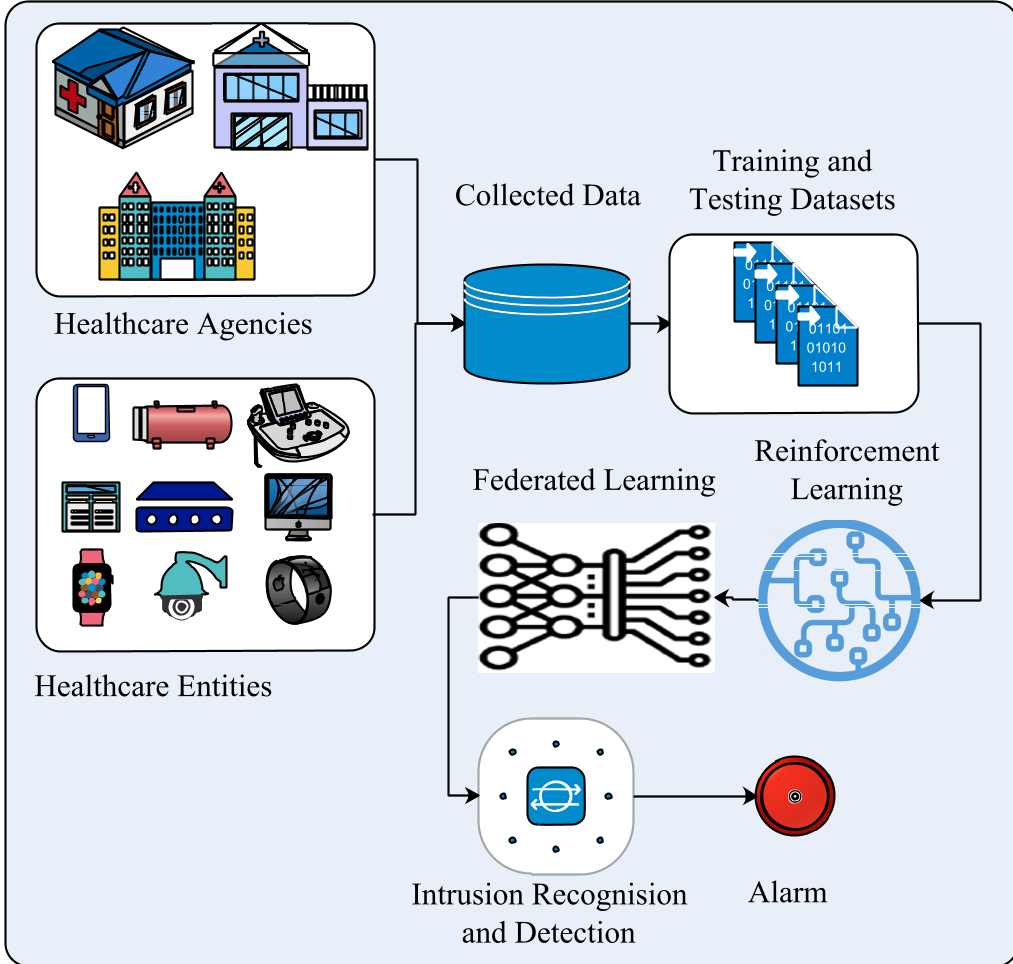 Fig 1: The FRL-IDS System Model showing the interaction between healthcare entities and the centralized aggregation server.
Experiments & Results
The model was tested against the CICIDS2017 dataset, which covers 2.8 million instances of traffic including DDoS, PortScans, and Web Attacks.
Key Highlights:
- Accuracy: FRL-IDS reached 98.5%, surpassing SVM (~96%).
- Detection Rate: Reached 96.5%, proving highly effective at identifying actual malicious instances while minimizing false alarms.
- Learning Efficiency: As shown in Fig 4 and 5, both accuracy and detection rates improved significantly as the number of communication rounds and training epochs increased, demonstrating the "learning" capability of the RL agent.
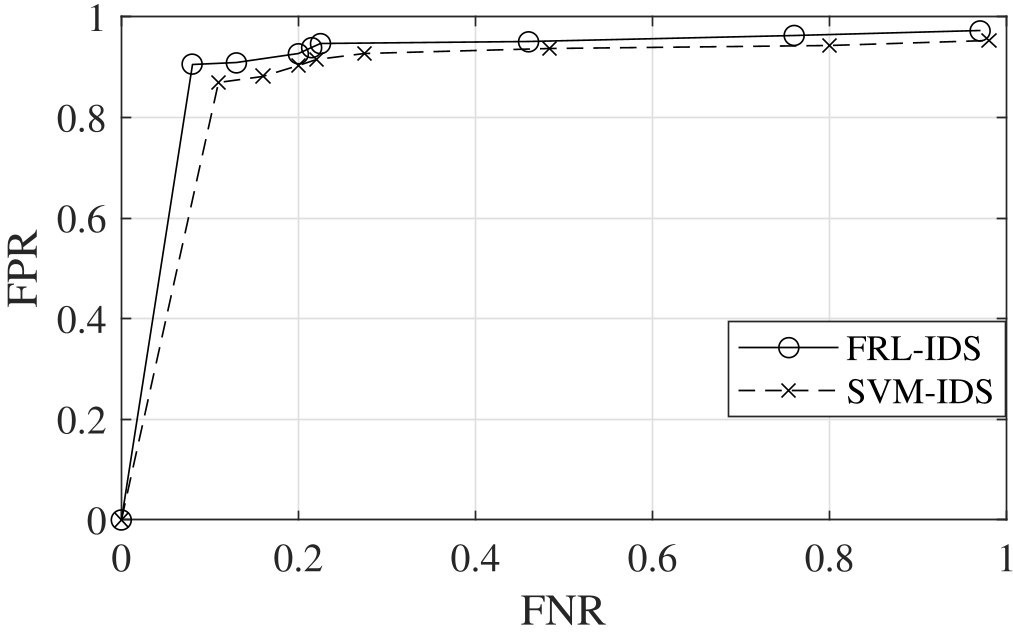 Fig 2: ROC Curve comparison showing the superior sensitivity of FRL-IDS over SVM-IDS.
Critical Insights & Conclusion
The "Why" Behind Success
Why does RL outperform SVM here? While SVM finds a static hyperplane to separate data, Q-Learning treats intrusion detection as a sequential decision-making process. By interacting with the environment, the RL agent develops a more nuanced "intuition" for anomalies in network behavior, which is particularly useful for the heterogeneous traffic seen in IoT.
Limitations & Future Work
- Heterogeneity: While the model is robust, extreme hardware differences between IoT devices (e.g., a simple sensor vs. a powerful gateway) might lead to "stragglers" in the Federated Learning process.
- Next Steps: The authors suggest exploring Deep Reinforcement Learning (DRL) to replace tabular Q-Learning, potentially allowing the system to handle even higher-dimensional feature spaces.
Summary
FRL-IDS proves that we don't have to sacrifice privacy for performance. By decentralizing the learning process and empowering it with adaptive reinforcement logic, we can build a resilient "immune system" for the Internet of Medical Things (IoMT).