
Verse: Engineering Reliable Social Connectivity in the Fast Lane
Feel Bored? Join Verse! Engineering Vehicular Proximity Social Networks
This paper introduces Verse, a decentralized vehicular proximity social network tailored for highway environments. It enables passengers to share content and discover friends via vehicle-to-vehicle (V2V) communications, achieving high bandwidth utilization through a social-aware rate control scheme without relying on cellular infrastructure.
TL;DR
Verse is a distributed software framework designed to turn the "boring" highway commute into a social experience. By leveraging vehicle-to-vehicle (V2V) communication, it allows passengers to share blogs and media without Internet access. Its core innovation lies in its ability to predict how long two speeding cars will stay in range and prioritize data transfers for users who share the most interests.
The "Highway Paradox" of Social Networking
Passenger social needs are high during long trips, yet connectivity is at its lowest. Relying on cellular networks is expensive and often unreliable in remote areas. While V2V communication offers a "free" alternative, it faces a physical reality: vehicles move fast, and connections are fleeting. If you start downloading a 5MB file from a car passing you at a relative speed of 20 km/h, there is a high probability the connection will drop before the last byte arrives, wasting precious bandwidth.
Methodology: The Fusion of Social Interest and Physical Mobility
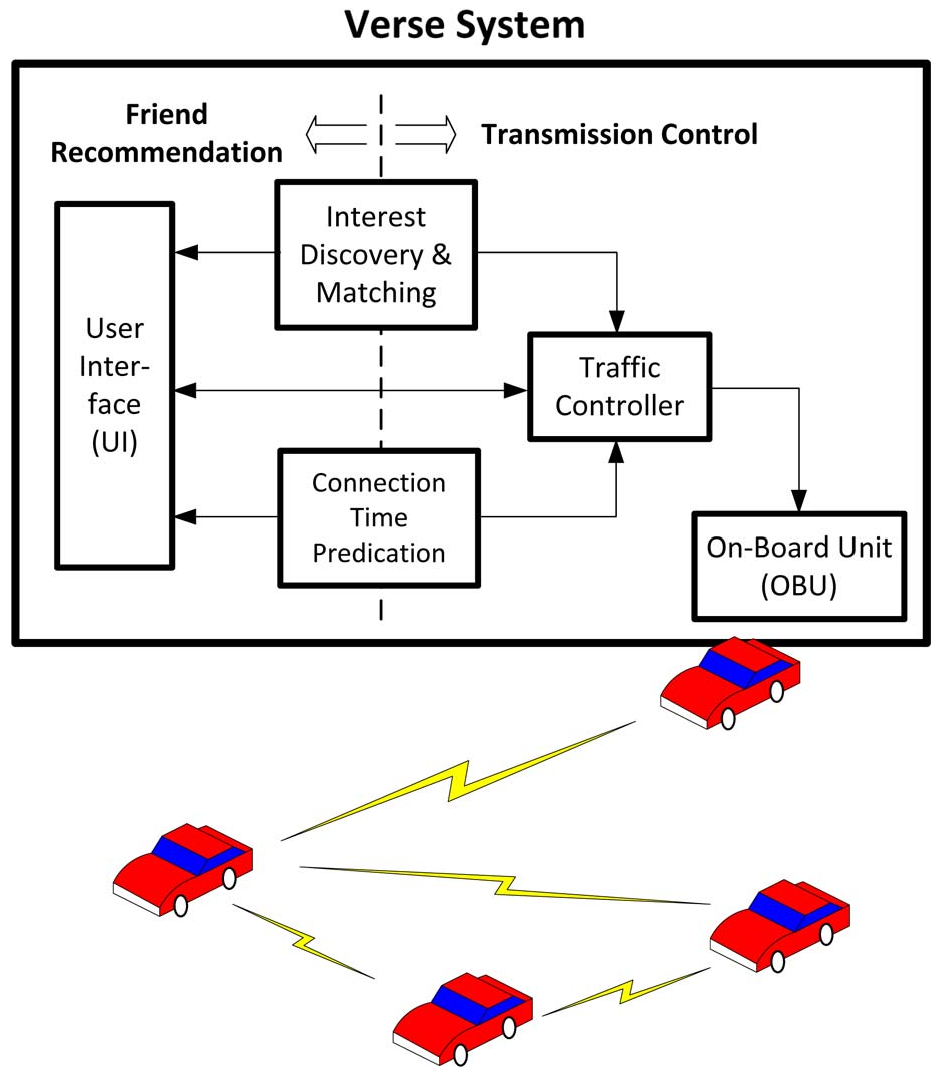
Verse tackles this by calculating a Social Score ()—a metric that combines "Who you like" with "How long you'll stay together."
1. Interest Matching (The "Who")
Using a Keyword Vector () and the TF-IDF (Term Frequency-Inverse Document Frequency) method, Verse builds a profile of the host's interests. It then uses Cosine Similarity to match one vehicle's profile against its neighbors.
2. Connection Time Prediction (The "How Long")
This is where the math gets serious. Verse models the distance between two vehicles as a Wiener Process (a stochastic queueing model). By solving the Fokker–Planck equation, it estimates the probability that a link will survive long enough to complete a specific data transfer.
Intelligent Transmission Control
The system doesn't just recommend friends; it manages the wireless pipe through two distinct mechanisms:
- Admission Control (AC): Before a download starts, the system checks the file size against the predicted connection duration. If the math says "you won't finish this," the request is rejected to prevent bandwidth waste from fragmented files.
- Social-Aware Rate Control: Verse uses a leaky-bucket controller to adapt the token generation rate (). If you have a high social similarity with a neighbor, the system grants you a higher transmission rate, optimizing the "Social Utility" of the entire local network.
Experimental Results
The authors validated Verse through extensive simulations of 1,000 vehicles.
- Accuracy: The Connection Time Prediction (CDF) curves closely matched simulation data, proving that the diffusion approximation is a robust way to model vehicular relative mobility.
- Efficiency: Without Admission Control, over 50% of the bandwidth was wasted on incomplete files. With Verse, fragmentation was drastically reduced, and users with high social scores successfully prioritized their traffic.
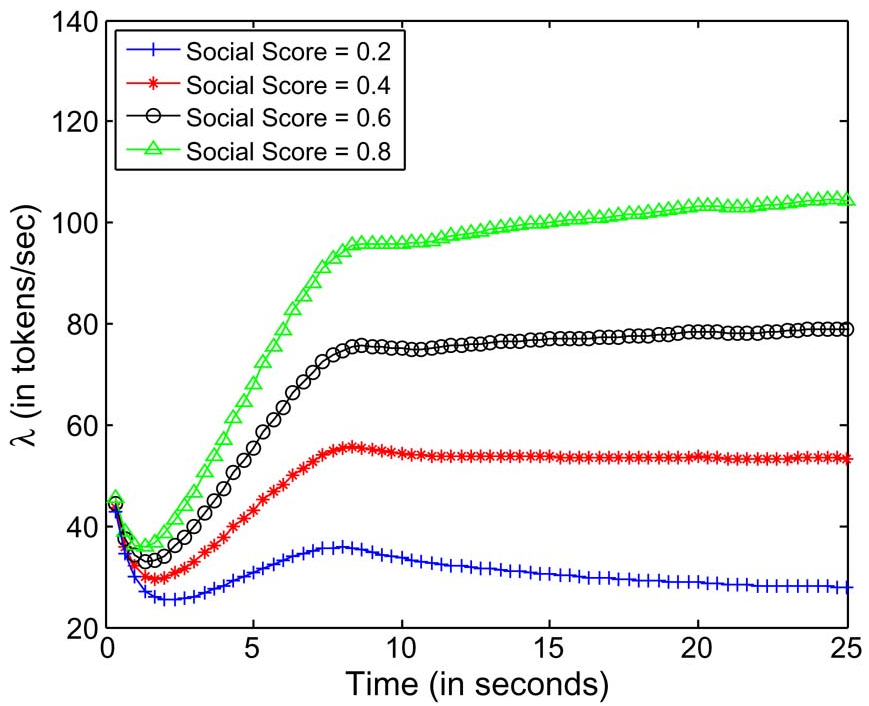 Figure: The token generation rate adapts dynamically as social scores change, demonstrating the system's responsiveness to network dynamics.
Critical Insight & Conclusion
The brilliance of Verse is the realization that in Transient Networks, the traditional "best-effort" delivery is inefficient. Instead, Context-Awareness (knowing the user's social interest) and Physics-Awareness (predicting relative velocity) must be coupled.
Takeaway: Verse provides a blueprint for "Grassroot" networks—systems that empower users to create a community using only the hardware they carry, transforming infrastructure-free environments into vibrant social hubs. Future iterations could integrate state-of-the-art State Space Models (SSM) for even more precise mobility tracking in complex urban "Stop-and-Go" traffic.