
Few Are as Good as Many: Semantic Anchoring to Combat Twitter Spam
Few are as Good as Many: An Ontology-Based Tweet Spam Detection Approach
The paper introduces an ontology-based approach for detecting event spammers on Twitter by analyzing tweet content against domain-specific knowledge dictionaries. It achieves a significant breakthrough by relying exclusively on public text metadata, outperforming traditional message-to-message similarity techniques by approximately 200%.
TL;DR
Researchers have developed a novel ontology-based detection system that identifies Twitter spammers by checking if their content actually "talks the talk" of a specific domain. By comparing tweets to a dictionary derived from a probabilistic ontology, the system avoids the need for private user data and outperforms standard similarity algorithms by 2x, proving that a few precise semantic matches are better than broad textual similarity.
Background: The Crisis of Metadata Access
For years, detecting spammers was a game of "follow the leader." Researchers looked at follower/followee ratios, account ages, and behavioral patterns. However, Twitter's evolving API restrictions have cloaked this metadata, making traditional statistical indicators expensive or impossible to retrieve. Simultaneously, spammers have become "creative," using spinbots to bypass simple keyword filters.
Current content-based methods like Cosine Similarity or NLTK fail because tweets are too short (140 chars). If two users talk about "Bitcoin," but one uses slang and the other uses technical jargon, a mathematical similarity check often misses the connection.
The Proposed Solution: Message-to-Ontology Evaluation
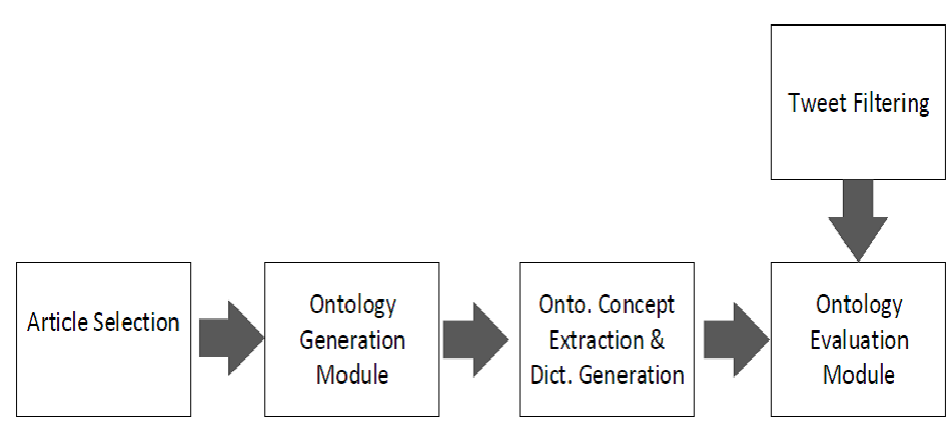
The core insight of this paper is that legitimacy equals semantic relevance. Instead of comparing a tweet to another tweet, the authors compare a tweet to a "Gold Standard" of knowledge—an Ontology.
1. Structure Over Similarity
The methodology involves generating a domain-specific ontology (e.g., Politics, Soccer, Technology) from reliable articles. This creates a dense web of "Concepts" and "Relations."

2. The Logic of "Few Are as Good as Many"
Unlike standard search engines that want a high match rate, this approach recognizes the brevity of social media. The "Few Are as Good as Many" principle posits that if a tweet contains even a small percentage (e.g., 20-30%) of highly specialized terms from the ontology, it is likely ham (legitimate). Spammers, who often use generic marketing language or unrelated trending hashtags, fail this semantic depth test.
Experimental Showdown
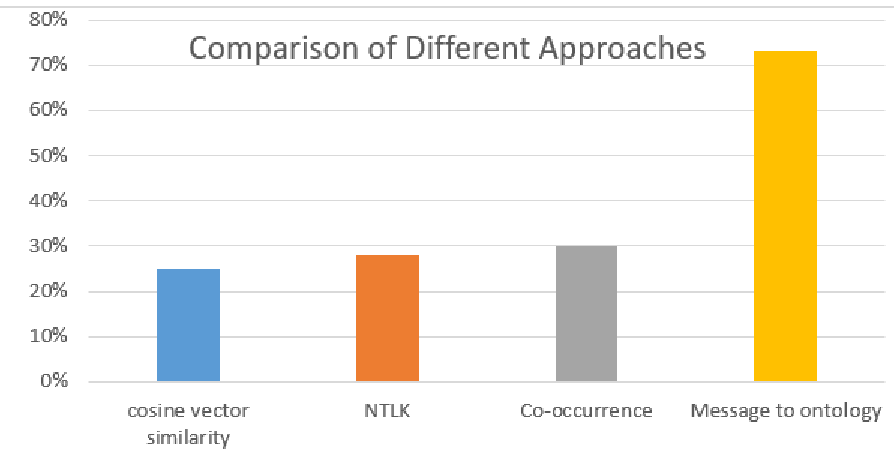
The authors benchmarked their ontology approach against three classic methods: Cosine Vector Similarity, NLTK, and Co-occurrence models.
Key Results:
- Baseline Failure: Traditional methods hovered around 25-30% accuracy.
- Ontology Victory: The proposed model achieved 60-70% accuracy.
- Domain Sensitivity: Politics tweets were the easiest to classify because they tend to follow more formal sentence structures compared to the slang-heavy sports domain.
The "Sweet Spot" Threshold
The study identifies 0.2 to 0.3 (20-30%) as the optimal similarity threshold. Beyond this point, the results converge, meaning higher strictness doesn't yield better detection—it only increases false positives. This finding is critical for scalability, as it reduces the computational overhead for large-scale stream analysis.
Critical Insight: Why This Works
This method provides an Inductive Bias that spammers cannot easily replicate. While a bot can copy a hashtag or a URL, it is much harder for a generic spam script to consistently generate linguistically coherent content that aligns with a complex, multi-layered domain ontology.
Summary & Future Outlook
This work shifts the spam detection paradigm from "Who is talking?" (Account Meta-data) to "What are they saying?" (Semantic Depth).
Limitations: The model currently struggles with the creative misuse of language (slang) in specific sub-cultures like Basketball fans. Future Work: Integrating this ontology approach with real-time URL redirect analysis could create a near-impenetrable defense against event-based spam.
As Twitter and other "X-like" platforms continue to restrict data access, semantic-heavy approaches like this will become the primary line of defense in maintaining digital trust.