
SEATLE: Solving the Sparse Check-in Puzzle with Few-Shot Learning and Geo-Context
4529_Few-Shot Learning for New User Recommendation in Location-based Social Networks.
The paper introduces SEATLE, a novel recommendation framework for Location-Based Social Networks (LBSNs) that targets the "new user" prediction task. It combines Metric-Learning-based Few-Shot Learning with a dual-modality geographical influence model (Convenience vs. Dependency) to achieve SOTA performance on sparse check-in datasets.
TL;DR
Recommending new businesses to users in Location-Based Social Networks (LBSNs) is notoriously difficult due to extreme data sparsity. SEATLE (SElf-Attention and few-shoT LEarning) addresses this by treating recommendation as a few-shot task. By modeling "Geographical Convenience" (how hard it is for you to get there) and "Geographical Dependency" (what else is near the business), it sets a new benchmark for identifying potential new customers.
Problem & Motivation: Why Distance is a Lie
In the world of Yelp and Foursquare, most users only visit a tiny fraction of available venues. Traditional Collaborative Filtering (CF) breaks down here because the user-item matrix is almost empty.
To fix this, researchers usually look at geographical distance. However, the authors argue that distance is a "blunt instrument."
- Convenience vs. Distance: Five miles is a short drive for a car owner but a long journey for someone relying on a bus.
- Contextual Dependency: A coffee shop next to a cinema is different from a coffee shop next to a car repair garage.
The motivation behind SEATLE is to move beyond "how far" to "how accessible" and "what is the neighborhood vibe."
Methodology: The SEATLE Architecture
The core of SEATLE lies in its two-pronged approach to geography and its meta-learning training strategy.
1. The Geographical Dual-Engine
- Geographical Convenience (GMM): Instead of a fixed radius, SEATLE uses a Gaussian Mixture Model to learn a user's unique "mobility footprint." This captures whether a user is a "local" or a "traveler."
- Geographical Dependency (GCN): The model builds a graph where nodes are businesses and edges represent proximity. Using Graph Convolutional Networks, the model learns the "neighborhood signature" of every venue.
2. Few-Shot Learning Framework
Instead of standard supervised learning, the authors adopt a Metric-Learning-based Few-Shot approach.
- References (Support Set): A few known check-ins for a business.
- Queries: Potential new users.
- The Logic: The model uses Self-Attention to ask: "Does this new user's behavior look like the set of people who already visit this place?"
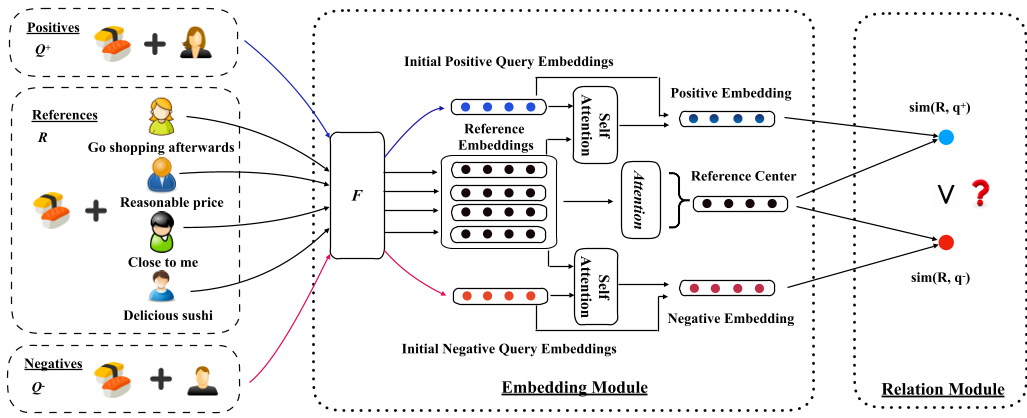 Figure: The SEATLE Few-Shot Framework highlighting the interaction between Reference and Query sets.
Experiments & Results
The authors put SEATLE to the test against 13 baselines, ranging from classical Matrix Factorization (WRMF) to deep learning models like PACE.
Key Findings:
- Superiority in MAP: Across cities like Las Vegas, Toronto, and New York, SEATLE consistently delivered the highest Mean Average Precision.
- Ablation Success: Removing GMM-based convenience led to the biggest performance drop, proving that personalized reachability is more important than simple neighborhood context.
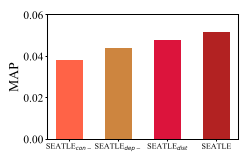 Figure: Performance comparison showing SEATLE's dominance over competitors like CORALS and PACE across different urban datasets.
Critical Insight: The Value of "How" and "Where"
The real breakthrough of this paper is the successful application of meta-learning to LBSNs. By framing the problem as a similarity match between a "query" user and "reference" check-ins, the model learns to generalize from very few examples.
Limitations: While SEATLE excels at spatial features, it doesn't heavily incorporate temporal dynamics (e.g., morning vs. night preferences) or textual reviews. Future work could integrate these into the embedding module for even richer user representations.
Conclusion
SEATLE proves that in sparse data environments, how we model ancillary information matters as much as the algorithm itself. By replacing raw distance with personalized convenience and using few-shot learning to maximize signal from limited check-ins, it provides a robust toolkit for modern LBSN recommendation.