
Beyond the Literal: How Figurative Language Powers Emotion in Chinese Social Media
Figurative Language in Emotion Expressions
This paper investigates the correlation between figurative language (metaphor, rhetorical questions, irony, etc.) and emotion expression in Chinese social media (Weibo). Utilizing a corpus of 300 annotated posts, it identifies that 27% of emotional expressions involve figurative devices, with "Anger" being the most likely emotion to be expressed non-literally.
TL;DR
Why do we say "Is it even possible for me to be any more tired?" instead of just "I am very tired"? This paper explores the "why" and "how" of figurative language in 300 Weibo posts. It finds that 27% of emotional posts are non-literal, with Anger being the most figurative emotion. Rhetorical questions and novel metaphors aren't just linguistic flourishes; they are primary tools for conveying intense, complex human feelings.
The Motivation: Why "Literal" NLP Fails
Most emotion classification systems act like "surface-level readers"—they look for keywords like "sad" or "happy." However, human communication is rarely that simple, especially in the snarky, creative world of social media.
The author points out that figurative language (metaphor, irony, etc.) is used because emotions are abstract and intense. A literal phrase like "get very angry" lacks the nuance of an idiom or a biting rhetorical question. In the context of Chinese social media, this gap in understanding figurative nuance is a major bottleneck for SOTA emotion detection models.
Methodology: Decoding the Weibo Corpus
The research team extracted 4,195 posts from Weibo, narrowing down to 300 high-quality samples after removing "noise" (ads and short fragments). They annotated five basic emotions: Happiness, Sadness, Fear, Anger, and Surprise.
The Figurative Toolkit
The study categorized the expressions into several key linguistic devices:
- Rhetorical Questions (RQ): "Why can't people's age be refreshed?"
- Metaphor: Comparing affection to a "luxury good."
- Simile: "Scolded like a dog."
- Hyperbole: "Eyes are almost blind from shopping."
- Irony: "You are so damn nice to me" (meaning the opposite).
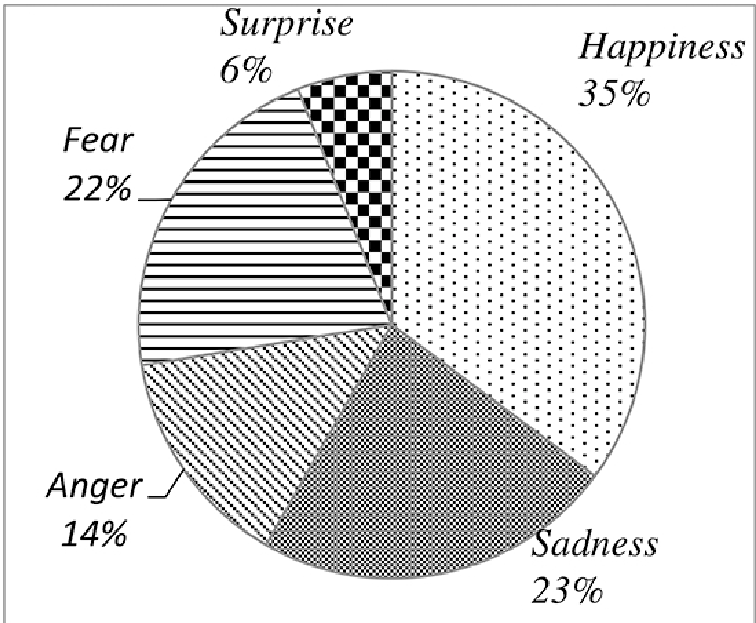 Figure 1: While Happiness is the most frequent emotion overall, it is the least likely to use figurative language.
Key Insights: Anger and the Power of Rhetorical Questions
The most striking finding is the uneven distribution of figurative language across emotion types.
| Emotion | Figurative Frequency |
|---|---|
| Anger | 57% |
| Sadness | 33% |
| Fear | 26% |
| Happiness | 13% |
1. The Dominance of Rhetorical Questions
Rhetorical questions make up 37% of all figurative devices found. They are particularly effective for negative intent. The study suggests that RQs engage the reader's mind more than a statement, forcing the audience to process the message more intensely.
- Insight: The more negative the emotion, the more likely a user is to pose a question they don't want answered.
2. Novelty Over Convention
Contrary to previous studies on English (which found many "dead" or frozen metaphors), Weibo users tend to create novel metaphors. Because social media is written, users have the "thinking time" to be creative, likening monks to "gold-panning thieves" or feelings to "luxury goods."
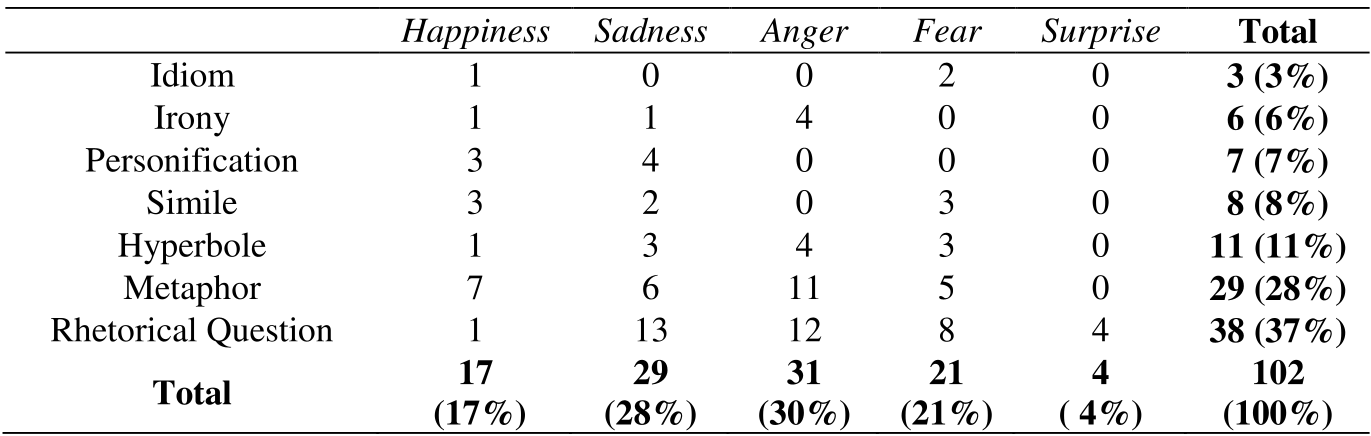 Table: Distribution of devices. Note the high frequency of Metaphors and Rhetorical Questions.
Critical Analysis & Future Directions
Takeaway for AI Developers
If you are building a sentiment analysis tool for the Chinese market, a simple bag-of-words model will fail on 57% of angry posts. Your model must be able to recognize:
- Wh-word patterns in rhetorical questions (e.g., "Why + negation").
- Punctuation intensity: The use of "extra" exclamation marks inside words (e.g.,
狗! 眼! 看人!).
Limitations
The sample size (300 posts) is small for a statistical generalization, though deep for a linguistic qualitative analysis. Furthermore, as social media slang evolves (e.g., "Internet Slang 2.0"), these figurative patterns may shift toward even more oblique forms of irony.
Final Conclusion: Figurative language is the "intensity dial" of human emotion. To truly understand how people feel online, we must look past what they say and decipher how they are creatively distorting the language to be heard.