
Smart Crowdsourcing: Revolutionizing Financial Advisor Recruitment with Machine Learning
9509_Financial Advisor Recruitment A Smart Crowdsourcing-Assisted Approach.
This paper introduces a smart crowdsourcing-assisted framework for financial advisor recruitment, utilizing a two-phased matching approach integrated with machine learning. By employing Gradient Boosting Regressor (GBR) for score prediction and K-means++ for advisor clustering, the system achieves a state-of-the-art matching accuracy that maximizes investor returns while maintaining advisor capacity constraints.
TL;DR
Recruiting the right financial advisor is often a "hit-or-miss" endeavor based on word-of-mouth or surface-level credentials. This paper proposes an automated, data-driven crowdsourcing platform that uses Gradient Boosting Regressors and Bipartite Graph Matching to pair investors with advisors. The result? A 96% increase in average returns compared to random selection and a significantly more stable investment experience.
Background & Motivation: The Recruitment Bottleneck
In Modern Portfolio Theory (MPT), while much focus is placed on asset allocation algorithms, the human (or robo) element—the Advisor—is often the weakest link in the chain. Investors have varying risk tolerances, budgets, and lifecycle goals, while advisors have specific niches, experience levels, and capacities.
The authors identify a critical gap: existing financial platforms don't intelligently match these two parties. Most use simple First-In-First-Out (FIFO) queues or basic filtering. This leads to "Expertise Mismatch," where a high-risk-tolerant investor might be paired with a conservative advisor, resulting in missed opportunities and frustration.
Methodology: A Three-Tiered Intelligence Pipe
The proposed system doesn't just look at a spreadsheet; it processes a multi-dimensional feature set including advisor licenses, failure years, and diplomas, alongside investor-side data like salary, marital status, and "Psychological Risk" levels.
1. Dimensionality Reduction via Clustering
To handle thousands of advisors without computational explosion, the system uses K-means++ clustering. This groups advisors with high similarity into "Expertise Hubs."
2. Matching Score Prediction (The "Brain")
The core of the system is a regression model. The authors compared Decision Trees (DTR), Random Forests (RFR), and Gradient Boosting Regressors (GBR). GBR emerged as the winner, effectively learning the non-linear "compatibility" between an investor's persona and an advisor's track record.
3. Double-Phased Assignment
As shown in the architecture below, the system utilizes a two-step matching process:
- Inter-CAP: Assigns investors to the most suitable advisor cluster.
- Intra-CAP: A many-to-many matching algorithm that ensures no advisor is over-leveraged while maximizing the total predicted return for all participants.
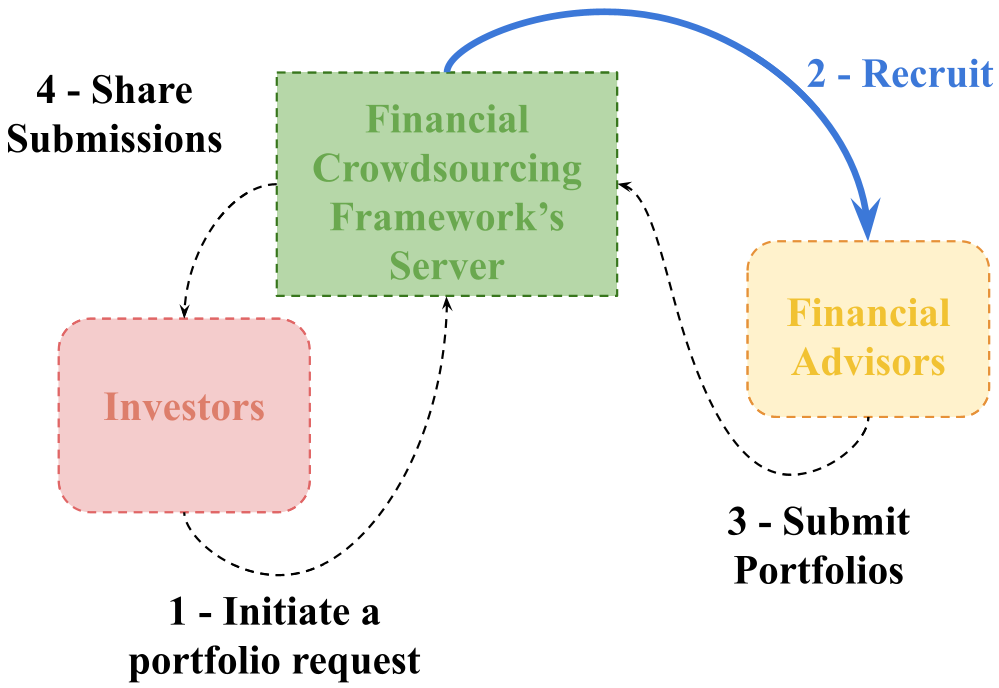 Figure 1: The four major steps of the crowdsourcing recruitment flow.
Experimental Results: Stability Meets Performance
The researchers tested their approach against a real-world dataset from the Australian Securities and Investment Commission.
- Predictive Accuracy: The GBR model attained an R² of 0.992, meaning it can predict the success of a partnership with near-perfect reliability.
- Global Optimization: Unlike "Greedy" algorithms (like FIFO), the proposed many-to-many matching looks at the whole "crowd" to find the global optimum.
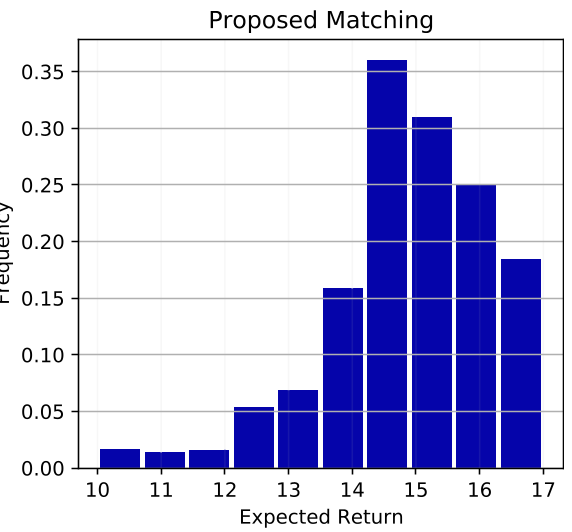 Figure 2: Distribution of returns across different matching strategies.
As seen in the results, the Proposed Matching (Red) shifts the entire return distribution to the right (higher gains) and narrows the bell curve (lower risk/deviation) compared to Random or FIFO methods.
Critical Insight & Conclusion
The true innovation here is the separation of concerns. The platform does not attempt to dictate how an advisor manages a portfolio (their "secret sauce" remains private). Instead, it optimizes the recruitment—ensuring that the right "sauce" is served to the right "customer."
Limitations & Future Work
While robust, the current model relies on synthetic data for investors (due to privacy regulations). Future iterations would benefit from Federated Learning to train on real-world sensitive financial data without compromising investor anonymity. Furthermore, integrating Robo-advisors into the same bipartite graph could create a truly hybrid ecosystem where human intuition and machine speed are allocated dynamically based on market volatility.
Final Takeaway: By treating advisor recruitment as a high-dimensional matching problem rather than a search problem, we can significantly de-risk the entry point of the investment lifecycle.