
Unified Dynamic Community Detection: Beyond the Two-Step Heuristic
Finding Communities in Dynamic Social Networks
The paper introduces a novel optimization framework for detecting communities in dynamic social networks by generalizing the Correlation Clustering problem. It utilizes Semidefinite Programming (SDP) and a rounding heuristic to minimize a "social cost" function comprising switching costs, false positives, and false negatives, achieving superior accuracy over traditional two-step heuristics.
TL;DR
This research tackles the challenge of finding evolving communities in social networks. Instead of the traditional "find clusters first, link them later" approach, the authors propose a unified social cost model solved via Semidefinite Programming (SDP). By weighing the costs of switching communities against the costs of non-interactions with group members, the model recovers latent structures with higher accuracy than previous heuristics.
The Core Challenge: The Temporal Gap
Most community detection algorithms are static—they look at a single snapshot of a network. When dealing with dynamic networks (like smartphone interactions or friend groups over months), researchers often fall into the trap of the Two-Step Approach:
- Detect communities at each time step independently.
- Try to "match" these communities across time.
The problem? This often ignores the inherent persistence of social groups. Communities don't just appear and disappear randomly; they evolve. If your static algorithm makes a slight error at , it can lead to a massive "hallucinated" community shift at .
Methodology: The Social Cost Model
The authors move away from purely structural metrics (like Modularity) and adopt a Social Theory intuition. They define a community interpretation as a coloring that minimizes three types of costs:
- Switching Cost (): Penalizes individuals changing their group affiliation.
- False Negative Cost (): Penalizes members of the same community who do not interact.
- False Positive Cost (): Penalizes members of different communities who do interact.
Mathematically:
To solve this NP-hard problem, the authors relax it into a Semidefinite Program (SDP). Instead of assigning a discrete "color" to each node, they represent nodes as vectors in dimensional space. If two nodes are in the same community, their vectors should have a dot product near 1.
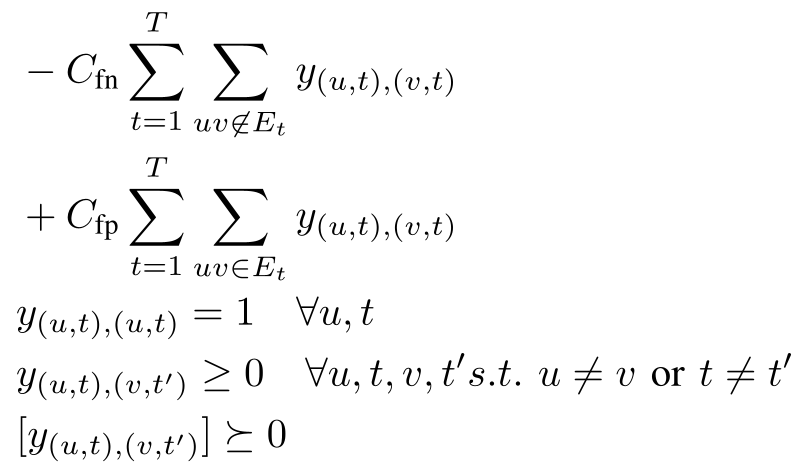 The SDP formulation seeks to maximize the alignment of vectors for interacting or persistent nodes while minimizing it for non-interacting ones.
Experiments & Results
The authors tested their method against common baselines like Girvan-Newman (GN) and Clauset-Newman-Moore (CNM).
1. Synthetic Accuracy
Using a Hidden Markov Model (HMM) to generate ground-truth dynamics, they found that the SDP approach consistently stays closer to the "truth" (lower Rand Index distance) than the two-step methods, especially when the network noise (false positives/negatives) is high.
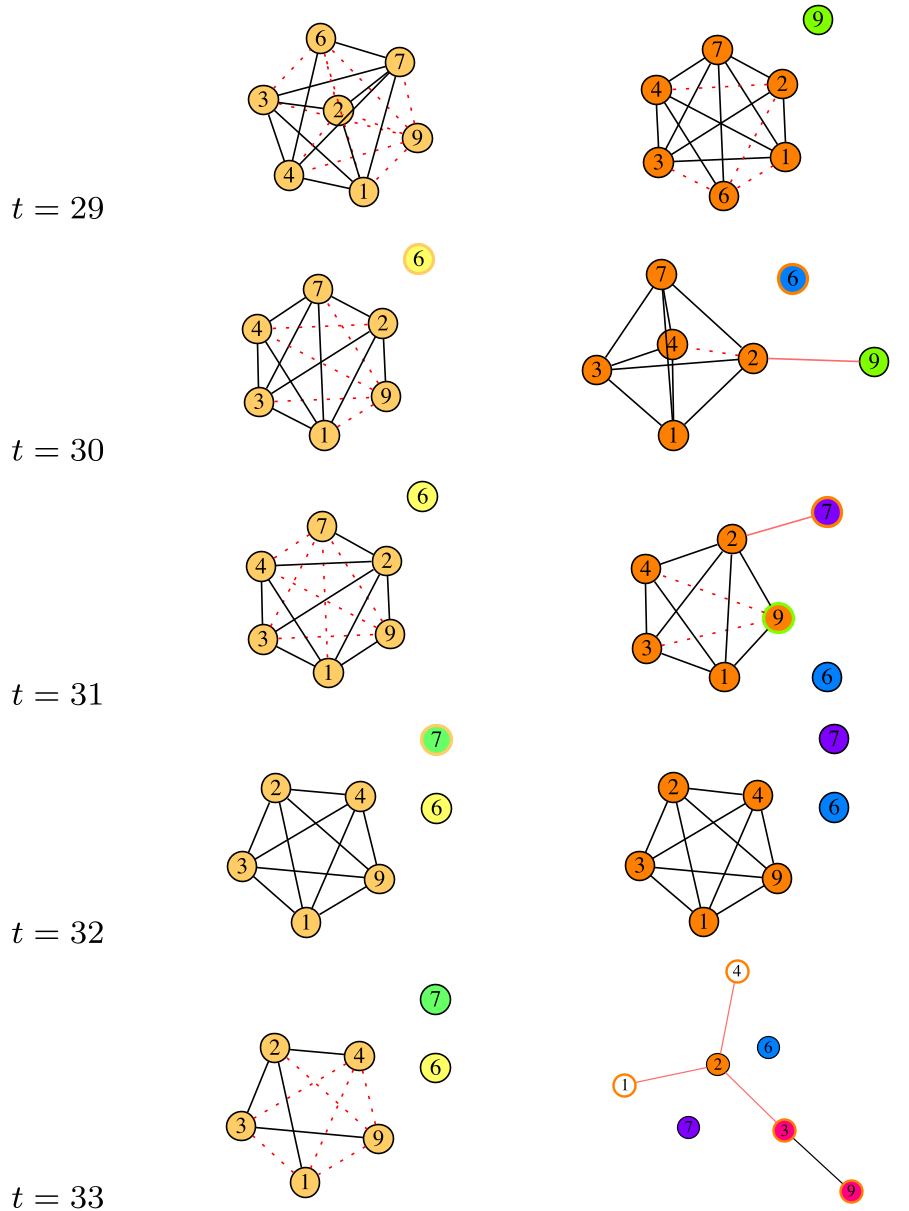 Performance of SDP vs. GN and CNM across various trials. Lower indicates better alignment with ground truth.
2. Real-World Insight: Bluetooth Traces
Applying the model to the Haggle project (Bluetooth contact logs), the researchers demonstrated how adjusting the parameter can "smooth" the results.
- High : Communities appear stable, ignoring transient "noise" encounters.
- High : Results in smaller, denser, more exclusive clusters.
Critical Insight & Limitations
The beauty of this work lies in its principled approach. It doesn't rely on local heuristics; it tries to optimize a global objective that reflects how social groups actually behave.
However, there is a massive elephant in the room: Scalability. SDP solvers use interior-point methods that are computationally expensive. While the method is accurate for 20-100 nodes, it struggles with the millions of nodes found in modern social media platforms.
Conclusion
This paper serves as a foundational step toward "Temporal First" community detection. It proves that by treating time as a first-class citizen in the optimization function, we can uncover a much more accurate picture of how social circles evolve, merge, and dissolve.