
Finding Disjoint Dense Clubs: Bridging Complexity Theory and Social Network Analysis
Finding disjoint dense clubs in a social network
This paper investigates the Disjoint Dense Clubs (DDC) problem in social networks, which involves finding multiple non-overlapping clusters with small diameters (s-clubs). The authors provide a comprehensive complexity analysis and propose a practical heuristic based on fixed-parameter tractability (FPT) for the dual vertex-deletion version of the problem.
TL;DR
Cohesive community detection is fundamental to understanding social networks, but the "clique" model is often too rigid. This paper tackles the Disjoint Dense Clubs (DDC) problem—finding multiple non-overlapping clusters where every node is within distance of each other. The authors prove that while the problem is theoretically "hard" (no polynomial kernel), a dual-version approach using intelligent branching rules can solve real-world network instances efficiently.
Background: Why s-Clubs over Cliques?
In a social network, trust is rarely transitive over many hops. If Alice knows Bob, and Bob knows Charlie, Alice might trust Charlie; however, if the chain extends to six people, the trust vanishes.
- Clique: Every node must connect to every other node (Diameter = 1).
- s-Club: A subset of vertices where the induced subgraph has a diameter of at most .
Finding disjoint s-clubs is vital for identifying functional, high-trust communities that are sparsely connected to the rest of the network.
The Complexity Wall
The paper first addresses the Parameterized Complexity. The authors prove that DDC does not admit a Polynomial Kernel. In layman's terms, this means we cannot "shrink" a massive graph into a tiny representative version using polynomial-time rules without losing essential information. This result suggests that traditional Fixed-Parameter Tractable (FPT) approaches might still be too slow for massive graphs.
Methodology: The "Dual" Rescue
The authors pivot to the dual version of the problem: How many vertices () must we delete to leave behind only isolated s-clubs?
1. The Branching Insight
If the distance between two nodes and is , they cannot exist in the same -club. In the path between them (of length ), there are vertices. To resolve this violation, at least one of these vertices must be removed. This creates a search tree with a branching factor of .
2. Practical Reduction Rules
To make this efficient, the authors introduce Reduction Rule I:
If a vertex has fewer than neighbors within distance , it can never be part of a club of size .
This simple check allows for the immediate deletion of thousands of "irrelevant" nodes in sparse networks like the US Power Grid.
 Figure 1: Illustration of densely connected communities vs. sparse inter-group connections.
Experimental Validation
The authors tested their algorithm on five major datasets, including social collaboration networks (Erdos, GRQC) and infrastructure networks (Power Grid).
Key Metrics:
- Node Reduction: On the US Power Grid graph (4941 nodes), their preprocessing rules deleted over 99% of nodes (4921 deleted) when searching for clubs of size 20 and diameter 2.
- Efficiency: For the Advogato trust network, solutions were found in just a few thousand milliseconds, even for complex configurations.
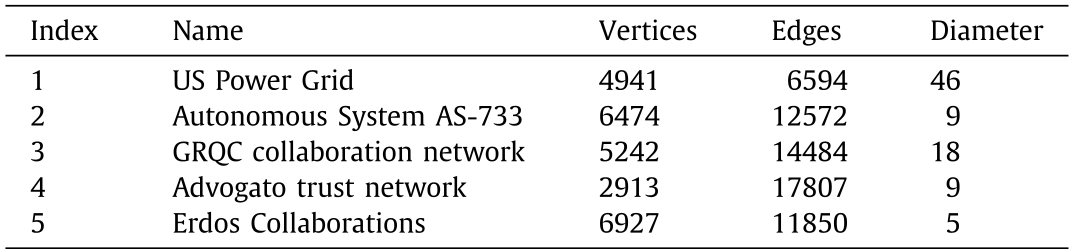 Table 1: Characteristics of the test networks, highlighting the diversity in diameter and density.
Critical Analysis & Conclusion
This work excels in bridging the gap between "hard" theoretical lower bounds and "practical" performance. By focusing on the dual problem and utilizing neighborhood-based pruning, the authors turned an NP-complete nightmare into a manageable tool for social scientists.
Limitations: The algorithm is still a heuristic in its current branching implementation—it may stop a branch if it cannot find an edge violating the rules, potentially missing some disjoint structures.
Future Outlook: The next frontier involves refining these branching rules to achieve a true FPT algorithm, which would provide theoretical guarantees alongside the empirical success demonstrated here.