
Scaling Hearts: Using Community Mining to Revolutionize Social Matching Efficiency
Finding and Matching Communities in Social Networks Using Data Mining
This paper proposes a community-based matching framework for social networks, specifically online dating, using K-means clustering to group users into communities. By matching these communities based on historical communication links rather than just profile similarity, the system achieves a 50.32% success rate and significantly reduces computational overhead.
TL;DR
Matching people in massive social networks is a daunting computational challenge. This paper moves away from expensive pairwise comparisons () by grouping users into homogenous communities through K-means clustering. By matching these communities based on historical communication links rather than just static profiles, the authors boosted matching accuracy to 50.32% and slashed computational costs by over 93%.
Background: The Scalability Trap
In the era of Facebook and specialized dating sites like RSVP, the sheer volume of data is a double-edged sword. While more data should lead to better matches, the "Pairwise Comparison Trap" means that for men and women, a system must perform operations. For a network of millions, this is a recipe for latency.
Furthermore, traditional systems are plagued by:
- Cold Start: New users have no activity history.
- Sparsity: Most users only interact with a tiny fraction of the network.
- Subjectivity: Profile data is often aspirational or incomplete.
Methodology: Community-Centric Matching
The core insight of the authors is that individual behavior can be inferred from community behavior.
1. Asymmetric Feature Clustering
The researchers didn't just cluster everyone together. They recognized a behavioral nuance:
- Males were clustered based on their own attributes (who they are).
- Females were clustered based on their preferred partner attributes (who they want). This asymmetry aligns the supply (males) with the demand (female preferences) more accurately than standard similarity metrics.
2. Architecture of the System
The system follows a pipeline of data cleaning, vector transformation (converting nominal data to binary vectors), and K-means clustering.
 Figure 1: The proposed system design, highlighting the split between Male and Female clustering paths.
3. Link-Based Community Matching
Instead of matching Community A to Community B based on the distance between their centroids (which proved inaccurate due to data sparsity), the authors looked at "Successful Links." If users in Community frequently receive positive replies from users in , then those communities are deemed a match.
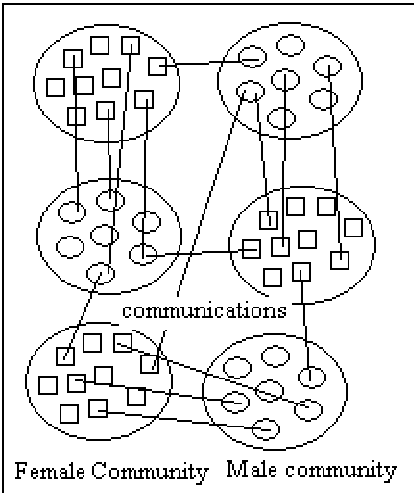 Figure 2: Visualizing successful communication channels between male (circles) and female (squares) clusters.
Experiments and Results
Testing on a subset of 76,000+ active users from a real dating site yielded impressive metrics:
- Accuracy Leap: The baseline success rate in the network was only 16%. The proposed community-matching method reached 50.32%.
- Complexity Reduction: The number of comparison operations dropped from 1.44 billion to 92 million.
Complexity Comparison
The transition from pairwise matching to community matching changes the complexity from to , where and are the number of clusters. This is a massive win for real-time recommendation engines.
Critical Insight & Conclusion
The true value of this work lies in its hybrid philosophy. It uses "hard" data (profiles) for the initial clustering to solve the Cold Start problem—since a new user can be immediately assigned to a community—but uses "soft" data (actual communications) to validate the matches between those groups.
Limitations: The paper relies on K-means which assumes spherical clusters—a limitation in complex social manifolds. Future iterations might benefit from Spectral Clustering or Graph Embedding (like Node2Vec) to capture more intricate social structures.
Final Takeaway: To scale social platforms, stop looking at users as isolated points; start looking at them as members of behavioral tribes.