
Finding the "Strangers" in a Crowd: Optimized Socially Tenuous Groups
On Finding Socially Tenuous Groups for Online Social Networks
This paper introduces the Minimum k-Triangle Disconnected Group (MkTG) problem to find Socially Tenuous Groups (STGs) in online social networks. By leveraging a novel "k-triangle" metric to quantify social distance beyond direct edges, the authors propose TERA and TERA-ADV algorithms to identify groups with minimal internal connections.
Executive Summary
TL;DR: While most AI and social graph research tries to find "communities" (dense clusters), this KDD paper tackles the opposite: finding Socially Tenuous Groups (STGs)—sets of people who are as far apart as possible. The authors define a "k-triangle" metric, prove the problem is NP-Hard, and provide an optimized algorithm (TERA-ADV) that finds optimal solutions for social networks that resemble "threshold graphs."
Background: This work sits at the intersection of graph theory and social computing. It moves beyond simple Independent Set problems by considering not just direct edges, but -hop social "triangles" that represent indirect familiarity.
Problem & Motivation: Why we need "Tenuous" Groups
In many real-world scenarios, being "connected" is a bug, not a feature:
- Therapy Groups: In substance abuse treatment, patients shouldn't know each other (or have mutual friends) to avoid subgroup formation and ensure privacy.
- Reviewer Selection: Program chairs need reviewers who aren't just "not co-authors," but are socially distant enough to prevent bias.
The Catch: Simply picking people without direct edges (Independent Set) isn't enough. If three people share a common close friend (a 2-triangle), they are still socially "warm." We need to minimize these -length connections.
Methodology: The k-Triangle & TERA-ADV
The core innovation is the k-triangle: A triplet of vertices where each pair is within hops.
1. The Metric
The goal is to find a group (size ) with no direct edges that minimizes: Where is the count of -triangles.
2. The TERA-ADV Architecture
To handle massive graphs like Youtube (1.1M nodes), the authors utilize Simplicial Pruning. A simplicial vertex's neighbors form a clique; since we can only pick one person from a clique to avoid direct edges, we can aggressively prune the graph without losing the optimal solution.
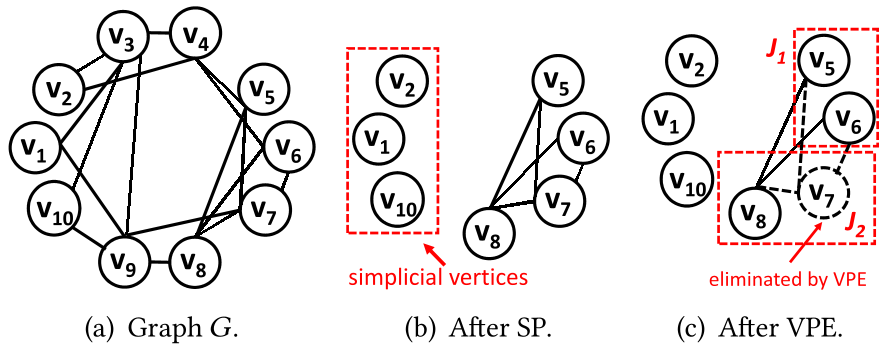 Figure: The pruning process using Vicinal Partitioning to reduce the search space.
3. Algorithm: TERA
The algorithm iteratively removes the "most connected" vertex (the one involved in the most -triangles) until the target group size is reached.
Experiments & Results
The authors tested their approach against baselines like BigClam (community detection) and Random selection.
- Efficiency: TERA-ADV processed million-node graphs in seconds by pruning up to 90% of redundant nodes.
- Solution Quality: On the Instagram (IG) dataset, TERA-ADV produced groups with nearly zero -triangles, whereas standard densest-subgraph algorithms on complement graphs failed to satisfy the no-pair constraint.
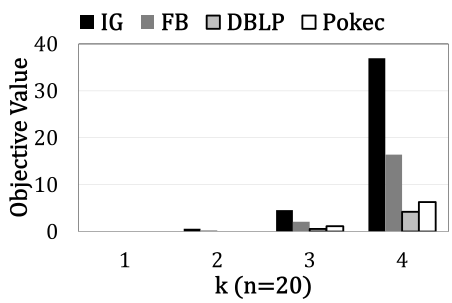 Figure: TERA-ADV consistently finds lower tenuity (better "stranger" groups) compared to random or clique-based baselines.
Critical Analysis & Conclusion
Takeaway
The paper effectively demonstrates that "social distance" is a measurable metric that can be optimized. The insight that social networks behave like threshold graphs is the "silver bullet" here—it allows a theoretically NP-Hard problem to be solved optimally in polynomial time for real-world data.
Limitations & Future Work
- Static Nature: The paper treats friendships as static. In reality, social distance changes over time.
- Attribute Blindness: While it finds "strangers," it doesn't account for whether those strangers have the expertise needed (e.g., for reviewer selection). The authors suggest adding "personal attributes" in future iterations.
Ultimately, this work provides a vital tool for any application where independence and privacy are more important than synergy and connection.