
Beyond the Mass Collection: Discovering Thematic Subgroups in Flickr Pools
Finding Subgroups in a Flickr Group
The paper introduces an unsupervised generative model designed to discover latent subgroups within Flickr Groups by identifying highly correlated topics from multimodal data. The approach, which utilizes both image features (visual words) and user-generated tags, employs a logistic normal prior to model topic correlations, effectively partitioning broad group themes into specific sub-clusters.
TL;DR
Flickr Groups act as massive repositories for specific interests, but they often become disorganized "junk drawers" of content. This paper presents a probabilistic generative model that automatically organizes these groups into meaningful subgroups (e.g., splitting "Aviation" into "Military" and "Commercial"). By utilizing both image features and tags while explicitly modeling topic correlations, the authors outperform traditional LDA-based multimodal models in capturing the latent structure of social media.
Background: The Problem of "Thematic Drift"
While Flickr Groups like "18th-century architecture" have a central theme, the reality is more complex. A group is rarely monolithic; it is a collection of clusters—some members focus on churches, others on forts. Existing tools treat topics as independent silos, ignoring the fact that if you see a "bridge," you are likely to see "water." This lack of correlation awareness makes traditional models poor at organizing content logically.
Methodology: Correlation as the Key to Organization
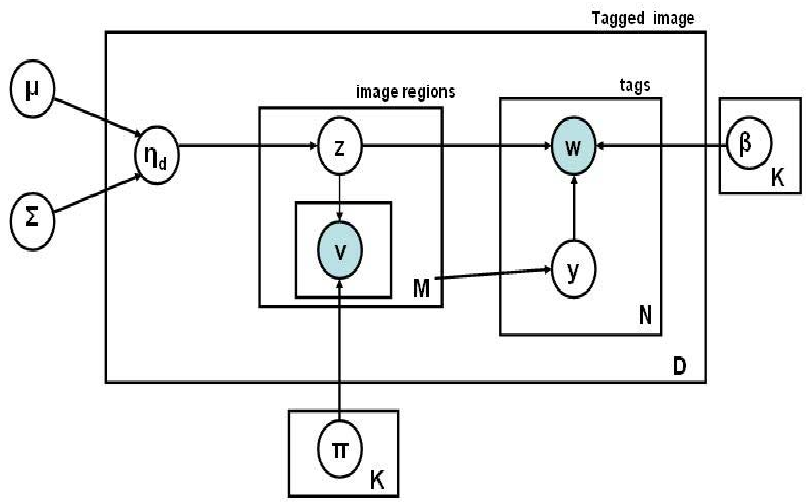
The authors' core contribution is the movement from Independence to Correlation. They leverage the Correlated Topic Model (CTM) intuition and apply it to a multimodal setting (Images + Tags).
1. The Logistic Normal Prior
Unlike the standard Latent Dirichlet Allocation (LDA), which uses a Dirichlet distribution that forces topics to be nearly independent, this model uses a Logistic Normal distribution. This allows the model to learn a covariance matrix where a high value between Topic and Topic indicates they belong to the same subgroup.
2. The Architecture
The model treats an image as a "bag-of-visual-words" (extracted via Harris-Laplace and SIFT) and captions as a "bag-of-words." It creates a joint latent space where tags are generated based on the topics present in the images.
Experiments: Measuring "Goodness of Fit"
The authors tested their approach on five distinct datasets, ranging from "Monuments" to "Gardens."
Qualitative Success
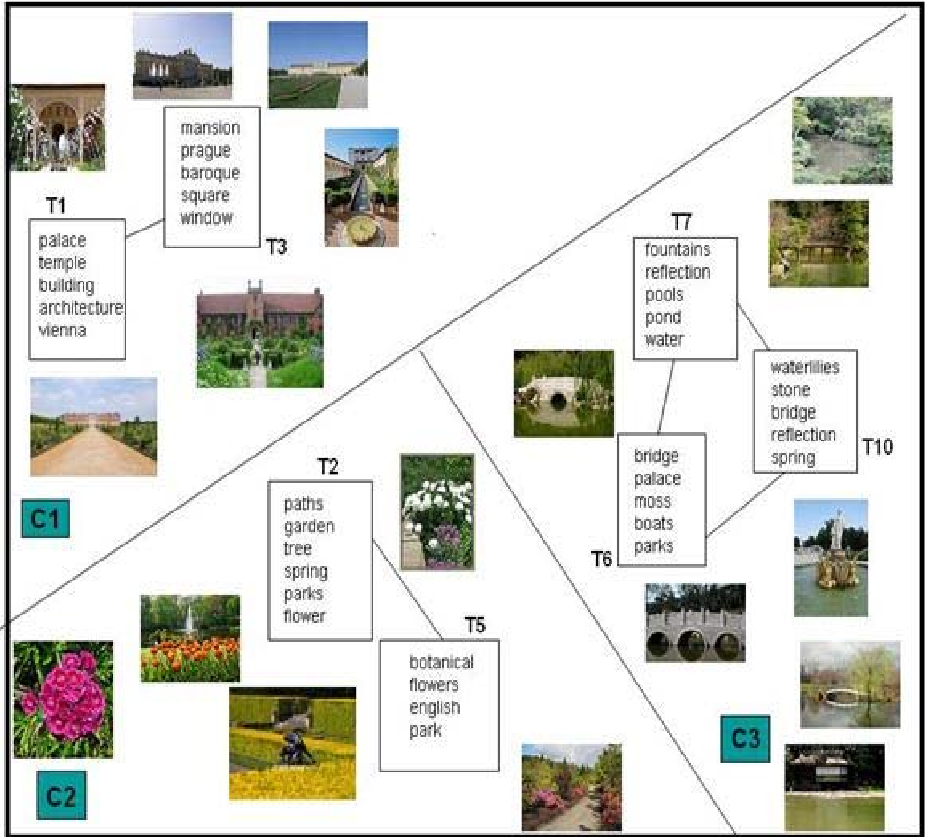
In the "Aviation" dataset, the model didn't just find topics; it grouped them into "Themes":
- Theme 1 (Commercial): Topics featuring tags like "boeing," "airbus," and "landing."
- Theme 2 (Military): Topics featuring "f16," "f18," and "fighter."
This clustering was achieved by setting a threshold on the learned covariance matrix, effectively "linking" correlated topics into a graph structure.
Quantitative Edge
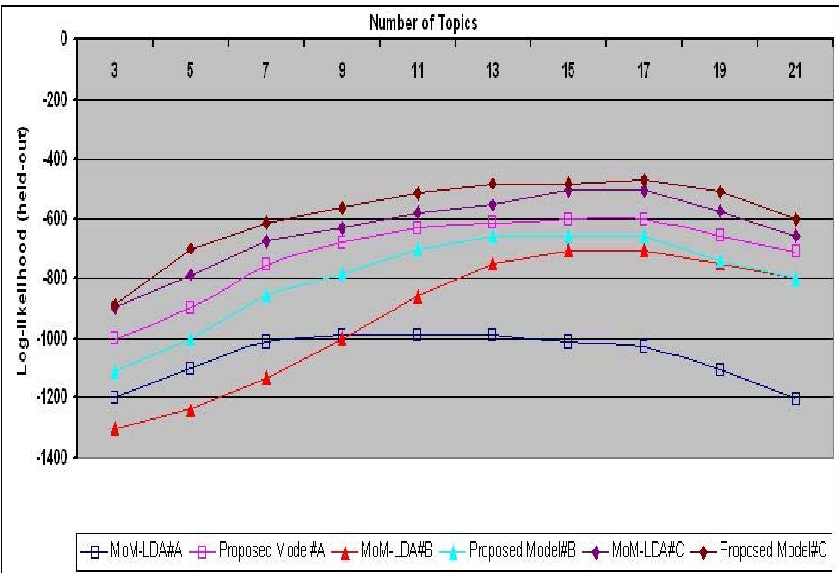
To prove the model wasn't just hallucinating clusters, the authors used Perplexity Analysis (held-out log-likelihood). A higher log-likelihood means the model is better at predicting the data it hasn't seen yet. Across all datasets, the "Proposed Model" (bottom curves in some graphs, top in others depending on axis scaling/negative parity) showed a marked improvement over the baseline MoM-LDA.
Critical Insight & Future Outlook
The beauty of this work lies in its unsupervised nature. It doesn't require humans to label "this is a military plane"; it learns the association purely from the co-occurrence of visual patterns (Skins/Wings) and keywords.
Limitations: The model is parametric, meaning you have to tell it how many topics () to look for in advance. If you choose a that is too small, you merge distinct themes; too large, and you splinter them. The authors suggest that moving toward Non-parametric Bayesian models (like Hierarchical Dirichlet Processes) would be the logical next step to allow the model to learn the number of subgroups organically from the data.
Summary Takeaway
By moving beyond the "independence assumption" of traditional topic models, this research provides a blueprint for how information management systems can automatically clean, categorize, and navigate the "Wild West" of user-contributed social media.