
Beyond Keywords: Decoding Human Intuition in Automated Job Recruitment
4620_Finding the Best Job Applicants for a Job Posting A Comparison of Human Resources Search Strategies.
This paper presents a comparative study of three algorithmic approaches—Crowdsourcing/Gamification, Information Retrieval (IR), and Text Mining—for ranking job applicants. The study evaluates these methods against a baseline of human HR experts across technical and non-technical job categories, achieving significant alignment with expert decisions through human-in-the-loop gamification.
TL;DR
Recruitment is as much an art as it is a science. This paper explores how to automate the "art" by comparing traditional keyword matching (IR) against gamified crowdsourcing and feature-weighted text mining. The verdict? Gamified human intuition still beats pure algorithms, especially for technical roles, but structured text mining is closing the gap by modeling expert weights.
Background Positioning
In the landscape of HR Tech, we have moved from physical paper stacks to "Black Box" applicant tracking systems (ATS). This paper acts as a bridge, attempting to quantify and replicate the subjective decision-making of HR experts through empirical analysis.
The Core Conflict: Why Software Struggles to Hire
Current Information Retrieval (IR) techniques in recruitment suffer from two main flaws:
- Semantic Gaps: They often miss synonyms or fail to understand the prestige of certain institutions unless explicitly programmed.
- Lack of "Soft" Logic: A human expert knows that "leading a team" at a startup is different from "leading a team" at a multinational corp; a standard IR system sees them as identical tokens.
The authors' insight was to test if non-experts (the crowd), when properly incentivized via a game, could mimic the high-level intuition of HR veterans.
Methodology: Three Paths to a Match
The study utilized actual job postings and resumes (anonymized) and tested three distinct pipelines:
1. The "Crowd & Game" Approach
Using Amazon Mechanical Turk, the authors created a gamified interface. Workers weren't just "rating"—they were competing for bonuses based on how well they aligned with expert rankings.
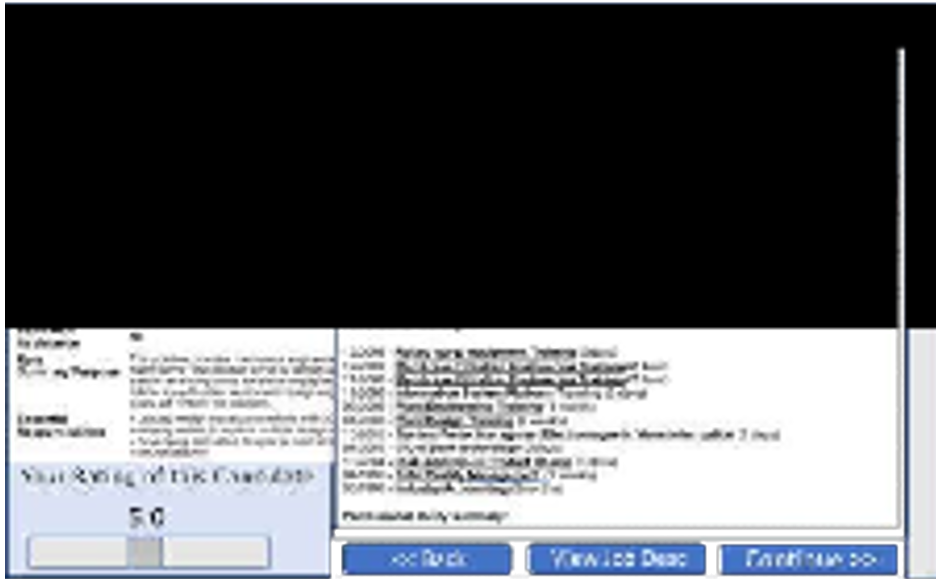 The interface allows non-experts to quickly digest job descriptions and candidate profiles side-by-side.
2. Standard Information Retrieval (IR)
Using the Indri search engine, this method performed baseline keyword and semantic matching. It represents the "standard" ATS approach.
3. Feature-Rich Text Mining
This was the "smart" algorithm. It didn't just look for words; it extracted specific features like:
- Academic Tier: Is the university top-tier or average?
- Job Stability: Average months spent in previous roles.
- Objective Alignment: Does the candidate's career goal match the job?
Experiments & Results: The "Expert" Benchmarking
The authors used Rank-Biased Overlap (RBO)—a metric that weights the top of a list more heavily than the bottom—to measure how closely each method matched three HR experts.
| Job Category | Crowd & Game (RBO) | IR Baseline (RBO) | Text Mining (RBO) |
|---|---|---|---|
| Technical Roles | 0.589 | 0.264 | 0.428 |
| Non-Technical | 0.515 | 0.324 | 0.512 |
Key Insights from the Data:
- Technical Advantage: Crowdsourcing was significantly better at technical roles. Humans (even non-experts) could better infer technical competence from project descriptions than the Indri engine could with simple keyword stems.
- The Non-Technical Convergence: In non-technical management roles, Text Mining performed almost as well as the Crowd. This suggests that non-technical hiring relies more on structured "proxy" features (like education level and job history) which algorithms can handle well.
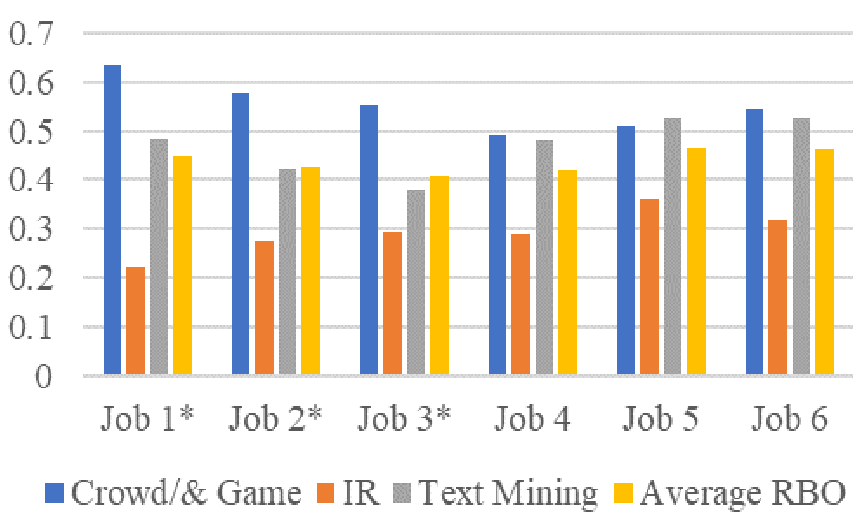 The visual evidence shows that the Crowd and Text Mining consistently outperformed basic IR (Green line).
Critical Analysis & Conclusion
The "Takeaway"
This paper proves that weighting matters. When the Text Mining system was tuned to prioritize "Level of Degree" and "Months in Job" (as experts do), its performance jumped significantly.
Limitations
- Scalability of the Crowd: While effective, paying Turk workers is still an expense, albeit lower than hiring an executive search firm.
- The Overfitting Risk: The authors noted that removing certain "negative" features improved scores on training data but risked over-specializing the model to a small sample size.
Future Outlook
With the advent of LLMs, the "Text Mining" approach described here could be supercharged. By using the feature-weighting logic identified in this paper (e.g., favoring institutional prestige and job stability) within a Generative AI framework, we might finally achieve a fully automated recruiter that "thinks" like a human expert.