
Reveal: Rescuing Hidden Gems from the Noise of Social Networks
Reveal: Fine-grained Recommendations in Online Social Networks
This paper presents Reveal, a fine-grained recommender system designed to recover media content (Music and Movies) shared by friends that is often buried by social network algorithms. By combining fine-grained interest profiling, semantic sentiment analysis, and a weighted similarity formula, the system identifies relevant high-value posts that users would otherwise miss.
TL;DR
Social networks like Facebook often hide interesting content posted by your friends because their algorithms prioritize who you interact with most, rather than what you are actually interested in. Reveal is a fine-grained recommender system that digs through the "noise" to find specific music and movies you'll love, even if they come from "weak ties." By profiling users at a sub-genre level and using sentiment analysis, it found nearly double the relevant content compared to the standard Facebook News Feed.
Background: The Hidden Value in Weak Ties
We have all experienced it: scrolling through a feed and seeing the same three friends' updates while missing a great song recommendation from an old classmate. This is the Algorithmic Filtering Problem. Facebook's News Feed is optimized for engagement and relationship strength. However, research suggests that some of our most valuable information and content come from "weak ties" — people we don't talk to daily but who share our niche interests.
The authors of Reveal argue that the problem isn't a lack of content, but a lack of fine-grained granularity in current recommendation engines.
Methodology: How Reveal Works
Reveal doesn't just look at what you "liked"; it understands why you liked it through a three-step pipeline.
1. Fine-Grained Bootstrapping
Most systems see a "Like" as a binary signal. Reveal breaks a "Like" down into its constituent genres. If you like Interstellar, Reveal doesn't just tag "Movies"; it tags "Sci-Fi," "Space Travel," and "Christopher Nolan" using a massive knowledge base (originally Freebase).
2. Sentiment Analysis (Filtering the Cynics)
Sharing a link doesn't always mean a recommendation—sometimes people share things to criticize them. Reveal employs a modified SO-CAL (Semantic Orientation CALculator) mechanism. It uses dictionaries and "valence shifters" (like "not", "very", or "hardly") to determine if a friend is actually praising the media they posted.
- Insight: If a post has no text, Reveal assumes positive intent, treating the act of sharing as an implicit "thumbs up."
3. The Similarity Formula: Beyond Jaccard
Instead of a simple overlap, Reveal uses a weighted formula to calculate the Friend Similarity Score (FSS).
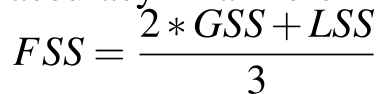 The system gives double weight to genre overlap (GSS) compared to individual item overlap (LSS). This is the secret sauce: you don't need to like the same exact movies as your friend for the system to know you both love Neo-Noir films.
Experimental Results: Better Than the Giant?
The researchers tested Reveal against the actual Facebook News Feed with real users. The results were startling:
- Entity Coverage: The system successfully mapped 89.32% of YouTube links in posts to specific entities.
- Hidden Discovery: In a two-week study, the Facebook News Feed showed 1,680 relevant items. Reveal found an additional 3,127 relevant posts that the users never saw in their main feed.
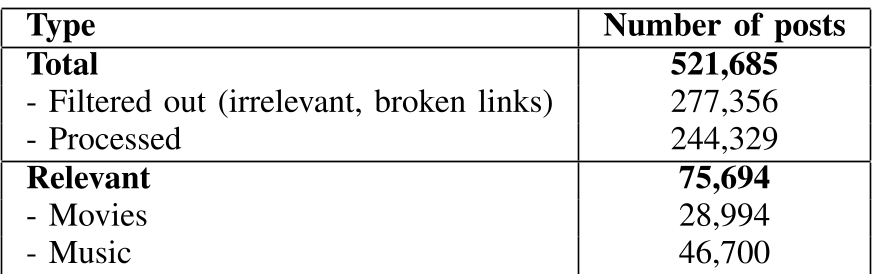 Figure: The process filtered over 521k posts, narrowing down to ~75k high-relevance music and movie recommendations.
Critical Insight & Conclusion
While this paper was published in 2017, its core philosophy is more relevant than ever in the era of TikTok and algorithmic curation. Reveal proves that "Social" and "Interest" graphs should be treated as distinct layers.
The Takeaway: The most effective recommendation systems for the future won't just ask "Who are your friends?" but "Which specific slice of your friend's personality matches yours?"
Limitations: The system relies heavily on public profile data and YouTube links. As social media platforms become more "closed" (private accounts, encrypted messaging), gathering this data via API becomes increasingly difficult for third-party apps, meaning such systems must eventually be integrated natively by the platforms themselves.