
FCBSN: Leveraging Social Network Theory to Outsmart Collusion Attacks
A new fingerprinting scheme using social network analysis for majority attack
The paper introduces FCBSN (Fingerprinting Code Based on Social Networks), a novel hierarchical coding scheme designed to protect multimedia content against collusion attacks, specifically the "majority attack." By integrating Boneh-Shaw (BS) and Tardos codes within a social network framework, it maps social relationships to codeword Hamming distances to maximize traitor-tracing efficiency and accuracy.
TL;DR
The paper "A new fingerprinting scheme using social network analysis for majority attack" proposes FCBSN, a hybrid coding framework. It breaks away from the "one-size-fits-all" approach to digital fingerprinting by assuming that people who steal content together usually know each other. By nesting Boneh-Shaw (BS) and Tardos codes within a social community hierarchy, the authors achieved 100% detection success while significantly reducing the computational "search space" for traitors.
The "Looming Massive Code" Problem
In digital rights management (DRM), a fingerprinted copy is unique to a user. However, a collusion attack (like the majority attack) allows a group of users to pool their copies and create a "clean" version.
The academic challenge has always been a trade-off:
- Boneh-Shaw (BS) Codes: Reliable but suffer from an "abrupt increase" in length as the user base grows.
- Tardos Codes: Shorter but require an search operation, making them slow for massive datasets.
The authors' core insight: Traitors are not random. They exist in specific "multimedia social networks" (friends, chat groups, etc.). If we can mirror the social structure in the code structure, we can trace them faster.
Methodology: The Hierarchical Approach
FCBSN works in four distinct stages that blend Social Network Analysis (SNA) with Information Theory.
1. Hierarchical Community Detection
The system treats the user base as a graph . It uses modularity measures to detect communities. Within these communities, social interactions are dense; between them, they are sparse.
2. Concatenated Coding (BS + Tardos)
The fingerprint is not one long string but a concatenation:
- Outer Code (BS): Encodes the community ID. Since communities are fewer than users, this stays efficient.
- Inner Code (Tardos): Encodes the users within that specific community.
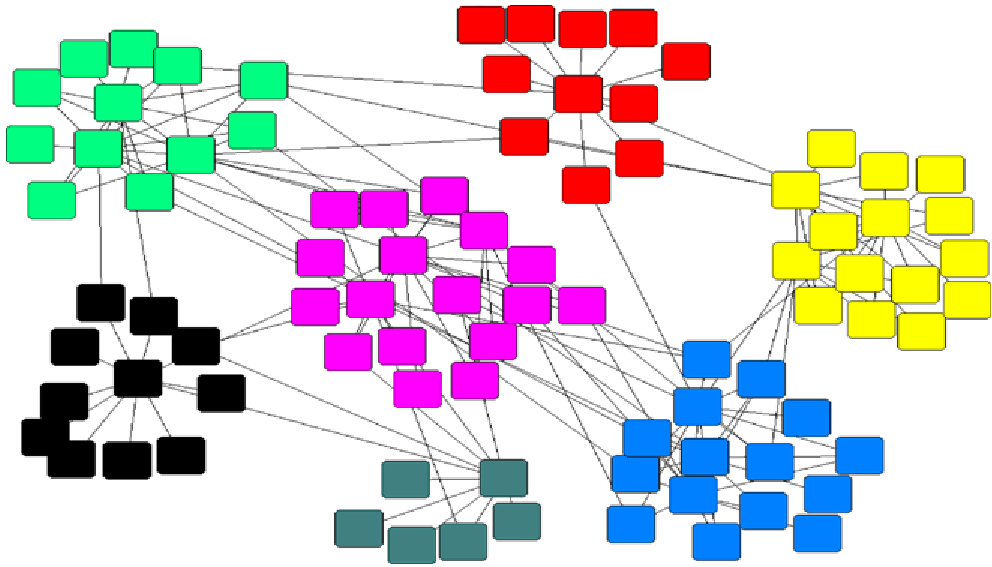
3. Leadership & Similarity Mapping
This is the most innovative part: the authors designate "Community Leaders"—nodes with high "betweenness centrality." They then map social similarity (how many common neighbors two users have) to the Hamming distance of their fingerprints.
- Insight: If two users are socially close, their fingerprints are mathematically close. Under the Marking Assumption, this makes it significantly harder for them to hide their tracks when they collude.
Performance: Speed Meets Accuracy
The experiments compared FCBSN against standard BS and Tardos benchmarks using a population of 1024 users and a code length of 10,000.
Traitor Tracing Efficiency
The FCBSN detector can isolate a pirate by first identifying the community and then focusing its search. This reduces the complexity from a global search to a local one.
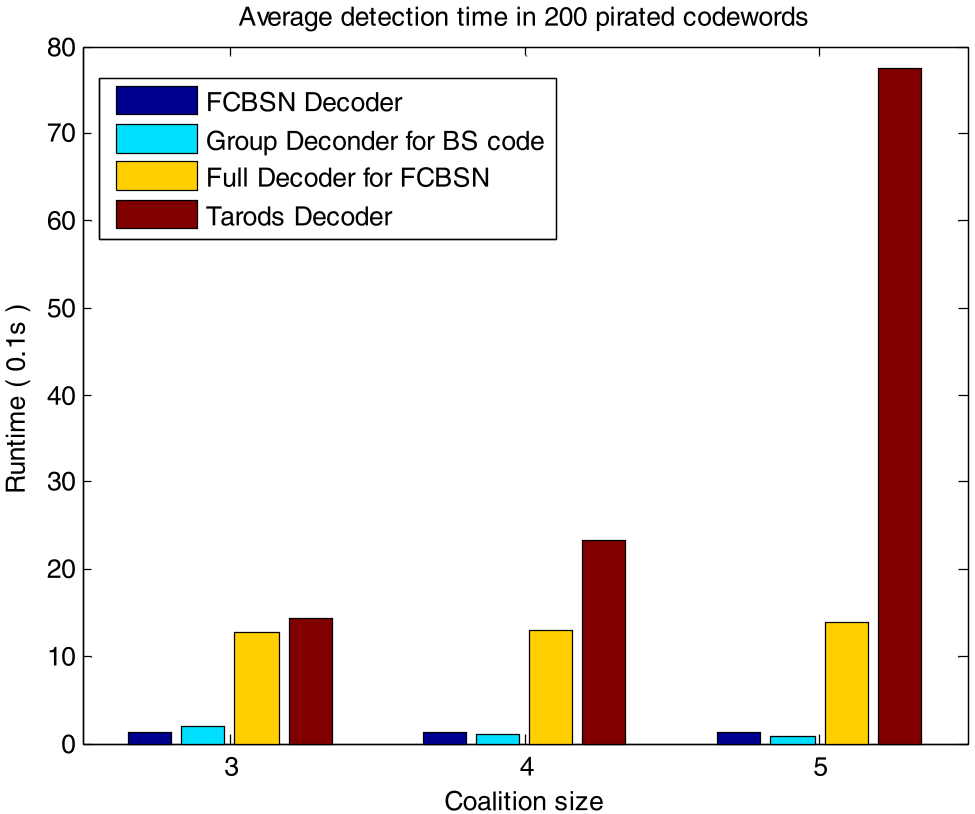
As seen in the results, FCBSN's execution time is orders of magnitude lower than the Tardos detector. While it matches the speed of the BS Group decoder, it excels where BS fails: Success Probability.
Success Rates
Against a majority attack with coalition sizes of 3 to 5:
- FCBSN: 100% Success ().
- BS Group Decoder: Suffered failure rates up to 14% when colluders were scattered across groups.
Critical Insight & Conclusion
The genius of FCBSN lies in its Inductive Bias. By assuming that "criminal units" in digital piracy follow the laws of social networks, the authors transformed a high-dimensional search problem into a structured hierarchical filtering task.
Limitations: The scheme relies on the accurately detected social network. If a network is highly dynamic (users constantly jumping between communities), the "map" might become stale. Future work should look into adapting these codes to "temporal" or "evolving" graphs.
Takeaway: FCBSN proves that the best way to secure a system is to understand the human behavior behind the attack.