
GoldAI Sachs: Bridging Biology and Fintech via Random Neural Networks and Genetic Evolution
Fintech Bitcoin Smart Investment Based on the Random Neural Network with a Genetic Algorithm
This paper introduces a novel Genetic Learning algorithm integrated within a Deep Learning Cluster structure based on the Random Neural Network (RNN). The methodology emulates biological genome transmission to optimize "GoldAI Sachs," a fintech multi-agent system for Bitcoin and cryptocurrency investment.
TL;DR
Researchers at Imperial College London have developed a multi-layered AI architecture that treats financial investment like biological evolution. By combining Reinforcement Learning, Deep Learning Clusters, and a novel Genetic Algorithm based on the Random Neural Network (RNN), the system—dubbed "GoldAI Sachs"—can learn, remember, and pass down investment "wisdom" to future generations of trading agents.
Positioning: This work moves beyond simple SOTA-chasing by introducing a biological framework for immortality in AI, where the weights of a model are treated as genetic material to be inherited.
Problem & Motivation: The Static Nature of Financial AI
The volatile nature of cryptocurrencies like Bitcoin and Ethereum poses a significant challenge for traditional machine learning. Most models are "born" (initialized), "live" (train), and "die" (become obsolete) without a mechanism to pass on learned strategic intuition effectively.
The author argues that biology evolves faster because organisms don't just pass on raw data; they pass on functional structures. Current Genetic Algorithms (GAs) often fluctuate too wildly. There was a need for a model that provides:
- Fast local reaction (Reflexes)
- Long-term identity (Memory)
- Global strategy (Management)
- Evolutionary continuity (Genetics)
Methodology: The Bio-Mimetic Architecture
The core of this paper is the hierarchical simulation of a human brain integrated with a genome.
1. The Random Neural Network (RNN) Foundation
Unlike typical ANN signals, the RNN uses "spikes" or impulses, mimicking biological neurons more closely. It utilizes "positive" and "negative" signals to achieve a unique steady-state solution.
2. The Genetic Autoencoder (C, G, A, T)
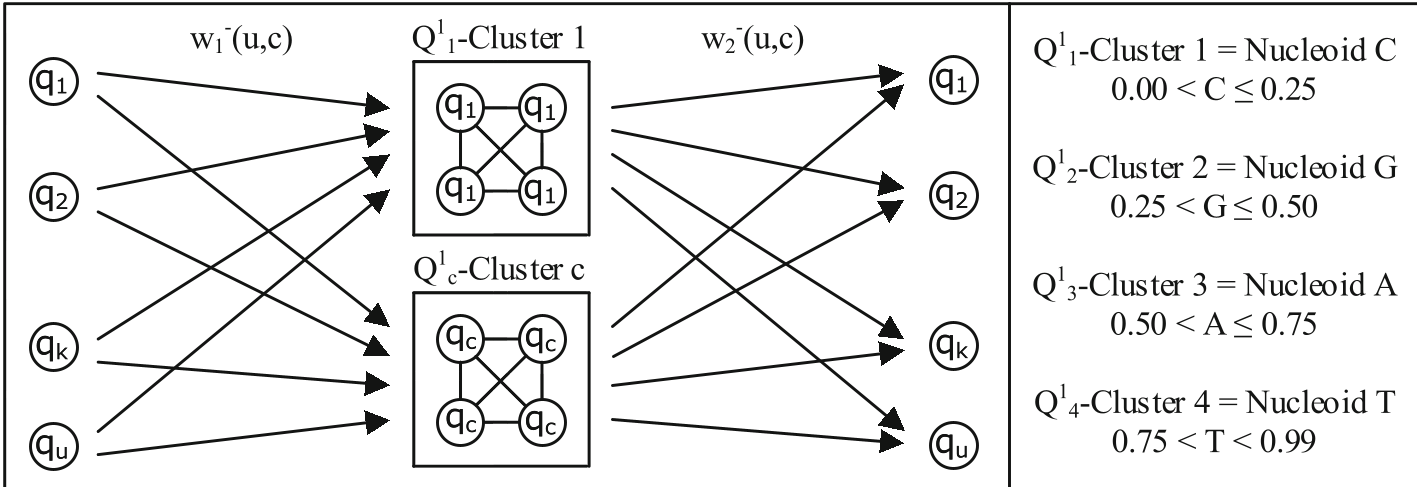
The most innovative feature is the Genetic Learning Algorithm. The author maps the four nucleoids of DNA—Cytosine (C), Guanine (G), Adenine (A), and Thymine (T)—onto a 4-neuron cluster.
- Network 1 (Encoder): Codes the "organism" (investment data) into these four nucleoids.
- Network 2 (Decoder): Uses the Moore-Penrose pseudoinverse to calculate weights such that the decoded state matches the original.
3. The "GoldAI Sachs" Hierarchy
- Asset Bankers: Use Reinforcement Learning to decide "Buy" or "Sell" based on immediate reward (profit).
- Market Bankers: Manage clusters of Asset Bankers, filtering for the best-performing assets.
- CEO Banker ("AI Morgan"): Takes final strategic decisions based on risk/reward ratios.
- Genetic Layer: When the CEO "retires," its knowledge is encoded via weights and transmitted to the next generation of bankers.
Experiments & Results: Winning the Crypto Game
The model was tested against seven assets (including Bitcoin, Ethereum, and Ripple) over 663 days.
Performance Gains
The results demonstrate that "collaboration" through the Management Clusters significantly boosts performance in diverse markets. In the Currency Market, the Market Banker improved profits by 154.09% compared to independent asset bankers.

Genetic Fidelity
The Genetic Algorithm achieved an error rate of 6.76E-31, effectively creating a mathematically perfect "clone" of the learned weights for the next generation. This ensures that the "wisdom" of the CEO Banker is never lost, only refined.
Critical Analysis & Conclusion
Takeaway
The paper successfully demonstrates that Random Neural Networks are uniquely suited for bio-mimetic structures. By treating network weights as genetic code transmitted via a four-nucleoid bottleneck, AI can achieve a form of "cultural transmission" that mimics biological evolution.
Limitations
- Limited Asset Diversity: While successful in crypto, the risk profiles of traditional equities might require more complex reward functions ().
- Optimization: The author notes that while profits are positive, they are not yet "optimum," suggesting a need for more granular Reinforcement Learning tuning (the parameter).
Future Work
The next frontier for this research involves analyzing the "relevance of memory"—determining exactly how much historical data an AI should "remember" before it becomes a hindrance to adapting to new market regimes.