
First Impression: When AI Decodes Personality through the Lens of Beijing Opera
First Impression: AI Understands Personality
The paper presents "First Impression," an interactive AI art system that bridges facial analysis with traditional Chinese culture. By detecting facial features and mapping them to personality traits, the system identifies the most representative Beijing Opera facial makeup (Lianpu) for a user and visualizes the transition through isomorphic triangulation morphing.
TL;DR
"First Impression" is an interactive AI system that translates human facial features into the symbolic language of Beijing Opera. By analyzing 68 facial landmarks and mapping them to a curated semantic dataset of personality traits, the AI identifies your "inner character" and visualizes it by morphing your face into a traditional Beijing Opera facial makeup (Lianpu).
Background: The Art of Symbolic Identity
Physiognomy—the idea that character is reflected in physical appearance—is a concept deeply rooted in both Eastern and Western cultures. In Chinese culture, Beijing Opera facial makeups (Lianpu) represent the pinnacle of this concept, using specific colors and patterns to symbolize traits like loyalty (red), bravery (black), or cunning (white). This paper, presented at ACM Multimedia (MM '20), positions AI as a bridge between modern facial recognition and these ancient symbolic traditions.
The Challenge: Mapping Realism to Symbolism
The primary difficulty in this task is the interpretative gap. How do you move from a digital landmark (a coordinate on a nose) to a personality trait (decisiveness), and finally to a specific artistic pattern? Existing computer vision models are excellent at "what" a face looks like, but not "who" that person represents in a cultural context.
Methodology: The Semantic Bridge
The authors developed a sophisticated three-step pipeline to solve this mapping:
1. Dual-Dataset Construction
The foundation consists of two critical datasets:
- Beijing Opera Makeup Dataset: 100 makeups for 81 characters, tagged with personality keywords (e.g., Cao Cao as "resourceful" and "suspicious").
- Facial Feature Semantic Dataset: Categorizes eyebrows, eyes, noses, and mouths into semantic types (e.g., "eight-character eyebrows") associated with specific psychological profiles.
2. Semantic Tree Matching
Using WordNet, the system builds a semantic tree for the user based on detected features. It then calculates the distance between the user's "personality tree" and the character trees in the database to find the best match.
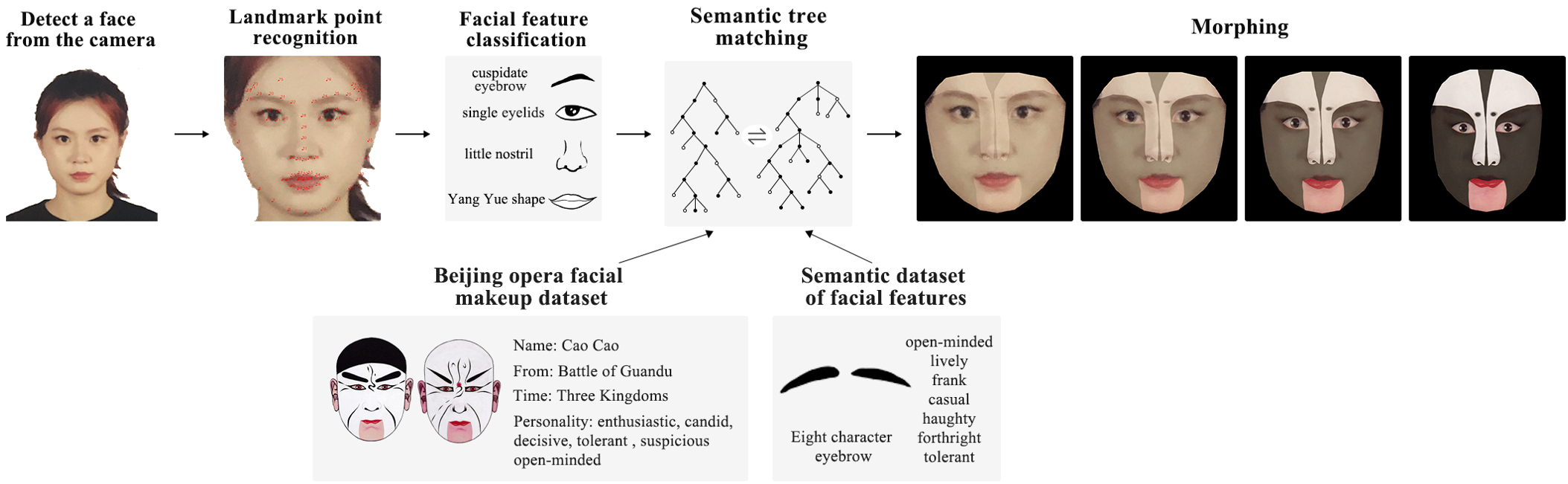 Figure 1: The First Impression system flowchart, from landmark detection to semantic matching.
3. Cross-Domain Morphing
Perhaps the most technically impressive visual feat is the morphing. Transitioning from a natural, textured human face to a high-contrast, geometric Beijing Opera mask requires isomorphic triangulation. This ensures that the transition is seamless even though the source and target images belong to different domains (natural vs. abstract).
Experiments & Results: Finding Your "Character"
The system was tested on various personas, demonstrating high cultural accuracy. For instance, a user with steady, upright features might be matched to Pang De, a character known for being brave and confident.
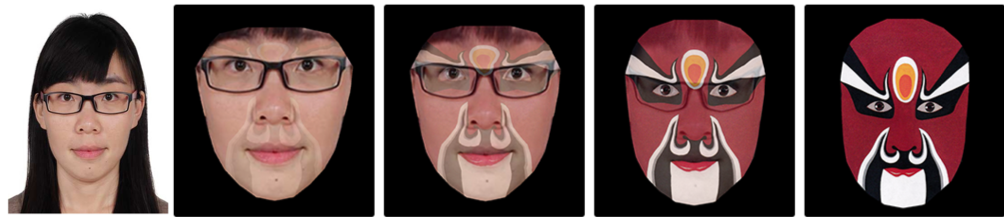 Figure 2: Examples of real-time matching, showing the diversity of characters like Cao Cao or Pang De.
Key Takeaways from Results:
- Feature-to-Trait Correlation: The system successfully bridges the gap between 68-landmark FACS (Facial Action Coding System) and qualitative personality labels.
- Aesthetic Engagement: The morphing process serves as a vital "black box" opener, allowing the user to viscerally feel the AI's "understanding" of their persona.
Critical Analysis & Conclusion
"First Impression" is more than a technical demo; it is a successful experiment in Human-Centered Computing. Its strength lies in its modularity—the matching algorithm could easily be adapted for personalized 3D avatars in gaming or social VR.
Limitations: As an interactive art piece, the system relies on predefined personality-to-feature mappings which are subjective. Additionally, the library of 81 characters, while extensive for a demo, only scratches the surface of the thousands of variations in Beijing Opera.
Future Outlook: With the rise of Diffusion Models and Large Language Models (LLMs), the "Semantic Tree Matching" could soon be replaced by multimodal embeddings, allowing for even more nuanced and generative character creation that respects cultural heritage while providing modern utility.