
EMJ: Reimagining Scientific Peer Review through Crowdsourcing and Possibility Theory
First Steps Towards an Electronic Meta-journal Platform Based on Crowdsourcing
The paper proposes an Electronic Meta-Journal (EMJ) platform that leverages crowdsourcing to automate scientific peer review. It introduces a decentralized architecture where reviewers self-select papers and utilizes Possibility Theory-based aggregation methods to determine final editorial decisions.
TL;DR
The traditional "editor-as-gatekeeper" model of scientific publishing is slow and prone to bias. This paper introduces the Electronic Meta-Journal (EMJ), a platform that replaces manual assignments with a crowdsourced model. By using Possibility Theory and T-norm aggregation, the system fuses multiple anonymous reviews into a single, high-credibility decision while accounting for reviewer expertise and self-reported uncertainty.
Background & Motivation: The Bottleneck of Science
Current peer-review processes are plagued by several inefficiencies:
- Editor Overload: A small number of people must find and manage a large pool of reviewers.
- Subjectivity: Decisions are often influenced by the author's affiliation or the editor's personal network.
- Binary Reliability: Standard systems treat all "Accepted" or "Rejected" votes as equal, ignoring that some reviewers are more expert than others.
The authors argue that by treating reviewing as a Human Intelligent Task (HIT) within a crowdsourcing framework, we can achieve more objective, triple-blind results.
Methodology: The Core Architecture
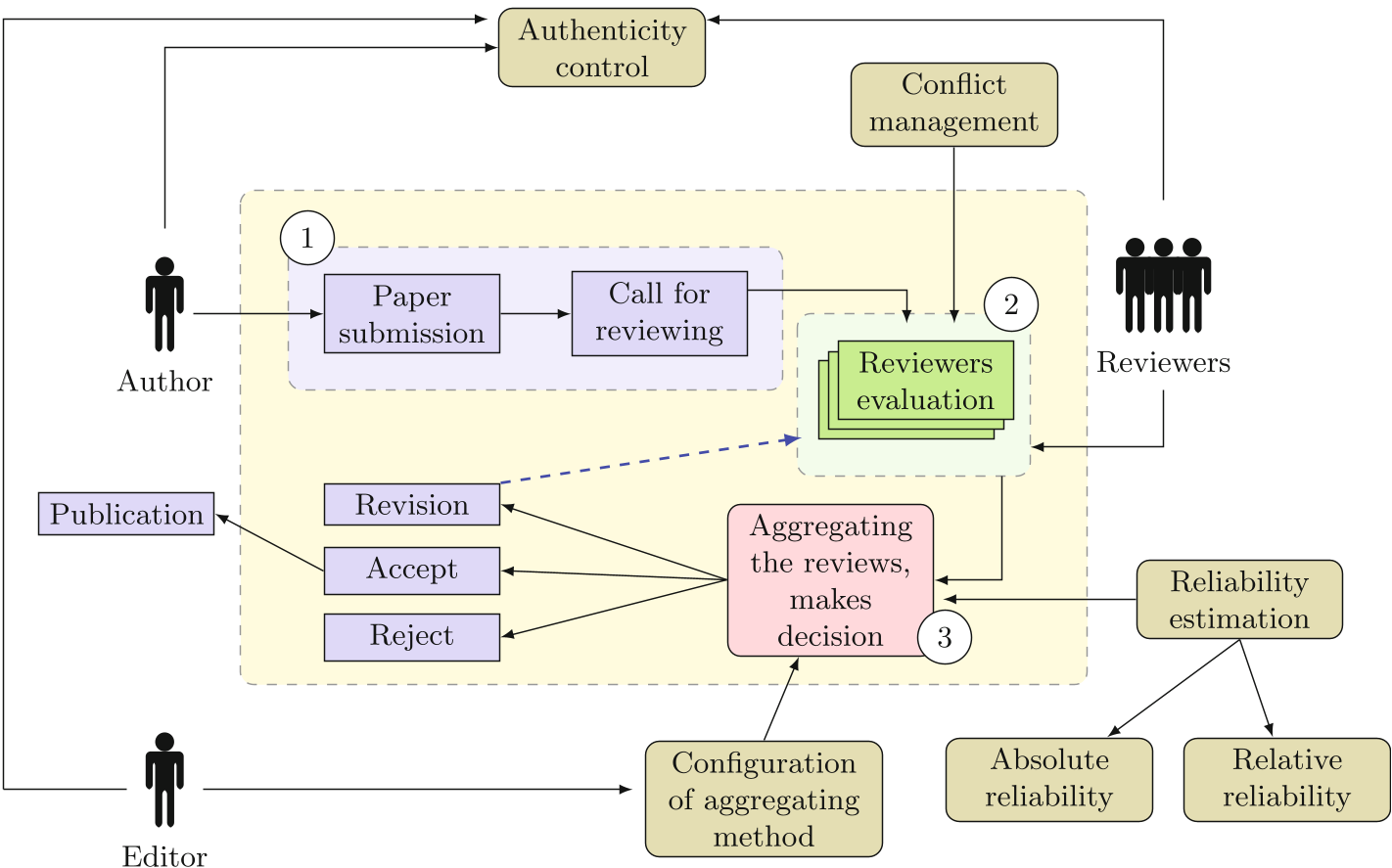
The EMJ system shifts the responsibility of paper selection from the editor to the "crowd" of qualified scientists. The core technical contribution lies in how these diverse, sometimes conflicting reviews are aggregated.
1. The Multi-Actor Workflow
The architecture involves a transition from submission to an automated aggregation phase:
2. Information Fusion via Possibility Theory
Unlike probability, which measures frequency, Possibility Theory (introduced by Zadeh) is better suited for modeling "partial ignorance." Each reviewer provides:
- A Decision (Accept, Minor Revision, etc.).
- A Certainty Degree (How sure are they?).
- A Reliability Measure (Based on h-index and university ranking).
3. Aggregation Methods
The paper compares several mathematical approaches to "fusing" these data points:
- Confidence Weighted Voting (CW): Perhaps the most balanced method, it weighs votes by the reviewer's reliability while filtering out uncertain responses using a tolerance margin .
- Score-Based (T-norms): Uses algebraic products or Lukasiewicz logic to find the "intersection" of reliability and certainty.
Experimental Analysis & Results
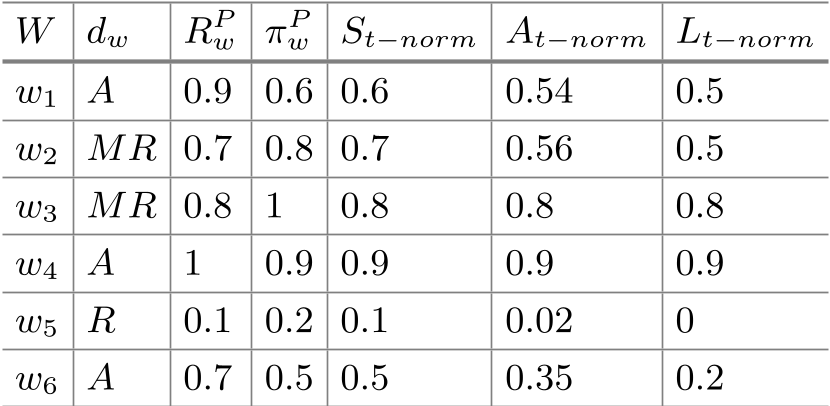
The authors illustrate their methods using a sample dataset of 6 workers with varying reliability and certainty scores.
Comparison of Results:
The findings suggest:
- Majority Voting is too naive; it ignores the quality of the reviewer.
- Confident-Only Voting is better but ignores the "expert vs. novice" dynamic.
- T-norm (Score-Based) methods are mathematically elegant but can be sensitive to a single high-scoring individual, potentially losing the "wisdom of the crowd."
Critical Insight & Future Outlook
The most striking takeaway is the authors' vision of a "Meta-Journal." Instead of submitting to a specific journal, authors submit to a category. This eliminates the "Out-of-Scope" rejection loop that delays scientific progress.
Limitations & Challenges:
- Motivation: Why would busy scientists review for a crowd-platform? The authors suggest "non-monetary remuneration" like journal subscriptions.
- Sybil Attacks: The system needs a robust "Authority Control" to prevent users from creating multiple accounts to "bomb" a paper with positive or negative reviews.
Conclusion
The EMJ platform represents a significant step toward "Science 2.0." By applying rigorous mathematical fusion (T-norms) to the social problem of peer review, the authors provide a blueprint for a more scalable, objective, and transparent scientific ecosystem.
Takeaway for the Industry: As academic publishing moves toward Open Science, the integration of bibliometric-weighted aggregation will be crucial to maintaining quality in a decentralized world.