
FM-DS-V4: Breaking the Linear Memory Wall with Lookahead Sparse Attention
FlashMemory-DeepSeek-V4: Lightning Index Ultra-Long Context via Lookahead Sparse Attention
The paper introduces FlashMemory-DeepSeek-V4 (FM-DS-V4), which utilizes a novel Lookahead Sparse Attention (LSA) paradigm to handle ultra-long contexts. By integrating a Neural Memory Indexer that proactively fetches only query-critical KV chunks from CPU to GPU, it reduces the KV cache footprint to 13.5% of the full-context baseline while achieving a +0.6% average accuracy gain on LongBench-v2 and RULER.
TL;DR
FlashMemory-DeepSeek-V4 (FM-DS-V4) introduces a paradigm shift in long-context serving. By treating historical context as a retrieval problem rather than a storage problem, it reduces GPU memory usage for KV caches by up to 90% at 500K tokens, while actually improving accuracy by filtering out irrelevant attention noise.
The Problem: The Prohibitive "Memory Tax"
In the race for "million-token" context windows, the primary enemy is not just compute (FLOPs), but GPU Memory (VRAM). Conventional LLMs are "passive": they keep every historical token's Key-Value (KV) pair in precious GPU memory, even if the current generation step doesn't need them.
The authors observed a striking inefficiency: over 90% of long-context queries can be solved using just the most recent 8K tokens. However, simply "dropping" the rest (sliding window) breaks the model's ability to perform global reasoning. The challenge is: How do we support global reasoning without paying the full VRAM tax?
Methodology: Lookahead Sparse Attention (LSA)
The core innovation is Lookahead Sparse Attention (LSA) powered by a Neural Memory Indexer.
1. The "Predictive" Fetching Mechanism
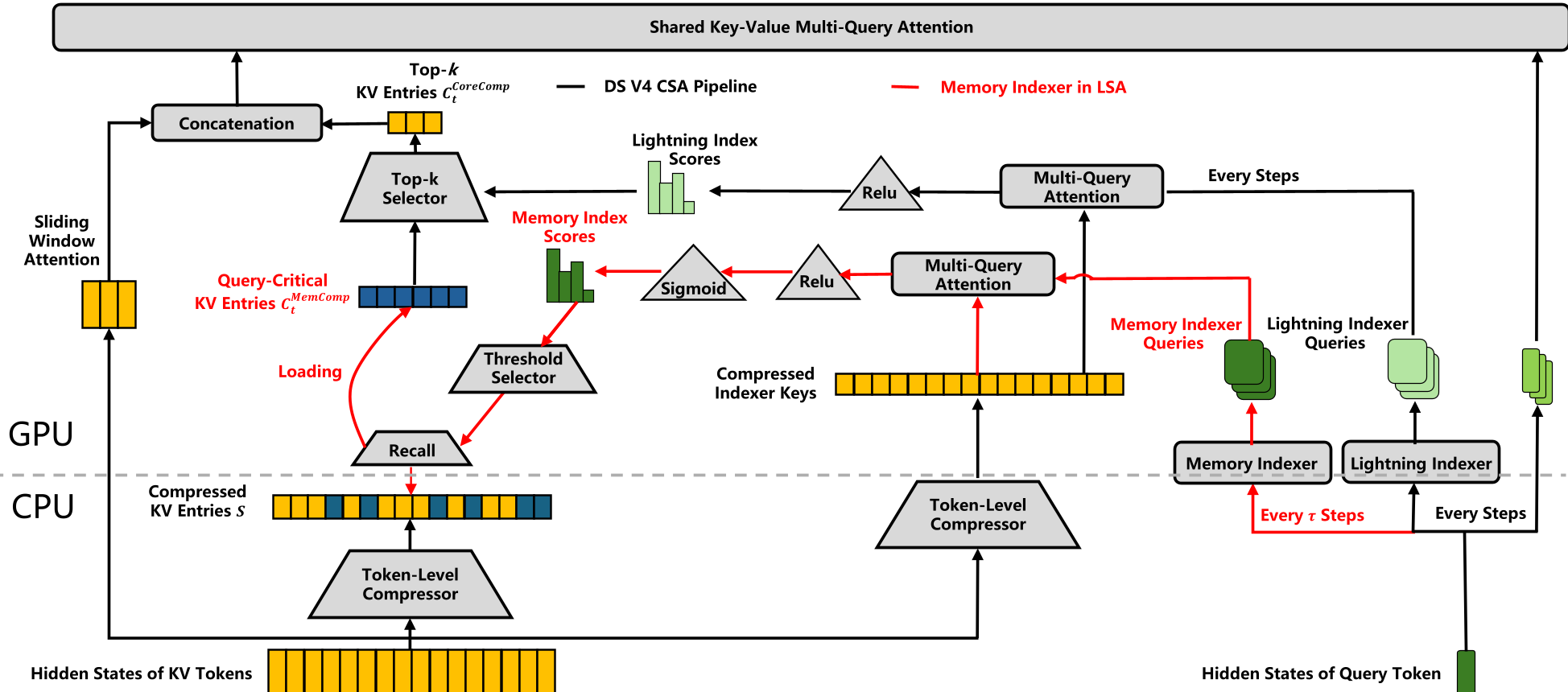
Instead of attending to everything, the model predicts the future. Every steps, a lightweight indexer evaluates the current hidden state and determines which historical KV chunks will be "critical" for the upcoming window. These chunks are then fetched from the "CPU Cold Pool" to the "GPU HBM" just in time.
2. Backbone-Free Decoupled Training
A brilliant engineering feat of this paper is the training strategy. Traditionally, modifying attention requires fine-tuning the whole massive model. The authors decoupled the indexer as a standalone Dual-Encoder.
- Frozen Backbone: The historical KV representations () are frozen.
- Retrieval Learning: The indexer is trained purely as a retrieval model using Binary Cross-Entropy and Focal Loss.
- Efficiency: Training converges in just one H20 GPU hour because the model never needs to load the parameter backbone.
3. Golden Label Filtering
To train the indexer, the authors developed a Cross-Layer Majority Voting pipeline. They extract attention logits from 21 layers of the original DeepSeek-V4 and only label a chunk as "golden" if at least 3 layers agree on its importance. This denoises the training data, moving away from rigid Top-k selection.
Experimental Breakthroughs
The results on LongBench-v2 and RULER benchmarks show that "Less is More."

- Memory Efficiency: The average KV cache footprint was compressed to 13.5% of the baseline. At 500K tokens, the overhead was reduced by over 90%.
- Accuracy Boost: Surprisingly, FM-DS-V4 achieved +0.6% to +1.9% accuracy improvements. By proactively fetching only critical chunks, the LSA acts as an attention denoiser, preventing the model from getting "distracted" by the irrelevant parts of a massive context.
Critical Insight: The Limitations
Despite the success, the paper candidly identifies three "Hard Walls":
- Dense Memory Failure: On the MRCR benchmark (which requires dense, global semantic access), the model's accuracy dropped significantly. The lightweight dual-encoder lacks the "bandwidth" to handle tasks that require 100% context recall.
- Length Generalization Ceiling: The indexer can only generalize to roughly 2x the context length it was trained on (e.g., training on 128K and inferring on 512K works, but 1M fails). This is likely due to out-of-distribution positional embeddings.
- Context-Independent Leakage: Even when the query doesn't need context, the Sigmoid gate still "leaks" some false positives, meaning the memory usage isn't perfectly constant.
Conclusion & Future Impact
FM-DS-V4 proves that we don't need "infinite" GPU memory for "infinite" context; we need smarter retrieval.
The "Backbone-Free" training approach offers a blueprint for researchers to optimize trillion-parameter models on a shoestring budget. While the project is currently suspended due to organizational changes, the Lookahead Sparse Attention paradigm is likely to become a standard tool in the long-context serving stack (alongside systems like vLLM and sglang).
Disclaimer: This tech report represents preliminary checkpoints. The project lead is currently seeking collaboration for future scaling tests.