
PSL: A Unified Framework for Modeling the Nuances of Social Trust
A Flexible Framework for Probabilistic Models of Social Trust
The paper introduces a flexible probabilistic framework for social trust prediction using Probabilistic Soft Logic (PSL). It defines and evaluates two major sociological theories—Structural Balance and Social Status—as relational models to predict weighted trust ties in social networks, achieving superior performance over traditional graph-based methods like EigenTrust and TidalTrust.
TL;DR
Social trust is rarely binary; it exists in degrees and follows complex sociological patterns. This paper presents a framework using Probabilistic Soft Logic (PSL) to model trust through competing theories: Structural Balance (the "friend of my friend is my friend" logic) and Social Status (a hierarchical ranking logic). By treating trust as a continuous truth value rather than a hard edge, PSL enables more accurate, collective inference that outperforms classic algorithms like EigenTrust and TidalTrust, especially in sparse networks.
The Problem: Why Hard-Coded Trust Models Fail
Most computational models for trust are rigid. They are built around a single intuition—for instance, that trust is transitive. However, sociological research suggests multiple competing mechanics:
- Structural Balance: Focuses on stability in triads (triangles). If A trusts B and B trusts C, A should trust C to maintain a balanced social clique.
- Social Status: Views trust as an expression of prestige. If A trusts B, it implies B has higher status. Here, trust doesn't necessarily reciprocate; in fact, it often flows one way up a hierarchy.
Existing tools often require entirely new algorithms to test these different theories. Furthermore, when social data is sparse (missing many links), local propagation methods like TidalTrust fail because they cannot find paths, and spectral methods like EigenTrust lose their signal.
Methodology: The Power of "Soft" Logic
The authors solve this by using Probabilistic Soft Logic (PSL). PSL is a domain-specific language that looks like First-Order Logic but operates on continuous values in the range.
1. Representing Theories as Rules
Instead of coding a graph traversal, the researcher simply writes rules. For example, a transitivity rule in PSL looks like this: In PSL, this isn't just "true" or "false." If A trusts B at and B trusts C at , PSL calculates how much the "trust" in should be to satisfy the rule, treating it as a distance-to-satisfaction problem.
2. Contrasting Architectures
The authors implemented both the Balance Model (emphasizing reciprocation and triadic closure) and the Status Model (emphasizing hierarchy).
 Above: (a) Stable structures in Structural Balance vs. (b) The flow of trust in a Status-based hierarchy.
Experiments and Results
The framework was tested on two real-world datasets: FilmTrust (continuous 1-10 ratings) and Epinions (binary trust/distrust).
Superiority in Sparse Networks
The results (Table 1 and 2 in the paper) show that PSL models (specifically PSL-Balance-Recip) consistently outperform baselines.
| Method | MAE (FilmTrust) | AUC (Epinions) |
|---|---|---|
| EigenTrust | 0.339 | 0.131 |
| TidalTrust | 0.229 | 0.129 |
| PSL-Balance-Recip | 0.207 | 0.343 |
Note: Lower MAE is better; higher AUC is better.
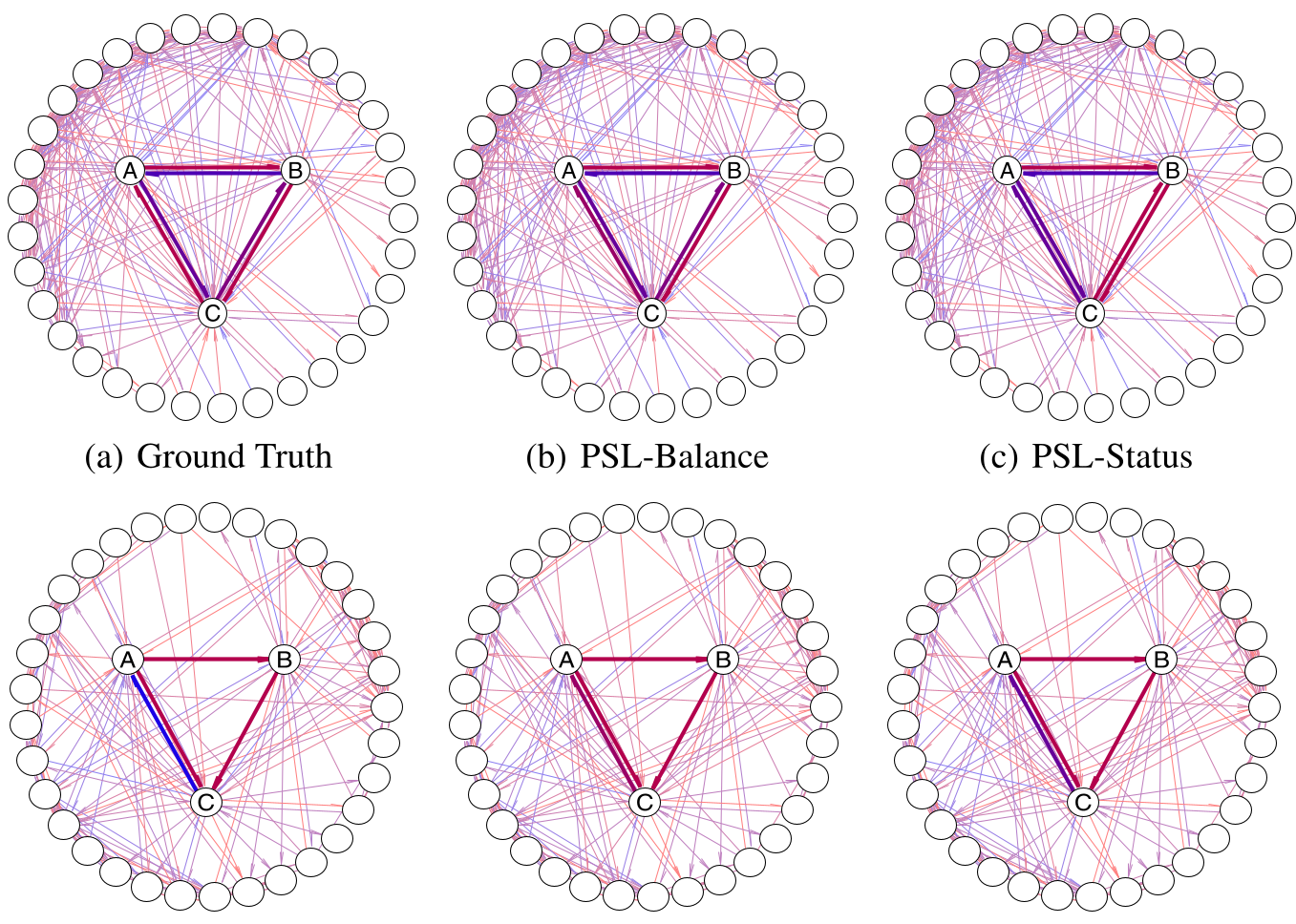 Visualizing instances where Balance and Status models disagree—PSL allows for nuanced analysis of which theory fits different network segments.
Why did PSL win?
- Joint Inference: Unlike TidalTrust, which looks at paths for a single pair, PSL performs collective inference. It optimizes the truth values of all unknown links simultaneously, allowing information to flow even through "weak" or "soft" connections.
- Weight Learning: PSL automatically learns the importance of each rule from the data. If the network actually follows "Status" more than "Balance," the optimization will reflect that in the final weights.
Critical Analysis & Conclusion
The core value of this paper isn't just a "better trust score." It is the flexibility of the framework. By moving away from fixed graph algorithms toward a declarative logic-based system, researchers can model complex human behavior (like "A trusts B regarding movies, but not regarding finances") by simply adding a few lines of logic.
Limitations
While PSL is efficient (using consensus optimization), grounding first-order rules into a graphical model can still face scaling challenges as the number of triads ( potential rules) explodes in massive networks like Twitter or Facebook.
Future Outlook
The "Soft Logic" approach is a bridge between the symbolic world of traditional AI and the probabilistic world of modern ML. As we move toward more complex social AI, the ability to encode sociological "common sense" as soft rules will be vital for building trustworthy recommender systems and social influence models.