
iDPS: Maximizing the "IQ" of Real-Time AI via Strategic Deferral
Flexible hard real-time scheduling for deliberative AI systems
The paper proposes iDPS (Imprecise Dual Priority Scheduling), a flexible scheduling framework for deliberative AI systems (like RoboCup agents). It utilizes a Prologue-Optional-Epilogue (P–O–E) task model to provide hard real-time guarantees for mandatory components while maximizing the execution time of optional anytime algorithms to enhance system utility.
TL;DR
Deliberative AI systems (like autonomous robots) face a paradox: they need complex reasoning (slow/variable) but must act within milliseconds (fast/hard). This paper introduces iDPS, a scheduling mechanism that uses Dual Priority Scheduling to squeeze every microsecond of CPU time into "Anytime" algorithms. It ensures the robot always does the mandatory basics while giving it the maximum possible time to "think" about a better plan.
The Problem: The High Cost of Certainty
In hard real-time systems, we schedule for the Worst-Case Execution Time (WCET). If an AI planning algorithm might take 50ms once in a blue moon, but usually takes 2ms, we must reserve 50ms. This leads to massive idle gaps where the CPU does nothing.
Earlier models tried the "Mandatory-Optional" approach, but they had a flaw: they couldn't always guarantee the Epilogue—the crucial stage where the AI actually sends the command to the motor. If the epilogue doesn't finish by the deadline, the robot doesn't move.
The Solution: The P–O–E Model and iDPS
The authors propose the Prologue-Optional-Epilogue (P–O–E) model.
- Prologue: Minimal setup (e.g., parsing sensor data).
- Optional: The "Thinking" (Anytime algorithm). More time = higher quality answer.
- Epilogue: Minimal action (e.g., sending the command).
The iDPS Insight
To maximize the "Optional" window, the authors created iDPS (Imprecise Dual Priority Scheduling). Instead of running tasks at a fixed priority, iDPS uses three priority "bands":
- High Band: For tasks nearing their deadline.
- Middle Band: For optional "anytime" computation.
- Low Band: For hard tasks that still have plenty of slack.
The Magic Trick: iDPS promotes the Prologue to the High Band immediately (start thinking ASAP) but keeps the Epilogue in the Low Band for as long as possible.
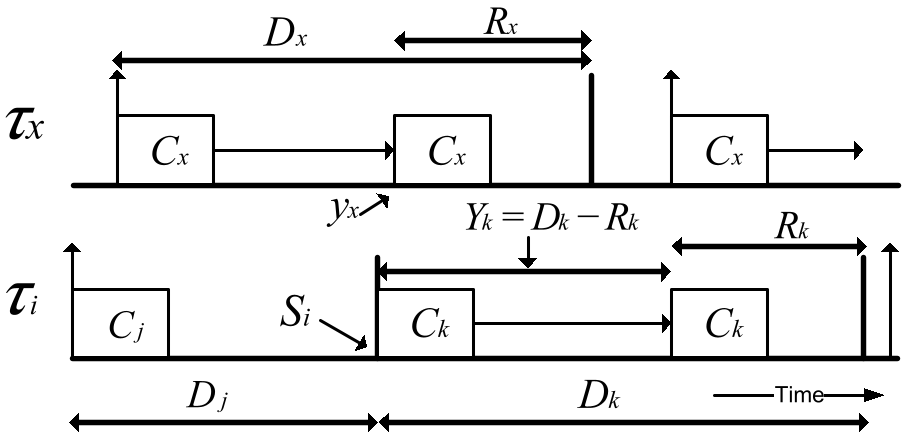 Figure: The iDPS Promotion Strategy. By pushing Cr and Ck (Mandatory parts) apart, the space for optional work is expanded.
Methodology: Math Behind the Motivation
The paper doesn't just guess; it uses Response Time Analysis (RTA). They provide a tractable schedulability test that accounts for task offsets.
A key contribution is Theorem 1: Under certain conditions (equal WCET for prologue/epilogue), iDPS exactly doubles the available window for AI deliberation compared to standard fixed-priority scheduling.
Results: Efficiency in Action
Using a RoboCup simulation (11 agents needing to move every 10ms), the authors compared iDPS against traditional scheduling.
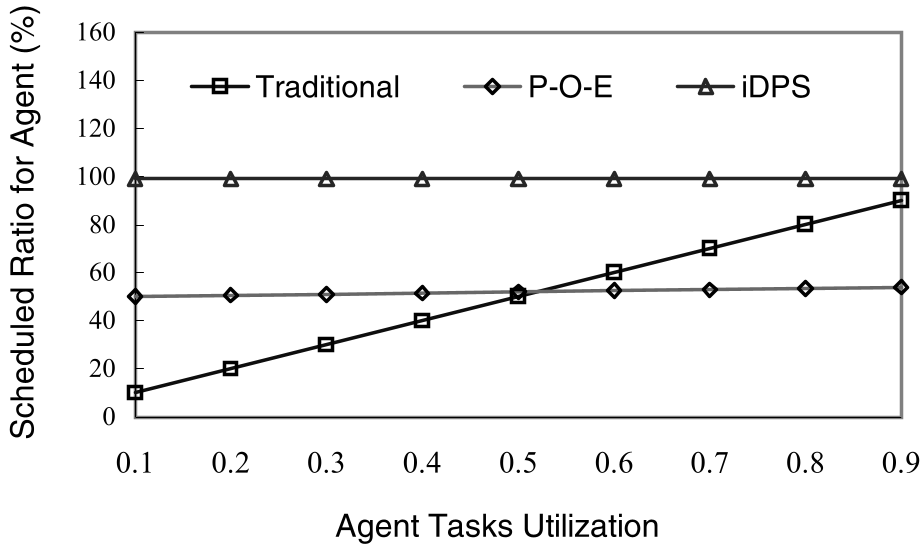 Figure: System utility vs. Task Utilization. iDPS (top line) stays near 100% efficiency, while traditional methods drop off.
- Adaptability: When the background system load increases, iDPS dynamically shrinks the optional window to ensure safety but never stops exploiting the available slack.
- Efficiency: Even when tasks only use 20% of their "worst-case" time, iDPS reclaims the other 80% for better AI reasoning.
Critical Insight & Conclusion
The brilliance of iDPS lies in its Inductive Bias toward flexibility. Most real-time researchers try to make AI more predictable. Chu and Burns argue the opposite: Accept that AI is unpredictable, and make the scheduler smart enough to handle it.
Takeaways for the Future
- For Developers: This framework allows you to deploy "heavy" AI on "weak" hardware without risking system crashes.
- Limitations: The model relies on accurate WCET for the mandatory parts. If your "minimal" prologue overruns, the whole dual-priority logic could fail.
- Future Work: This approach is ripe for application in Autonomous Driving and LLM Edge Inference, where "anytime" results (faster but lower precision) are often better than a perfect result that arrives too late.