
FlexSensing: Balancing Vision Quality and Latency in the Vehicular Fog
13517_FlexSensing A QoI and Latency-Aware Task Allocation Scheme for Vehicle-Based Visual Crowdsourcing via Deep Q-Network.
This paper introduces FlexSensing, a context-aware task allocation scheme for vehicle-based visual crowdsourcing. It utilizes a Deep Q-Network (DQN) to jointly optimize the Quality of Information (QoI) and processing latency by dynamically adjusting data collection rates and offloading tasks to Vehicular Fog Nodes (VFNs), achieving a 51% reduction in latency and a 34% increase in QoI.
TL;DR
FlexSensing is a deep reinforcement learning-based framework designed for vehicle-based visual crowdsourcing. By transforming commercial vehicles (like buses) into Vehicular Fog Nodes (VFNs), it intelligently decides how fast a car should capture images and which "bus-node" should process them. The result is a system that sees better (34% QoI boost) and acts faster (51% lower latency).
Background: The Crowdsourcing Bottleneck
Urban monitoring—ranging from pothole detection to high-definition map updates—increasingly relies on dashcam data from the "crowd" of vehicles on the road. However, we face a paradox: to get high Quality of Information (QoI), we need high-resolution, high-frame-rate data. Yet, flooding the network with 4K video creates massive congestion and sky-high processing latency.
Existing works often treat all data equally or use simple rules that break down in the chaotic, high-mobility environment of city traffic.
The Core Insight: Context Matters
The authors propose FlexSensing, based on a crucial observation: the value of a frame depends on the vehicle's position, speed, and orientation relative to the target.
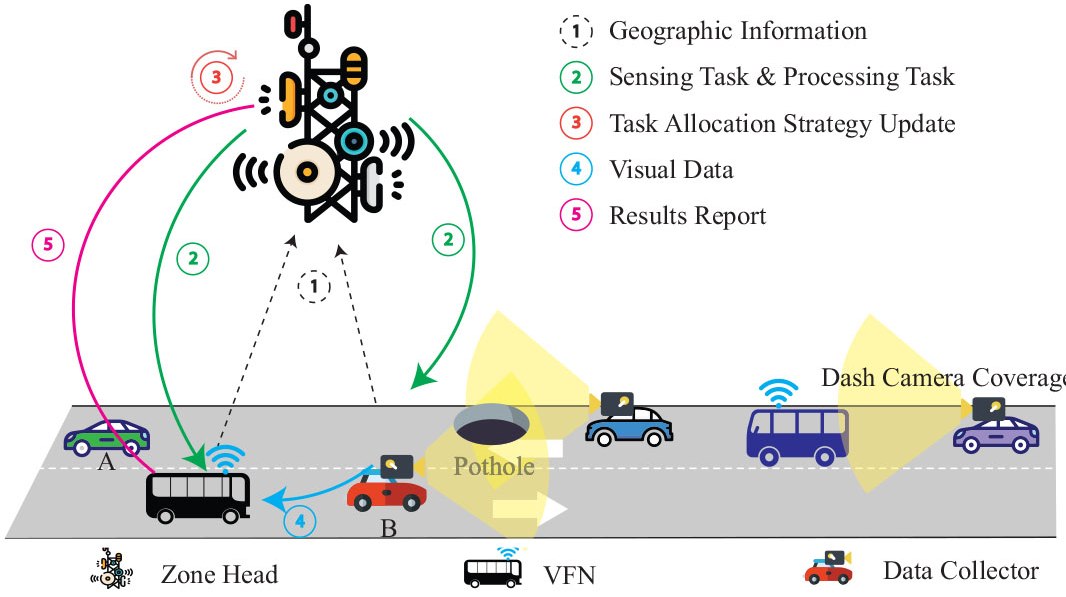
- Dynamic VFNs: Instead of sending everything to the cloud, use buses as local edge servers.
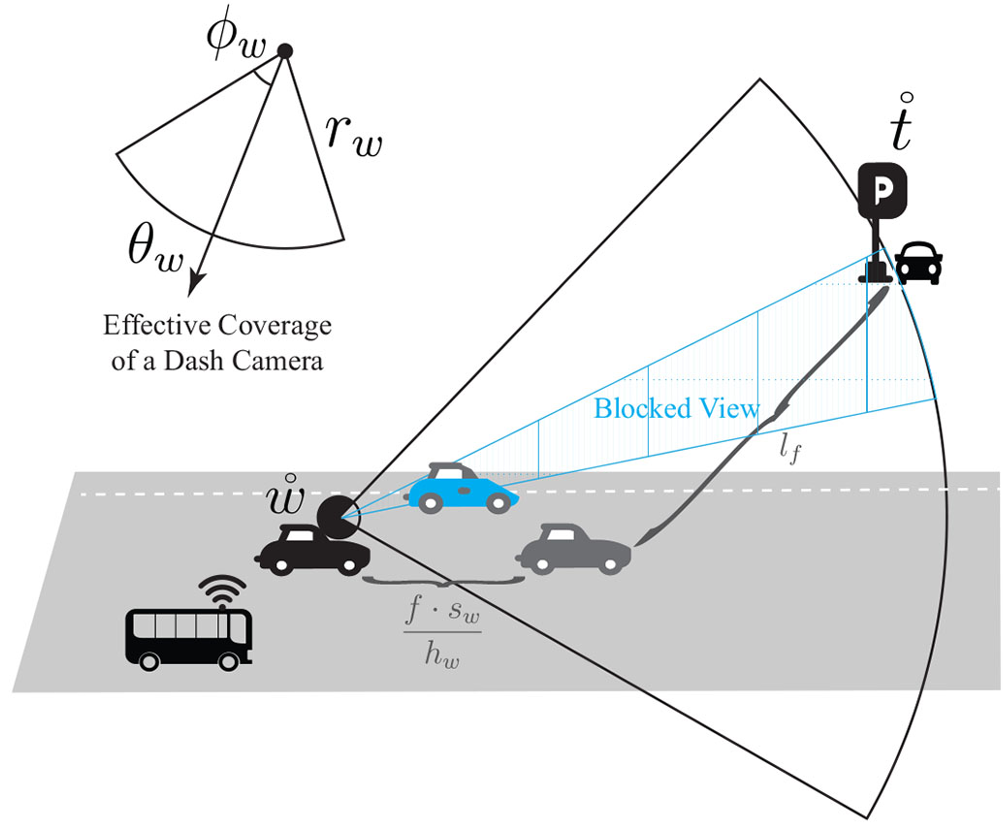
- Context-Aware QoI: QoI isn't just "resolution"; it's the number of pixels covering a target, adjusted for the probability of the view being blocked by other cars.
Methodology: Deep Q-Learning at the Edge
The problem is modeled as a Markov Decision Process (MDP). Because the state space (vehicle locations, speeds, workloads) is virtually infinite, a Deep Q-Network (DQN) is employed.
1. State & Action Space
The "Zone Head" (Base Station) monitors the coordinates and speeds of all vehicles. It issues commands:
- Action: Which VFN to use? What frame rate (10, 20, or 30 fps) to capture?
- Reward: A weighted balance () between QoI gain and Latency penalty.
2. Physical Modeling
The paper derives specific formulas for Connected Duration (how long two moving cars stay in Wi-Fi/V2X range) and Effective Coverage (how long a target stays in the camera's FOV).
Experimental Results: Real-World Evidence
Using real-world bus trajectories and traffic flow data from Helsinki, the authors simulated a 1-square-kilometer urban grid.
Key Findings:
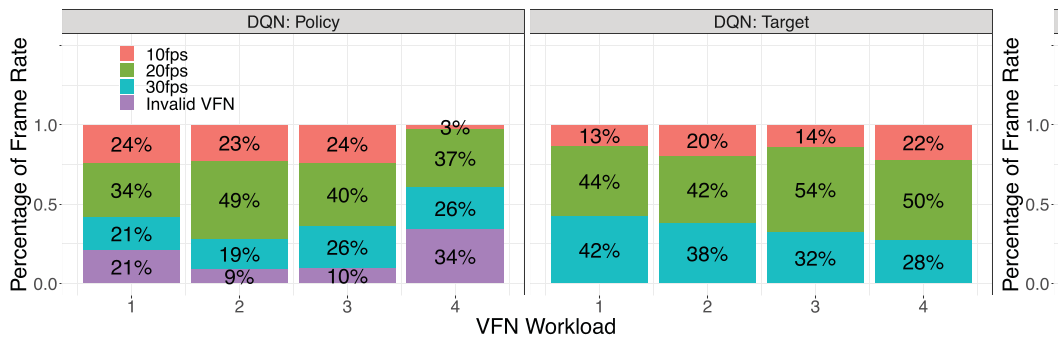
- Workload Awareness: When VFNs are busy (high traffic), the DQN automatically lowers the frame rates of less critical collectors to maintain low latency.
- Superiority over Baselines: Compared to
MUEECA(a latency-constraint method) andAdaptive(simple rule-based), FlexSensing provides a significantly better Pareto frontier.
Critical Analysis & Future Outlook
Strengths: FlexSensing moves beyond "What did we collect?" to "What was the value of what we collected?". Using real-world traffic data from Helsinki lends the simulations high credibility.
Limitations:
- Centralization: The current model assumes the Base Station knows everything. In reality, signaling overhead for this "perfect knowledge" might be significant.
- Static Targets: The model currently focuses on fixed targets (like potholes). Dynamic targets (like pedestrians) would require much more complex MDP states.
Future Work: The authors suggest moving toward Partially Observable MDPs (POMDPs) to handle the uncertainty of real-world sensing and incorporating Drones as mobile relays in areas where buses (VFNs) are scarce.
Conclusion
FlexSensing proves that "Fog Computing" isn't just about static boxes on poles—it's about the intelligence to utilize the moving resource pool of the city itself. By treating task allocation as a learned experience, we can finally achieve real-time, high-quality urban sensing without crashing the network.