
Beyond Keywords: Modeling Flickr Communities Through Probabilistic Topics
14557_Modeling Flickr Communities Through Probabilistic Topic-Based Analysis.
This paper introduces a probabilistic approach to jointly model Flickr users and groups as equivalent entities using unsupervised Topic Modeling (PLSA). By representing both users and groups as "bags-of-tags" derived from their photo collections, the authors successfully map social media entities into a shared semantic latent space for advanced discovery and analysis.
TL;DR
Researchers have moved beyond simple social graphs to understand the Flickr "ecosystem" by treating users and groups as semantically equivalent. By applying Probabilistic Latent Semantic Analysis (PLSA) to the massive aggregate of user tags, this work enables a shared latent space where users can find groups—and groups can find users—based on deep "topics of interest" rather than just surface-level keywords.
Background: The Social-Multimedia Intersection
Flickr isn't just a photo hosting site; it's a massive collection of self-managed communities called "Groups." While previous research heavily analyzed the "Who follows Whom" social graph, this paper argues that content defines the community. The authors propose that if you aggregate the tags from all photos in a group, you create a profile that is mathematically comparable to a single user's profile.
Methodology: The Latent Topic Bridge
The researchers treated both users and groups as Bags-of-Tags. They applied a PLSA model to bridge the gap between specific tags (like "retriever," "puppy," "canine") and a latent topic (like "Dogs").
The Formal Generative Process
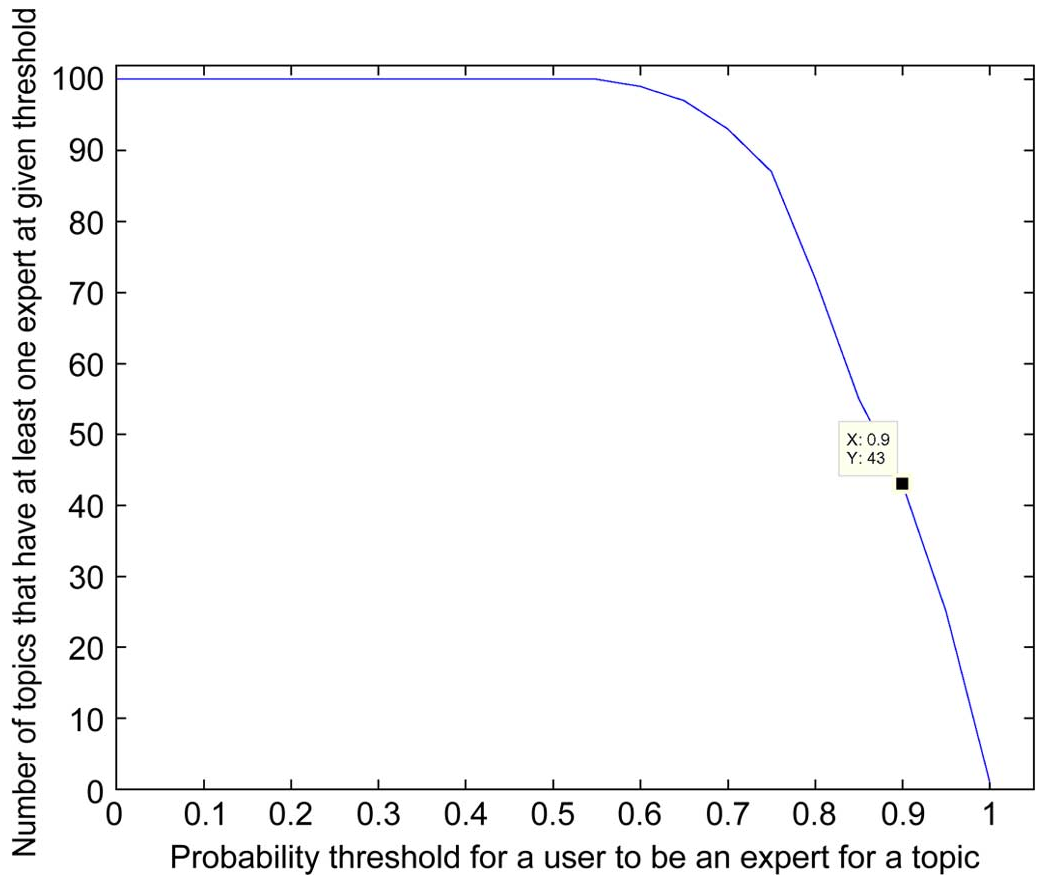
The model assumes that an entity (user or group) chooses a topic with probability , and that topic then generates a tag with probability . By learning these distributions through the Expectation-Maximization (EM) algorithm, the authors reduced 10,236 tags into 100 semantic topics.

Key Insights: Social vs. Thematic Groups
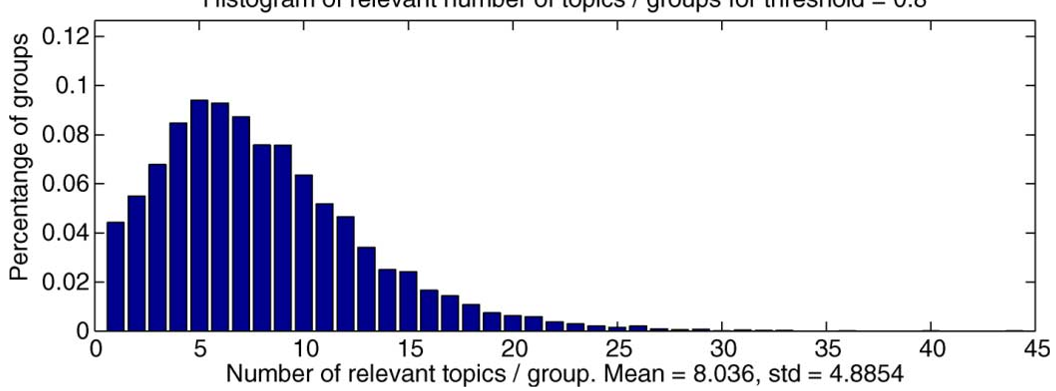
By analyzing the "entropy" of topics within groups, the study revealed a fascinating structural difference:
- Thematic Groups: Highly focused on 1-2 topics (e.g., "North New Jersey" or "Macro Photography").
- Social Groups: Broad and "noisy," spanning dozens of topics (e.g., "FlickrCentral"), where the community value is the interaction rather than a specific subject.
Comparing Users and Groups
The authors found that users who belong to the same groups have significantly lower Bhattacharyya distances in their topic distributions compared to random users, validating that the topic model accurately captures the "social glue" of interest.
Experiments & Results: Improving Discovery
The authors prototyped Topickr, an application for interest-based exploration. When comparing topic-based retrieval against raw tag-matching (Bag-of-Tags):
- Diversity: Topic-based search retrieved over 2,200 distinct users as top results for groups, whereas tag-matching was biased toward a small set of "heavy" users.
- Relevancy: For specific concepts like "Guitar," the topic model successfully returned "Live Music" and "Gigs" groups—entities that didn't necessarily have the word "guitar" in their title, but shared the semantic context.
Critical Analysis & Takeaways
The brilliance of this work lies in its simplicity. By ignoring the visual pixels—which are computationally expensive to process—and focusing on the semantic "exhaust" of user tagging, the authors created a scalable way to navigate social media.
Limitations:
- Tag-Poor Entities: The model struggles with users who tag infrequently (e.g., only 1-5 tags), as there isn't enough evidence to infer topics accurately.
- Temporal Dynamics: Interests change over time, and the static PLSA model doesn't account for "trending" topics.
Future Outlook: The next frontier involves integrating Visual Features directly into this topic space (Multimodal Topic Models) to bridge the "Semantic Gap" even further, allowing for discovery based on what a photo looks like, not just how it is labeled.