
NMF-AUI: Reshaping Flickr Group Recommendations via Heterogeneous Information Networks
Flickr group recommendation with auxiliary information in heterogeneous information networks
This paper presents NMF-AUI, a group recommendation framework for Flickr that utilizes a Regularized Non-negative Matrix Factorization (NMF) approach. It achieves state-of-the-art performance by integrating heterogeneous auxiliary information—including CNN-based visual features, mobile contextual data (locations), and entity-category knowledge from Wikipedia—into the recommendation process.
TL;DR
The exponential growth of social media has made finding the right community (or "Group") harder than ever. This paper introduces NMF-AUI, a recommendation framework that doesn't just look at what groups you joined. It looks at where you took your photos, what is in those photos (using Deep Learning), and how group descriptions relate to real-world concepts in Wikipedia. By combining these into a Heterogeneous Information Network (HIN), the authors boost recommendation accuracy significantly, even when user data is extremely sparse.
The Pain Point: The Sparsity Trap
Standard Collaborative Filtering (CF) relies on a simple logic: "If User A and User B liked the same things in the past, they will like the same things in the future." However, on platforms like Flickr, most users only join a handful of the thousands of available groups.
This results in a User-Group Matrix that is mostly zeros. When the matrix is this sparse, traditional Matrix Factorization (MF) fails because there aren't enough "overlap" points to learn meaningful latent factors. Furthermore, new users (the "Cold Start" problem) provide no interaction data at all, leaving the system blind.
The Insight: Beyond the Matrix
The authors argue that while interaction data is sparse, auxiliary information is abundant.
- Visual Cues: If two users both upload photos of "Golden Retrievers," they share interests regardless of their group history.
- Mobile Context: If users frequently upload photos from the "Great Wall," they share a geographical context.
- Semantic Common Sense: If one group is about "Dogs" and another about "Cats," a human knows they both belong to the "Animal" category. The system should know this too.
Methodology: Meta-Paths and Regularized NMF
The brilliance of this paper lies in how it structures these disparate data types into a Heterogeneous Information Network (HIN).
1. The HIN Schema
The authors define two separate types of networks:
- GT(1): Links Users, Groups, Entities, and Categories (Knowledge-based).
- GT(2): Links Users, Images, and Locations (Context-based).
2. Meta-Paths: Proximity via Logic
To calculate similarity between users, the authors use Meta-Paths. For example:
User -> Group -> Entity -> Category -> Entity -> Group -> UserThis path connects two users if they belong to different groups that share a common high-level category in Wikipedia.
3. The Objective Function
Instead of standard NMF, they use a Regularized NMF. They add "penalties" to the optimization objective that force users who are similar in the HIN (via visual, location, or semantic paths) to have similar latent representations in the mathematical space.
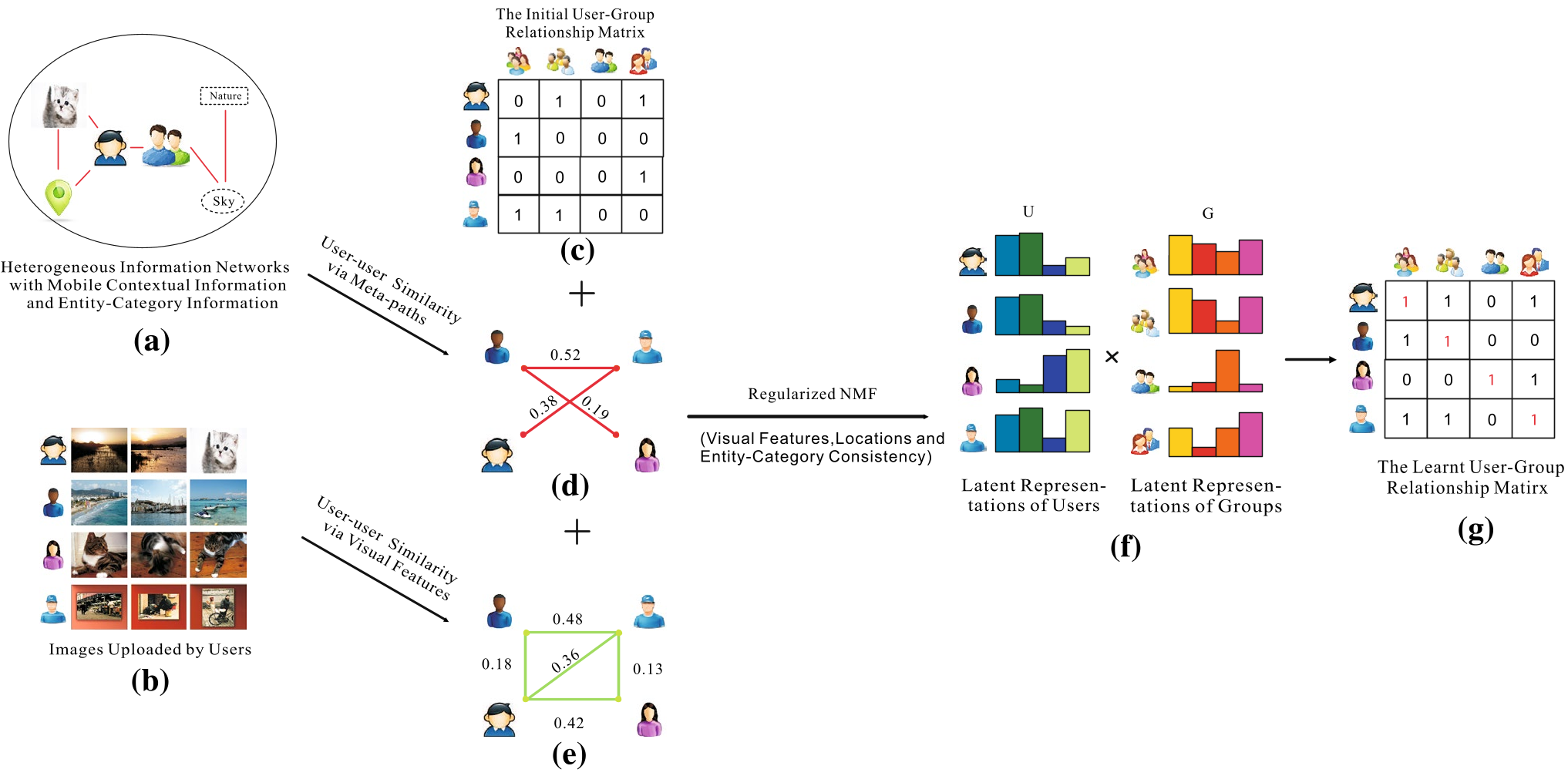 Figure 1: The workflow of NMF-AUI showing how visual features and HIN meta-paths regularize the factorization process.
Experimental Results: Proving the Theory
The authors created a custom dataset called FDAI (Flickr Dataset with Auxiliary Information) with over 1,000 users and 280,000 images.
Key Performance Metrics
- MAP (Mean Average Precision): NMF-AUIall achieved the highest score (0.238), significantly better than standard NMF (0.212).
- Robustness: As the authors removed more training data (increasing sparsity), the gap between NMF-AUI and traditional methods widened, proving that auxiliary info acts as a safety net.
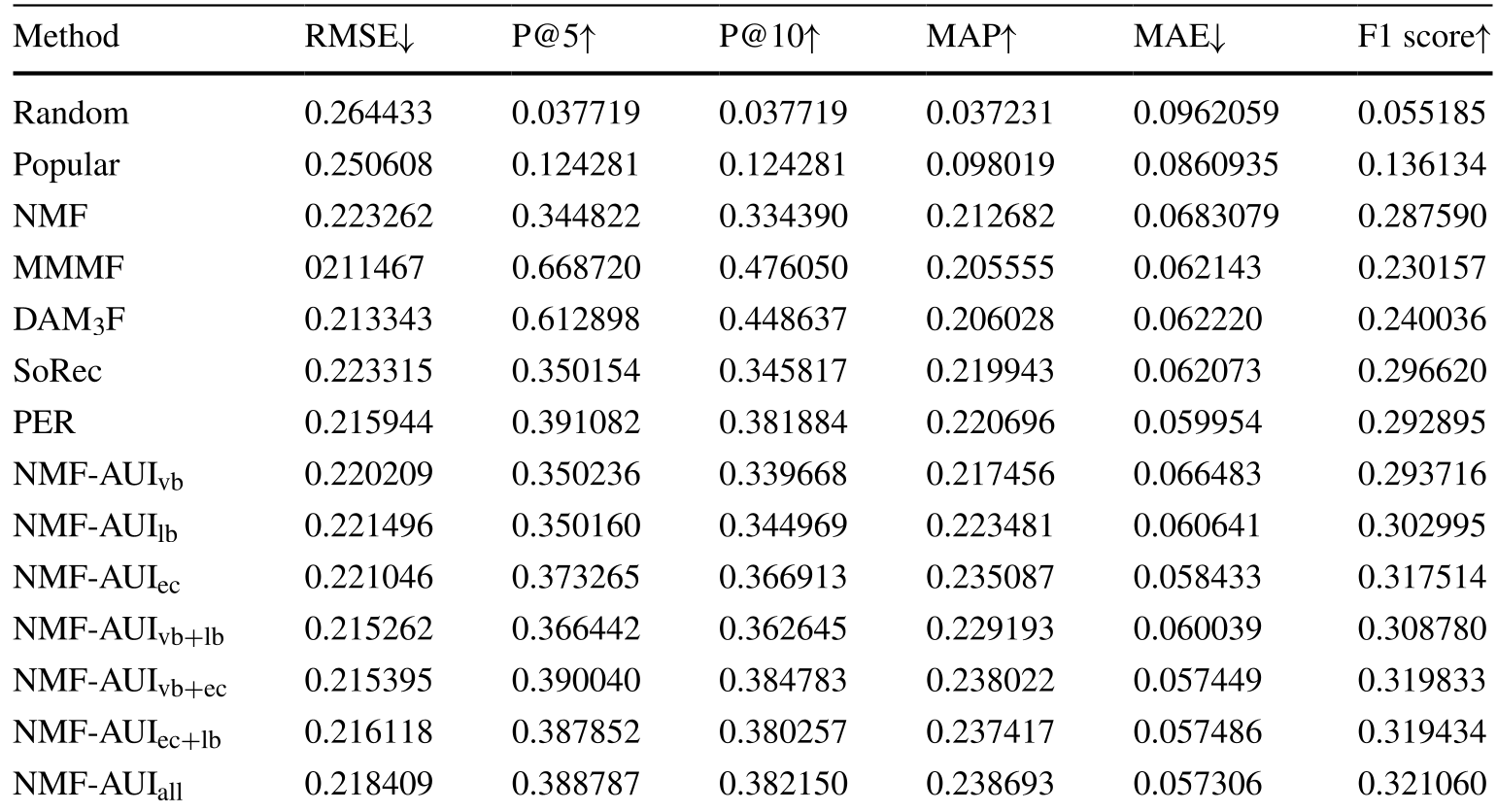 Table 1: Comparative analysis showing NMF-AUI (bottom rows) consistently outperforming baselines across RMSE, Precision, and F1 scores.
What mattered most?
Interestingly, the Entity-Category (Wikipedia) information was often more powerful than visual features alone. This suggests that high-level semantic labels provide a stronger signal for group membership than raw pixels.
Critical Analysis & Conclusion
Takeaway: This work is a masterclass in "feature fusion." It demonstrates that the future of recommendation isn't just better math—it's better data structures (HINs).
Limitations:
- Computational Complexity: Calculating meta-path similarities (PathSim) for millions of users is expensive.
- Static Knowledge: The model relies on Wikipedia as a static source; it might struggle with rapidly evolving internet slang or niche subcultures not yet categorized.
Future Outlook: With the rise of Graph Neural Networks (GNNs), the "Meta-Path" approach seen here is the direct ancestor to modern "Graph Convolution" over heterogeneous graphs. For researchers today, this paper provides the foundational logic for why multi-modal context is essential for social community modeling.