
Decoding Flickr: A Decade of Social Multimedia Evolution and Research Challenges
A survey on Flickr multimedia research challenges
The paper presents a comprehensive survey of research utilizing Flickr as a multimedia platform. It categorizes a decade of work into information retrieval (textual, visual, and hybrid), content interpretation (auto-tagging and localization), human-centric applications, and benchmarking efforts.
TL;DR
This survey serves as a definitive roadmap for the evolution of Flickr-based research, spanning from 2004 to 2016. It explores how a simple photo-sharing site became the primary "test-bench" for breakthroughs in Computer Vision, Information Retrieval, and Human Activity Tracking. The core insight? The value isn't just in the pixels, but in the "social heartbeat" captured via tags and GPS coordinates.
Problem & Motivation: Beyond Pixels
Before the social media explosion, image retrieval was a cold, mathematical process of matching color histograms and textures. However, the rise of Flickr introduced the "humanistic framework". Users weren't just uploading files; they were storytelling through tags, comments, and locations.
The challenge for researchers was twofold:
- The Semantic Gap: How to map low-level features (edge gradients) to high-level human emotions or specific landmarks.
- Unstructured Chaos: Unlike curated datasets, Flickr data is noisy, biased, and uncontrolled.
Methodology: The Flickr Research Taxonomy
The authors categorize the research landscape into three pillars:
1. The Retrieval Engine (Text, Visual, Hybrid)
Initially, researchers relied on Text Retrieval (tags). However, as visual descriptors like SIFT and SURF matured, the focus shifted to Visual Retrieval. The current gold standard is Hybrid Retrieval, which uses text to provide context for visual patterns.
 Figure 1: Typical metadata structure including tags, geo-location, and camera settings.
2. Content Interpretation & Localization
One of the most exciting fields is Localization. By analyzing "visually similar neighbors," systems can predict exactly where a photo was taken even without GPS data.
- Key Finding: Textual tags (e.g., "Eiffel Tower") are often more precise for localization than raw visual matching, but the combination is unbeatable.
3. Humanistic Applications: "Building Rome in a Day"
Perhaps the most famous application mentioned is 3D Reconstruction. Using Structure-for-Motion (SfM) algorithms, researchers proved they could reconstruct the architectural core of a city like Rome by simply "scraping" public photos.
 Table 7: Comparison of Travel and Route Suggestion Systems.
Experiments & Results: Quantifying the Social Web
The survey meticulously compares various "localization" and "tagging" efforts.
| Approach | Success Metric | Core Discovery |
|---|---|---|
| Visual Localization | ~150m accuracy | Reachable for 97% of landmark datasets (Kalantidis et al.). |
| 3D Modeling | 24-hour city-scale build | Possible with 500-core clusters and 150K photos. |
| Tag Recommendation | TF-IDF / Social Pulse | Social links drive tag propagation more than visual similarity. |
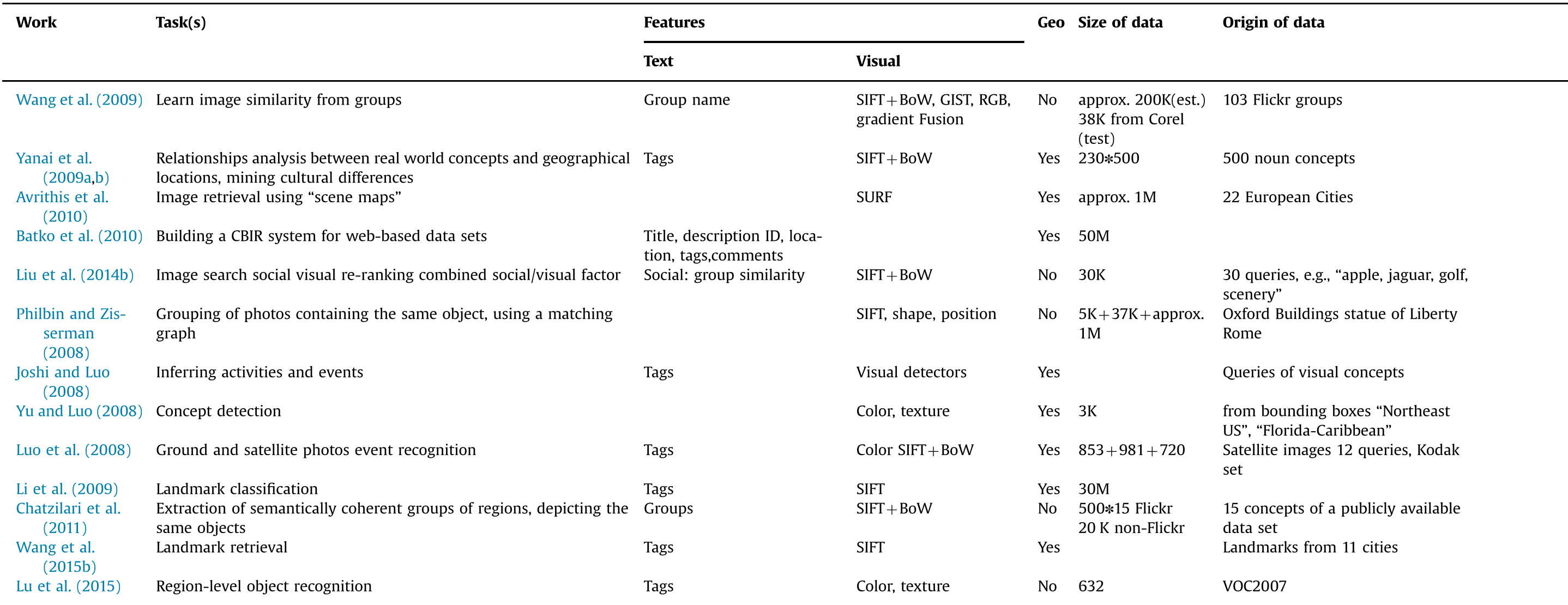 Table 2: Breakdown of visual tasks and features used in landmark classification.
Global Insights & Conclusion
The Takeaway
Flickr research isn't just about finding a better way to search for cat photos. It's about "Collective Intelligence". By observing how millions of people move and tag, we can:
- Predict human mobility patterns.
- Automate travel planning and route suggestions.
- Understand cultural differences (e.g., what a "castle" looks like in different countries).
Limitations & Future Work
The survey concludes that the "Evaluation Plague" (diverse, non-standardized datasets) remains a hurdle. However, the rise of Deep Learning and massive datasets like the YFCC100M (100 million items) will likely bridge the semantic gap, enabling AI to "understand" the intent behind the image, not just its content.
Final Thought: As we move toward a world of AR and autonomous tourism, the metadata-heavy foundations laid by Flickr research will be the "digital maps" of the future.