
Fog Computing in Healthcare: Bridging the Gap Between Bio-Sensors and the Cloud
Fog Computing in Healthcare–A Review and Discussion
This paper provides a comprehensive review of Fog Computing in the healthcare sector, proposing a classification for use cases across five deployment scenarios. It maps application-specific tasks to network tiers and establishes Fog Computing as a vital architectural requirement for real-time, private, and dependable medical informatics.
TL;DR
Healthcare is moving from reactive hospital visits to continuous, proactive monitoring. However, sending massive biometric data (ECG, EEG) directly to the cloud creates "bottlenecks" in latency, privacy, and reliability. This paper argues that Fog Computing—placing intelligence at the network edge (gateways and routers)—is the only way to realize the "Internet of Healthcare Things" without compromising patient safety.
The Motivation: Why Cloud-Only Healthcare is Dangerous
As sensors become small enough to be printed on skin or integrated into contact lenses, a single patient might soon produce dozens of data streams. Modern medicine faces three "cliffs" where pure Cloud Computing falls short:
- The Reliability Cliff: If the hospital's internet goes down, a cloud-based cardiac alarm stops working. In healthcare, downtime isn't just an inconvenience; it's a life threat.
- The Privacy Cliff: Regulations (like GDPR or HIPAA) often forbid sensitive biometric data from leaving local premises or national borders.
- The Bandwidth Cliff: High-fidelity signals like 192-lead EEG require nearly 1 Mbps per patient. Multipy this by thousands of patients, and the localized network collapses.
Methodology: The Landscape of Medical Fog
The authors identify that Fog nodes act as a "middle tier" that can perform filtering, temporary storage, and feature extraction.
1. Deployment Scenarios
The paper defines five critical environments where Fog logic must adapt:
- Mobile: Using smartphones as hubs for wearable sensors.
- Home Treatment: Using smart gateways to allow chronic patients (COPD, Parkinson's) to stay at home.
- Hospital: Advanced LAN-level coordination for surgical and ICU monitoring.
- Non-Hospital Premises: Clinics and nursing homes.
- Transport: Ambulances and helicopters requiring cellular/satellite Fog nodes.
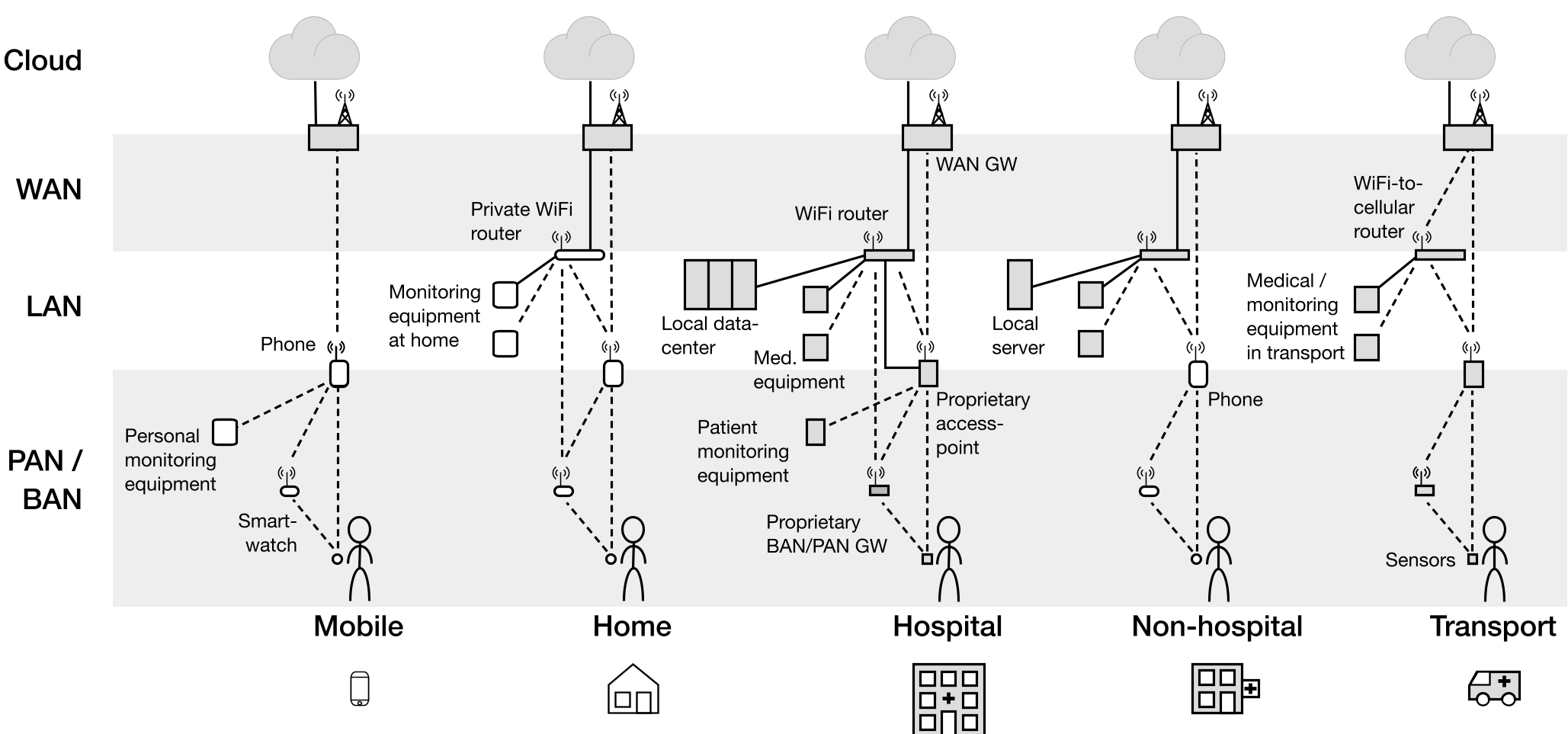 Figure 1: The hierarchical distribution of sensors, fog nodes (gateways), and the cloud across different healthcare settings.
2. Task Categorization
Not all medical data is equal. The authors categorize tasks based on their "Criticality":
- Data Collection/Analysis: Non-urgent logging (e.g., step counting).
- Critical Analysis: Seizure or fall detection where sub-second latency is vital.
- Critical Control: Actuators like pacemakers or oxygen dispensers that require a closed-loop locally to ensure safety even during outages.
Experimental Insights: Where to Place the Logic?
The paper reviews several SOTA systems (e.g., LOBIN, MobiHealth) to find the "Locus of Computation."
The Key Finding: Most successful systems use a hybrid approach.
- PAN/BAN Level: Used for noise filtering and encryption.
- LAN Level: Used for complex feature extraction (e.g., ECG R-peak detection) and local context management (identifying which doctor is nearest to a distressed patient).
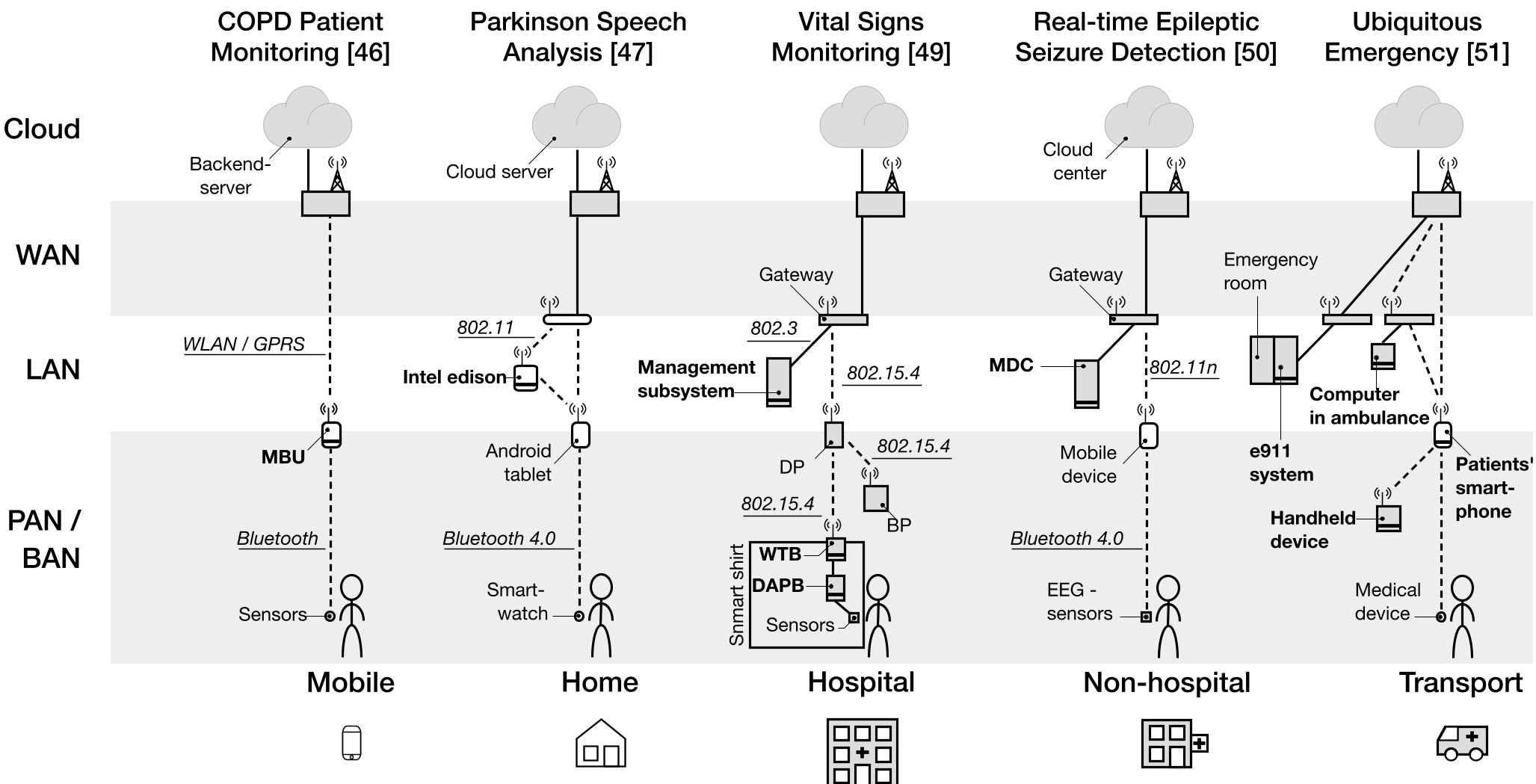 Figure 2: Real-world implementations of Fog Computing, from Parkinson speech analysis at home to vital signs monitoring in high-stakes hospital environments.
Critical Analysis & The Future
The authors conclude that while the technological pieces exist (Arduino, Intel Edison, BLE), the field lacks standardization. Every hospital uses a different "siloed" infrastructure.
Future Research Directions:
- Autonomic Management: Fog nodes must be "self-aware," shifting workloads if one node fails without manual IT intervention.
- Verifiable Computing: How can we trust a Fog node provided by a third-party vendor (like a cafe's Wi-Fi) to process medical data?
- Cross-Scenario Mobility: A patient's sensors should transition seamlessly from a Hospital Fog to an Ambulance Fog, and finally to a Home Fog without data loss.
Conclusion
Fog Computing is the "architectural glue" for the next generation of medicine. By moving the "brain" of the application closer to the "skin" of the patient, we can achieve a system that is faster, more private, and—most importantly—more dependable in critical moments.