
Beyond the Leash: A Fog-Driven M-LSTM Framework for Proactive Veterinary Care
Fog-inspired smart home environment for domestic animal healthcare
2020-07-01
Summary
Problem
Method
Results
Takeaways
Abstract
This paper introduces a fog-driven IoT framework designed for real-time domestic animal healthcare monitoring and vulnerability prediction. The core methodology combines temporal data mining with a Multi-scaled Long Short-Term Memory (M-LSTM) network to achieve SOTA predictive accuracy (95.12% precision) and low-latency emergency alerting.
## TL;DR
Domestic animals are frequently overlooked in the smart health revolution. This research presents an **IoT-Fog-Cloud (IFC)** ecosystem that doesn't just track pets—it predicts medical emergencies. By combining **Temporal Data Mining** with a custom **Multi-scaled LSTM (M-LSTM)**, the system identifies health vulnerabilities with **95.12% precision**, allowing for life-saving alerts before symptoms become critical.
## The Motivation: Why Your Pet Needs an Edge Node
While the US sees nearly 6 million pet adoptions annually, the mortality rate for domestic animals remains stubbornly high (approx. 9% in certain surveys). The current paradigm is reactive: we take a pet to the vet *after* it shows distress.
The authors argue that the missing link is **continuous, context-aware monitoring**. Challenges include:
- **Heterogeneity**: Fusing heart rate (health) with ambient temperature (environment) and restlessness (behavior).
- **Latency**: Cloud-only processing is too slow for acute conditions like Tachycardia.
- **Evaluation**: Raw data is useless without a mathematical way to quantify "adversity."
## Methodology: Quantifying "Health Adversity"
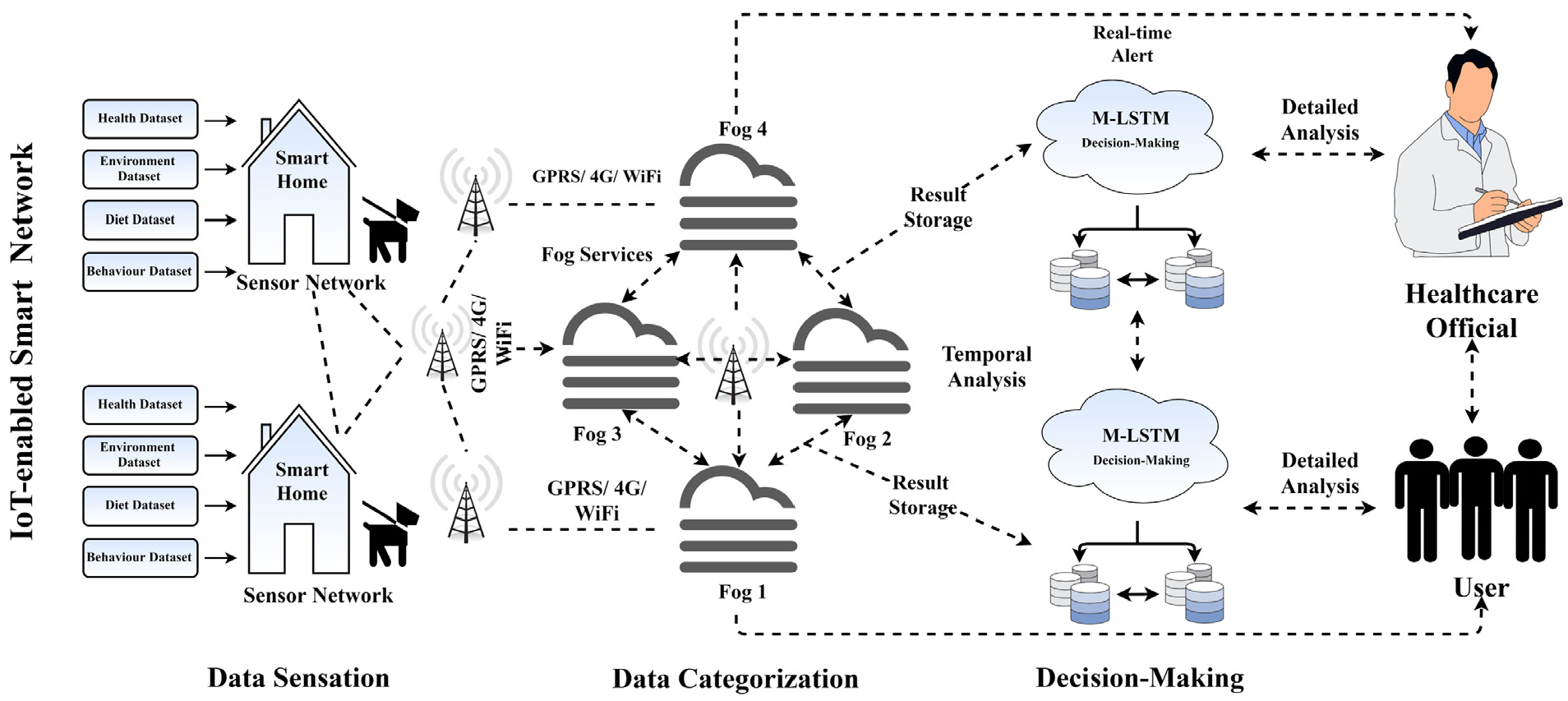
The framework moves through a sophisticated four-layer pipeline (Data Sensation, Categorization, Information Mining, and Predictive Decision-Making).
### 1. The Metric: SoHA & TAE
The authors define the **Scale of Health Adversity (SoHA)** as the probability of a health risk based on a specific data value. These are aggregated into a **Temporal Adversity Estimate (TAE)**, a weighted sum that provides a snapshot of the animal's vulnerability over time.
### 2. The Model: M-LSTM
The secret sauce is the **Multi-scaled Long Short-Term Memory (M-LSTM)**.
- **CNN Component**: Acts as a feature extractor to identify local patterns in temporal granules using **ReLU** activation.
- **LSTM Component**: Handles the long-term dependencies and "irregular state" analysis, determining if a sequence of events leads to a "Vulnerable" state.
## Performance: Precision at the Edge
The system was validated on a massive dataset of 34,120 instances. The results highlight the superiority of the deep learning approach:
- **Classification**: The **Bayesian Belief Network (BBN)** used in the fog layer outperformed KNN and Decision Trees in categorizing data as "Vulnerable" or "Invulnerable."
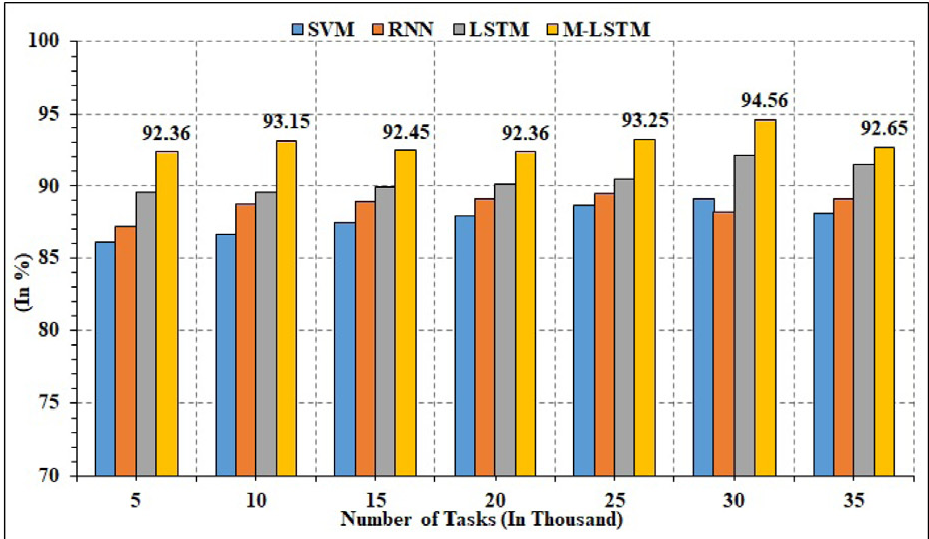
- **Prediction**: The M-LSTM reached a **95.12% precision rate**, beating standard RNNs (92.56%) and SVMs (90.13%).
- **Efficiency**: The total delay for the entire mining-to-prediction pipeline was approximately **203 seconds**—fast enough for effective emergency intervention.
## Critical Insight: The Power of Fog
By utilizing **Raspberry Pi** nodes as fog gateways, the system ensures that sensitive pet health data is processed locally first. This reduces the bandwidth burden on the cloud and ensures that "Warning-based Alert Signals" can be generated even if the external internet connection is unstable. The stability analysis (AAS of 0.63) proves this architecture is robust against the fluctuations of real-world IoT sensor data.
## Summary & Future Outlook
This paper shifts the narrative of pet tech from "activity trackers" to "life-support monitors." The integration of **TAE quantification** and **M-LSTM prediction** provides a blueprint for the next generation of veterinary services.
**Limitations**: The current model focuses on domestic environments; however, the authors suggest that future work should extend these "Smart Environments" to street animals and investigate more complex IoT security protocols (like ECC) to protect sensitive bio-data.