
FBVO: Scaling Visual Knowledge via Collective Intelligence and Folksonomy
Folksonomy-Based Visual Ontology Construction and Its Applications
2016-02-10
Summary
Problem
Method
Results
Takeaways
Abstract
This paper proposes a systematic framework to automatically construct a Folksonomy-Based Visual Ontology (FBVO) by mining 2.4 million Flickr images. It utilizes a three-stage pipeline—concept discovery, relationship extraction, and hierarchy construction—to generate a large-scale ontology containing over 139,000 concepts and millions of semantic relationships.
## TL;DR
While AI models like GPT-4 and Llama are impressive, they lack the structured, hierarchical world-view that humans possess. Traditionally, building these "knowledge maps" (Ontologies) required massive human labor (WordNet). This paper introduces **FBVO**, a framework that automatically builds a massive visual ontology from 2.4 million Flickr images, capturing not just *what* objects are, but how they relate in a coarse-to-fine hierarchy.
## Problem: The Bottleneck of Human-in-the-loop Ontologies
Building a visual knowledge base has historically been a binary choice:
1. **High Quality, Low Scale**: Expert-curated ontologies like WordNet or LSCOM are accurate but "frozen in time" and expensive.
2. **High Scale, Low Quality**: Text-mining the web provides quantity, but fails to capture visual intuition. (e.g., A car and a wheel are functionally inseparable visually, but text documents don't always mention them together).
The challenge with using "Social Tags" (Folksonomy) is the **Noise**. Users tag images with subjective or irrelevant terms like "beautiful" or "my dog," which are useless for a general ontology.
## Methodology: Filtering Noise to Find Semantic Truth
The paper proposes a three-stage pipeline to transform messy Flickr tags into a clean Directed Acyclic Graph (DAG).
### 1. Robust Concept Discovery
To prevent the model from learning "noisy" associations, the authors used **Neighborhood Voting** (Kernel Density Estimation). If an image tagged "Apple" is visually distant from other "Apple" images, it is discarded. Furthermore, they use **Max-Margin Hard Negative Mining** to ensure the classifiers can distinguish between subtle differences (e.g., a "sedan" vs. a "truck" within the "vehicle" node).
*Fig 1: The three-stage framework: Discovery, Relationship Extraction, and Hierarchy Construction.*
### 2. Relationship Extraction: The Power of Visual Context
How do we know "Animal" is the parent of "Dog"? The authors use a dual-metric:
* **Textual Google Distance**: How often do these words co-occur?
* **Visual Similarity**: Clustered image features are compared.
* **Frequency Discrepancy**: If "Animal" is used in 90% of cases where "Dog" appears, but "Dog" is only in 5% of cases where "Animal" appears, "Animal" is likely the parent.
### 3. Hierarchy Construction via Concept Entropy
The authors introduce **Concept Entropy** to measure semantic broadness. Concepts with high entropy (like "Nature") serve as root nodes, while low entropy concepts (like "Redheaded Woodpecker") become leaves.
## Experiments & Results: Better Features, Better Logic
The FBVO was tested on two fronts: its internal logic and its external utility.
**Consistency with Human Perception**:
Comparing FBVO against WordNet, the combined "Text + Visual" approach outperformed text-only methods significantly, proving that visual data helps "bridge" relationships that text misses.
**Visual Recognition Utility**:
The researchers used FBVO nodes as "mid-level features" for complex tasks like scene recognition.
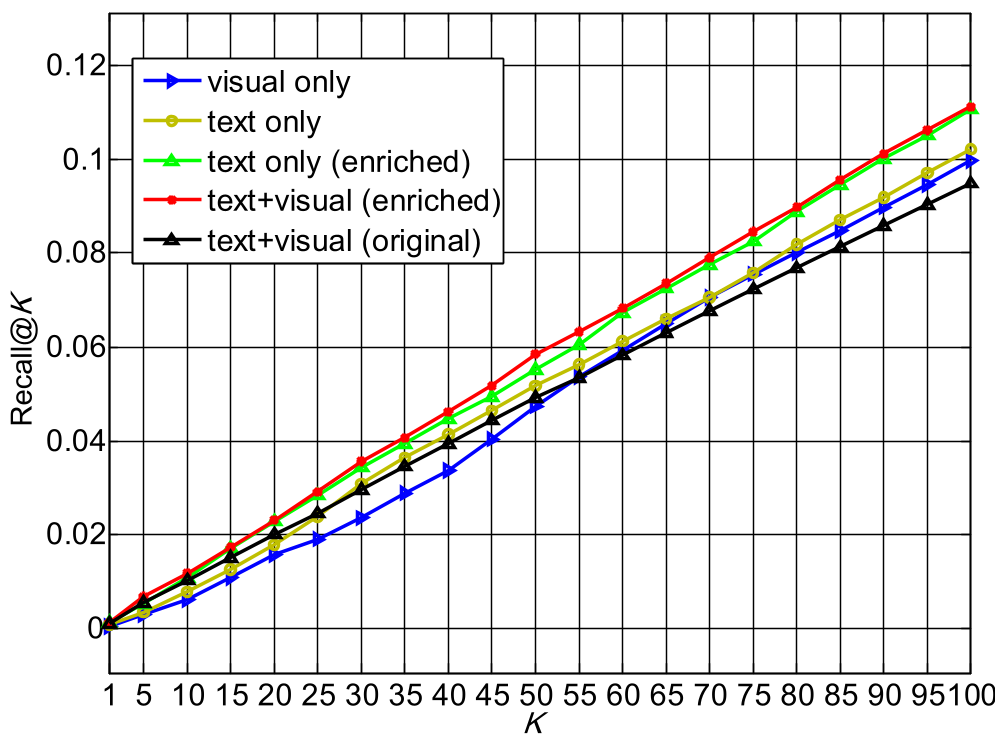
*Fig 2: Performance comparison showing that the enriched text+visual approach yields the highest precision in relationship extraction.*
On the **UIUC-Sport dataset**, using these visual-semantic features reached an accuracy of **94.06%**, outperforming traditional CNN features alone and prior SOTA methods like Object Bank.
## Critical Analysis & Conclusion
### Takeaway
The FBVO framework successfully proves that we can turn "unstructured social noise" into "structured semantic signals." It effectively captures the **subsumption** relationship (is-a) which is the backbone of human reasoning.
### Limitations
1. **Wikipedia Dependency**: Currently, the system only recognizes tags that have a Wikipedia entry. This might miss hyper-local or emerging slang/trends.
2. **Static snapshots**: While the paper claims "never-ending learning" potential, the primary experiments were conducted on a static 2.4M image crawl.
### Future Outlook
With the rise of Large Multimodal Models (LMMs), this type of structured visual ontology could be used to **augment RAG (Retrieval-Augmented Generation)** systems, allowing LLMs to verify visual facts against a structured knowledge graph rather than relying on probabilistic "guessing."