
Beyond the Follow: Deciphering and Managing Social Media Noise through FMN
Followee Management: Helping Users Follow the Right Users on Online Social Media
The paper introduces a "Followee Management" framework for Online Social Media (OSM), specifically Twitter. It proposes two novel metrics—User Affinity Score (UAS) and Content Similarity Score (CSS)—to characterize user-followee relationships and identifies that 60% of connections exhibit minimal engagement or relevance, leading to a "Followee Management Nudge" (FMN) browser tool.
TL;DR
Online social media often turns into a high-entropy "noise machine" as we follow more people over time. This paper proposes a systematic way to identify "useless" followees by measuring social affinity and content similarity. By introducing a browser-based nudge, the authors help users prune their feeds, revealing that a staggering 60% of our social ties on Twitter might be functionally irrelevant.
Problem & Motivation: The "Follow-and-Forget" Trap
Most social media research focuses on Expansion: Who should you follow next? However, the authors argue that the real problem is Retention and relevance. As a user's follow-count grows, the timeline—Twitter's primary value proposition—becomes saturated with content that the user neither likes nor relates to.
The core insight is that we follow people for two main reasons:
- User-Conscious Behavior: You follow them because you know them or like them (Social Ties), even if their content is random.
- Content-Conscious Behavior: You follow them because you like their topics (Topical Ties), even if you don't know them personally.
The authors hypothesize that any followee who fits neither category is "noise" that should be removed to preserve user experience.
Methodology: UAS and CSS
To quantify these behaviors, the researchers developed two primary metrics:
1. User Affinity Score (UAS)
This is a measure of "Social Bonding." It ignores what is being said and focuses on how often you interact.
- Formula: Sum of Retweets + Likes + Mentions for a specific followee.
2. Content Similarity Score (CSS)
This measures "Topical Alignment." It uses two sophisticated NLP approaches:
- Textual Similarity: Using Word2Vec pre-trained on Google News to compare the word-level vectors of a user's own tweets vs. their followees' tweets.
- Topic Similarity: Using Latent Dirichlet Allocation (LDA) to extract high-level themes (e.g., "Politics", "Tech") and check for overlap.
 Fig 1: The workflow from data scraping to behavioral characterization.
The "Inconclusive" 60%: A Wake-up Call
The study analyzed 234,403 tweets from 26,516 followees. The results were startling. By plotting the distribution of scores, the authors found that for 60% of user-followee pairs, the scores were essentially zero. These are "zombie" follows—people you don't interact with and whose content doesn't match your interests.
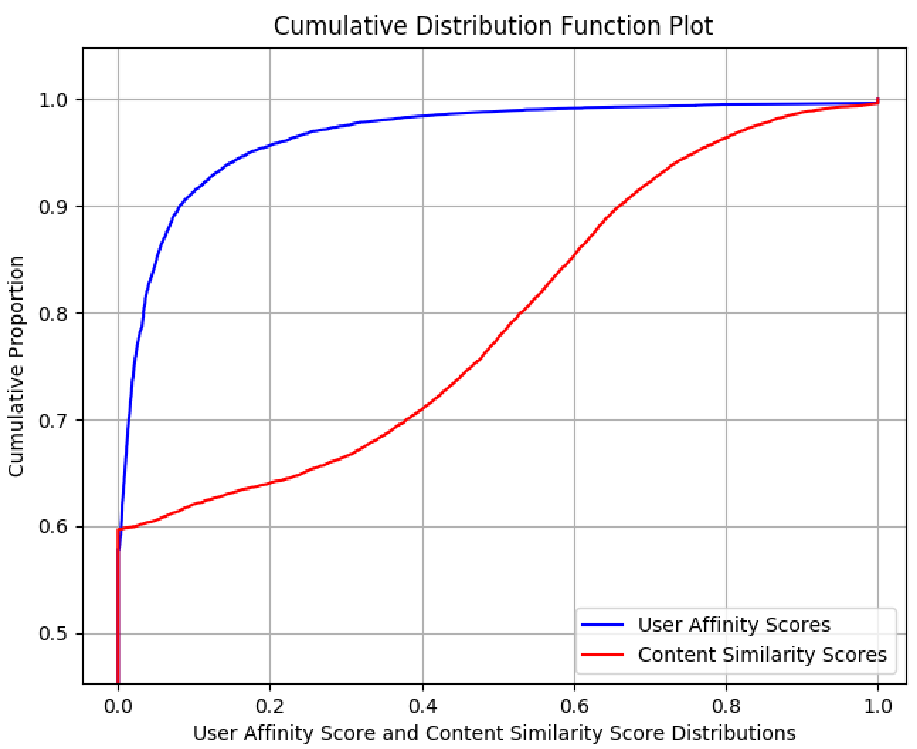 Fig 2: Scatter plot showing the clustering of users. Most users fall into either low social affinity or low content similarity, but the density at the origin highlights the "Noise" problem.
The Nudge: Followee Management Nudge (FMN)
Instead of an automated "mass unfollow" (which might be jarring), the authors designed a Nudge. Implemented as a Chrome extension, it presents a list of the "least relevant" followees and provides an easy "Unfollow" button.
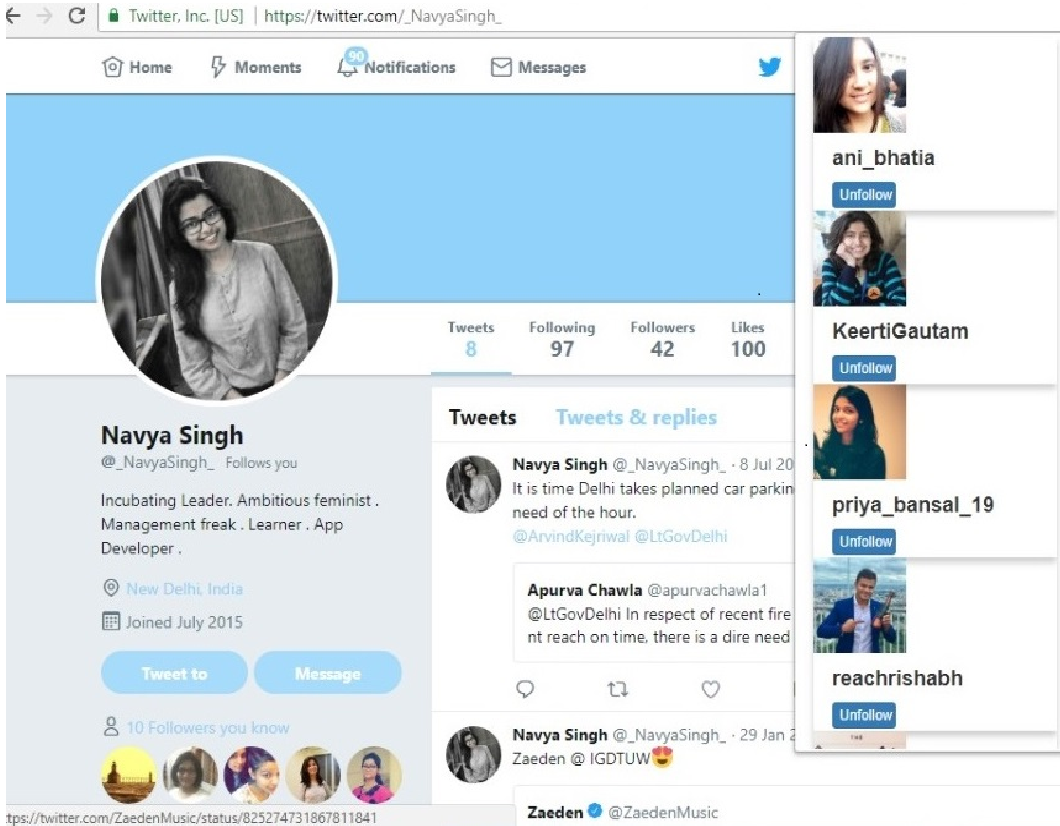 Fig 3: The FMN UI highlighting followees with minimal engagement.
Critical Analysis & Conclusion
While the study is small-scale (100 users for characterization, 8 for the lab study), it addresses a fundamental flaw in algorithmic feeds: they are designed to keep you scrolling, not to help you curate.
Strengths:
- Actionable Metrics: UAS and CSS are computationally efficient enough to run in a browser tool.
- User Empowerment: It moves away from "black-box" algorithmic sorting to "glass-box" user management.
Limitations:
- The "Silent Observer" Problem: Some participants noted that they enjoy reading certain tweets even if they never "Like" or "Retweet" them. The metrics currently fail to capture passive consumption.
- NLP Maturity: Using Word2Vec (from 2013/2014 era) is slightly dated; modern Transformers (BERT/GPT) would likely provide even more accurate similarity scores.
Future Outlook: This research paves the way for "Self-Healing Feed" technologies where the UI periodically asks: "You haven't interacted with [X] in 6 months; do you still want them in your timeline?" This shift from Recommender Systems to Management Systems is crucial for the long-term health of social networks.