
GTS-FR: Decoding the "Information-Need" in Asymmetrical Social Networks
Followee recommendation in asymmetrical location-based social networks
The paper introduces GTS-FR (Geographic-Textual-Social Based Followee Recommendation), a novel mining-based approach for followee recommendation in asymmetrical location-based social networks (LBSNs). By integrating user movement trajectories, online textual comments, and social graph transitivity, the method achieves significantly higher precision and recall compared to traditional friend-of-friend or purely trajectory-based recommendation baselines.
TL;DR
Most social recommendations assume that if you follow someone, you want to be their friend. In reality, you often follow someone because you need the information they provide. This paper introduces GTS-FR, a system that combines where you go (Geographic), what you say (Textual), and who you know (Social) to predict followees in asymmetrical networks like EveryTrail, significantly outperforming traditional friend-recommenders.
Background: Symmetrical vs. Asymmetrical Networks
In a Symmetrical Social Network (SSN) like Facebook, a link is a mutual agreement (friendship). However, in Asymmetrical Social Networks (ASN) like Twitter or EveryTrail, links are directed. You follow an expert hiker because you want their trail data, not necessarily because you’ve met them.
The authors argue that current recommenders fail because they rely on "Friend-of-Friend" (FOF) logic, which doesn't capture this information-need relationship. Furthermore, trajectory-based systems suffer from experience-limitation: if two users haven't visited the same park, the system thinks they have nothing in common, even if both are obsessed with "extreme hiking" in their comments.
Methodology: The Three Pillars of GTS-FR
The core of the GTS-FR approach is a two-phase algorithm that transforms heterogeneous LBSN data into descriptive features for an SVM-based classification task.
1. Social Property (SP): The Transitivity of Following
Rather than just looking at common friends, the authors define a Transition-Setter. If User A follows B, and B follows C, B is the transition-setter. The algorithm measures "LinkTran" (the density of links between followers and followees) and "CTran" (communication/comment frequency) to determine how "infectious" a user’s information is.
2. Geographical Property (GP): Beyond Coordinate Matching
Instead of raw GPS points, the system identifies Stay Locations (regions where users actually spend time). It uses the Longest Common Sequence (LCS) to compare sequences of locations, weighted by the length of the trip (Weighted Average). This captures the intent of a journey rather than just a random path overlap.
3. Textual Property (TP): The "Information Need" Bridge
This is the "secret sauce" of the paper. By building User-Keyword (UK) and Location-Keyword (LK) graphs, the system uses a HITS-based random walk model.
- The Intuition: If User A talks about "hiking" and User C talks about "hiking," they are linked via the keyword, even if their GPS coordinates never overlap.
- Random Walk: It calculates the probability that a user's information need (expressed in text) matches another user's provided information.
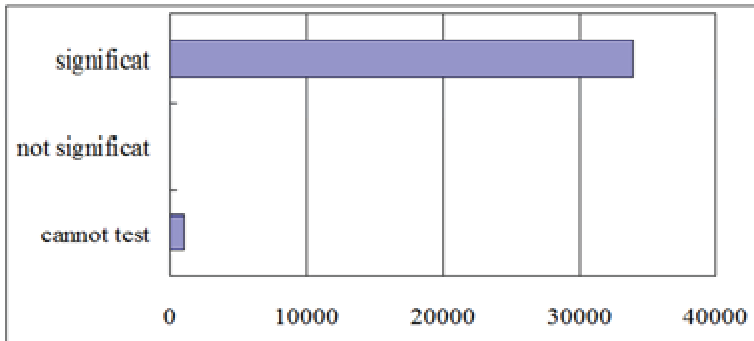 Figure: The GTS-FR workflow and the User-Keyword bipartite graph structure.
Experiments & Results
The authors crawled EveryTrail data over four snapshots (35,000+ users). They compared GTS-FR against HGSM (a top-tier trajectory method) and FOF (the industry standard).
Key Findings:
- Textual Power: TP (Textual Property) features were the strongest predictors of whether a user would follow another. This proves that "searching for information" is a primary driver in ASNs.
- Predicting the Future: Interestingly, many of the "false positives" (the system suggested a follow, but it hadn't happened yet) actually became "true positives" in later months. This suggests the model is lead-correcting the social graph's evolution.
- Overall Performance: GTS-FR consistently outperformed baselines across Precision, Recall, and F-measure.
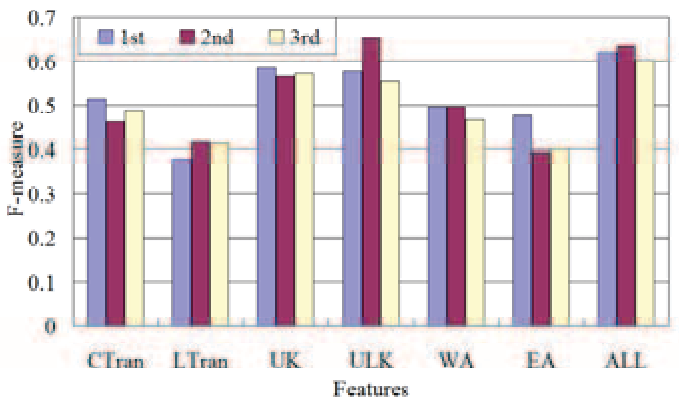 Figure: (a) Precision, (b) Recall, and (c) F-measure comparisons showing GTS-FR's superiority.
Critical Insight: The Value of Heterogeneity
The brilliance of this paper is in its recognition that location is semantic. A GPS coordinate is just a number until you attach the word "hiking" to it. By bridging the gap between physical movement and digital discourse (text), GTS-FR solves the "cold start" problem for users who are new to a geographical area but have established interests.
Conclusion & Limitations
GTS-FR represents a significant step forward in understanding asymmetrical relationships. While the 2012-era SVM classification might now be replaced by deep embedding models or GNNs, the core logic—that we must balance Social, Geographic, and Textual signals—remains a gold standard for LBSN research.
Future Outlook: Integrating real-time "Information Need" (e.g., streaming text) could make these recommendations even more dynamic, potentially adapting to a user's changing interests as they travel.