
Following the Follower: Precision Community Detection via Celebrity Proxies
Following the follower:Detecting communities with common interests on Twitter
The paper introduces an efficient interest-based community detection method for Twitter by leveraging the followership of category-specific celebrities. By using an "interest-first" filter before applying Infomap and Clique Percolation Methods (CPM), it successfully identifies cohesive user clusters without processing the entire social graph.
TL;DR
This research presents a "bottom-up" approach to identifying interest-based communities on Twitter. Instead of partitioning the whole global graph and then figuring out what each group likes, the authors use celebrity followership as a high-signal filter. This method reveals that as interests become more specialized (e.g., moving from "Music" to "Country Music"), the resulting social communities become exponentially more cohesive and interconnected.
Background & Motivation
In the era of viral marketing, finding "your people" is the holy grail. However, Twitter doesn't provide explicit "Interest Groups" like Facebook or LinkedIn. Most academic approaches try to solve this by running massive community detection algorithms (like Infomap or Louvain) on the entire Twitter graph and then analyzing the resulting clusters.
The authors argue this is computationally wasteful. Why scan hundreds of millions of nodes if you only care about "Music fans"? They propose that celebrities act as anchors for interests. By tracking the followers of category-specific leaders, we can isolate a high-probability subgraph of interested users before ever running a detection algorithm.
Methodology: The "Follower" Filter
The core innovation lies in the definition of an Interest Metric. The authors define the interest of a user in a category as the number of celebrities in that category followed by .
The process follows three steps:
- Celebrity Selection: Identify top-tier users (>10,000 followers) within a category (e.g., Movie stars, News anchors).
- User Filtering: Construct a set of "fans" who follow these celebrities.
- Structural Analysis: Apply detection algorithms (Infomap and CPM) on the Friendship links (mutual follows) between these fans, as these represent stronger, real-world social ties than one-way followership.
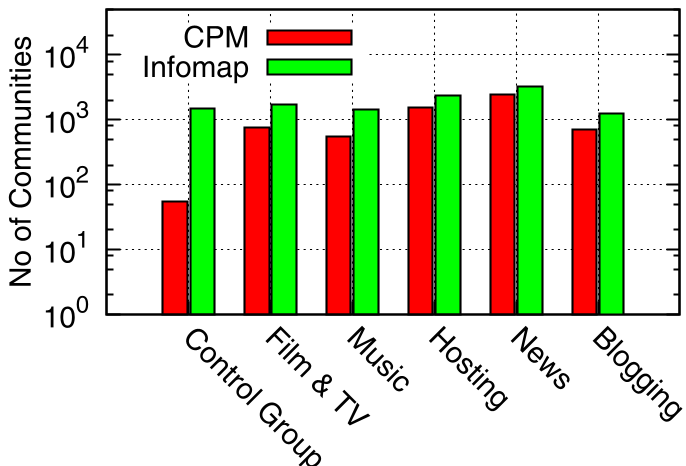 Figure 1: Comparison of total communities formed across different interest categories.
Specialized Interests: The "Country Music" Effect
One of the most profound insights of this paper is the specialization effect. The authors compared a general category (Music) with a specialized sub-category (Country Music).
The findings were striking:
- Normalized Average Community Size (NACS): When users focus on a niche like Country Music, they are 23 to 28 times more likely to form large, connected communities compared to general music fans.
- Cohesion: Specialized groups showed a higher Clustering Coefficient (0.76 vs 0.63) and a much smaller Diameter (4 vs 8), suggesting a "tight-knit" small-world structure where everyone is only a few hops away from each other.
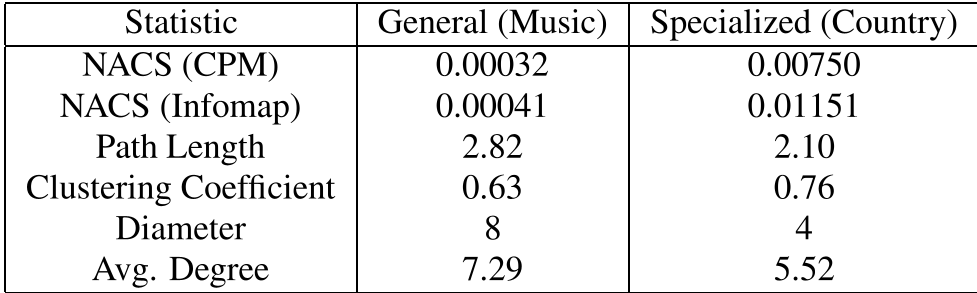 Table 2: Substantial increase in connectivity metrics when transitioning from General to Specialized interests.
Critical Analysis & Takeaways
This work provides an elegant heuristic for a complex problem. By using celebrities as semantic proxies, it bypasses the need for expensive Natural Language Processing (NLP) on actual tweets, which can be noisy or ambiguous.
Key Insights for the Industry:
- Marketing Strategy: Targeted ads should not just target "Music." They should target the overlapping followers of multiple niche influencers to find the most cohesive social clusters.
- Scale-Free Nature: Even within these niche communities, the networks remain "Scale-Free," meaning a few "minor" influencers within the community hold most of the power.
Limitations: While efficient, this method relies heavily on the initial selection of celebrities. If the "seed" celebrities are poorly chosen or have a broad, cross-over appeal (like a pop star who is also a fashion icon), the "interest signal" might get diluted. Future work could benefit from dynamically identifying these "seed" nodes using automated category classification.
Conclusion
"Following the Follower" reminds us that social structure is dictated by shared passion. As we deepen our interests, we don't just consume more content—we weave a tighter social web. For researchers and marketers alike, the path to a community starts not with the masses, but with the leaders they choose to follow.