
Hybrid Intelligence: Bridging Linear and Non-Linear Frontiers in Capital Markets
A comparison of forecasting approaches for capital markets
This paper evaluates the efficacy of various machine learning algorithms—including ANN, SVR, k-NN, and Self-Organizing Fuzzy Neural Networks (SOFNN)—in forecasting financial time series. The core methodology involves creating hybrid models that combine linear ARIMA statistical methods with non-linear machine learning residuals, achieving superior directional accuracy (DA) in log returns forecasting compared to traditional benchmarks.
TL;DR
The eternal struggle in financial forecasting is between the Efficient Markets Hypothesis (EMH)—which claims prices are unpredictable random walks—and the search for hidden alpha. This paper demonstrates that while beating the market is hard, a hybrid approach combining ARIMA (for linear trends) and Self-Organizing Fuzzy Neural Networks (SOFNN) (for non-linear residuals) can achieve a directional accuracy of 58% in log returns, offering a statistically significant edge over pure random chance.
Problem & Motivation: The Chaos of Market Efficiency
Predicting stock prices is often called the "hardest task in financial economics." The authors identify two primary bottlenecks:
- The Linear Limitation: Traditional models like ARIMA are excellent for stationary, linear data but are blind to the chaotic, non-linear signals resulting from millions of human and algorithmic participants.
- The Black-Box Dilemma: While Artificial Neural Networks (ANNs) can approximate any function, they lack transparency. In finance, where "why" matters as much as "what," the inability to interpret model behavior is a significant risk.
The motivation here is to leverage the Research Intuition: If a time series is composed of both linear and non-linear parts, why not use a "specialist" for each?
Methodology: The Hybrid Framework
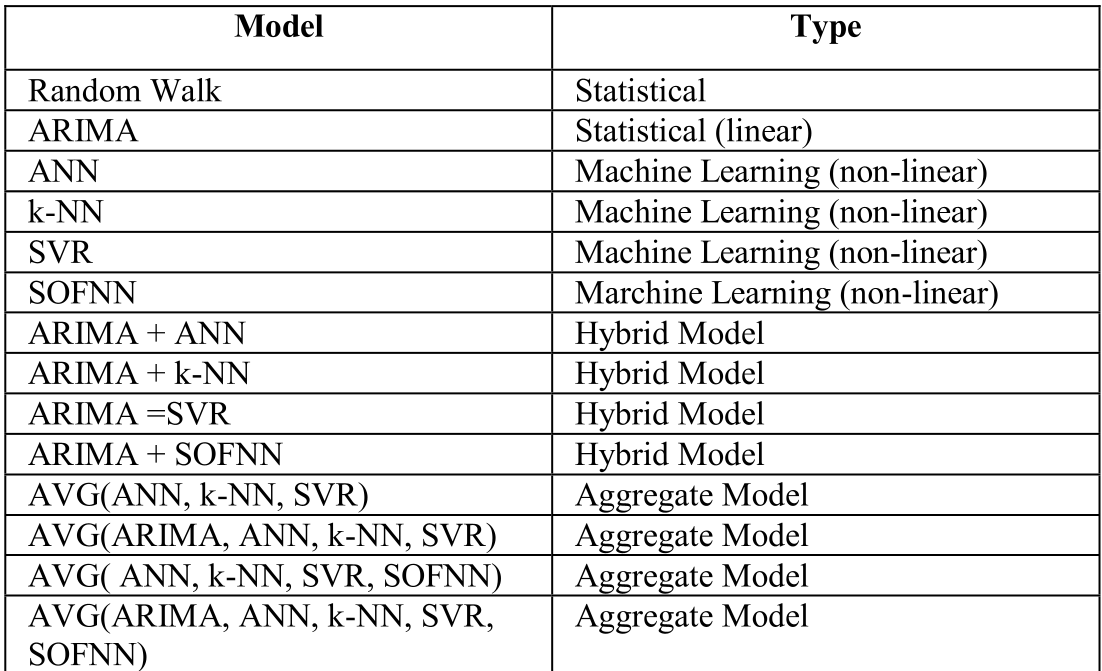
The authors implement a multi-stage forecasting pipeline. The most sophisticated version involves the SOFNN. Unlike static networks, the SOFNN can dynamically grow and prune its structure.
The Architecture
The hybrid logic follows the equation: Where is the ARIMA prediction of the linear trend, and is the machine learning prediction of the residual error left behind by ARIMA.
SOFNN: The "Optimal Brain Surgeon"
The SOFNN stands out because it uses Fuzzy Logic rules (if-then statements) that are human-readable. To prevent "rule explosion," it utilizes the Optimal Brain Surgeon algorithm:
- Step 1: It calculates the importance of each neuron using second-order derivatives.
- Step 2: It prunes redundant neurons that don't contribute to reducing the Root Mean Squared Error (RMSE).
- Step 3: It maintains a compact, efficient, and interpretable model.
Experiments & Results: Beating the Random Walk
The study tested 14 models across 36 time series (including the S&P 500 and DJIA stocks). Two distinct experiments were conducted: Price Prediction and Log Returns Prediction.
1. Price Prediction (The Benchmark Trap)
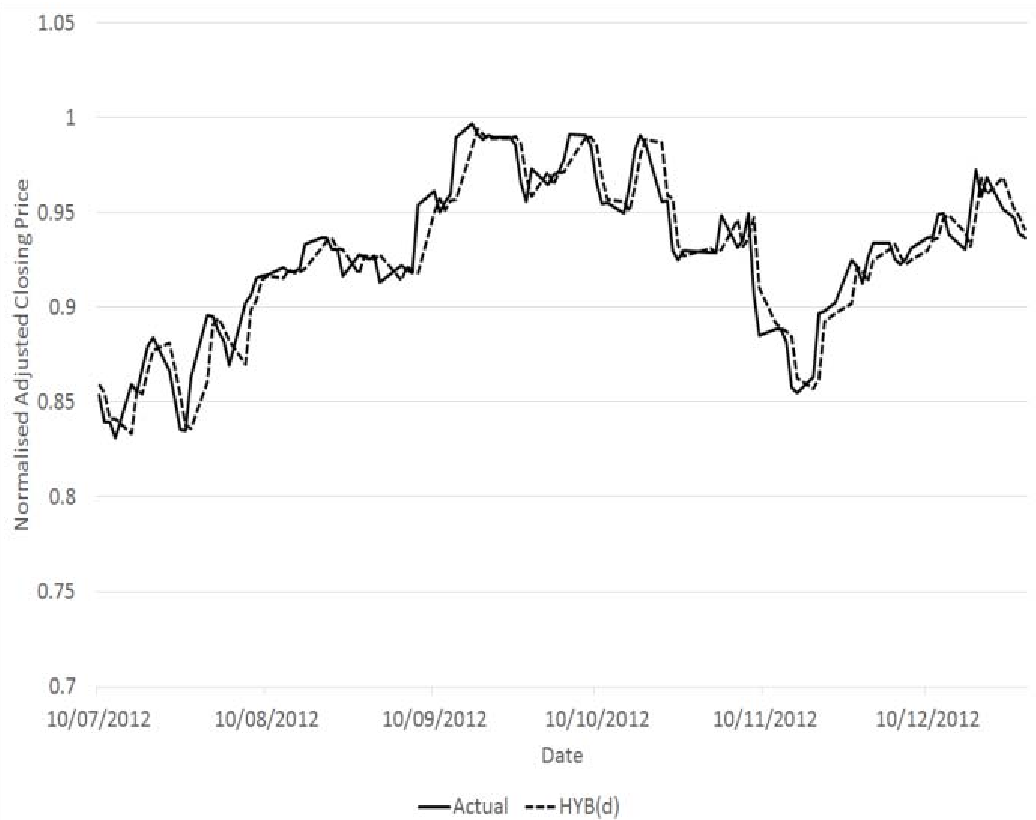
For adjusted closing prices, the Random Walk (RW) remains a formidable opponent. Most models struggled to significantly exceed 50% directional accuracy. This reinforces that in short time horizons, price levels are nearly perfectly integrated with current information.
2. Log Returns (The Success Story)
When shifting to Log Returns, the non-linear capabilities of the hybrid models began to shine.
Key Findings:
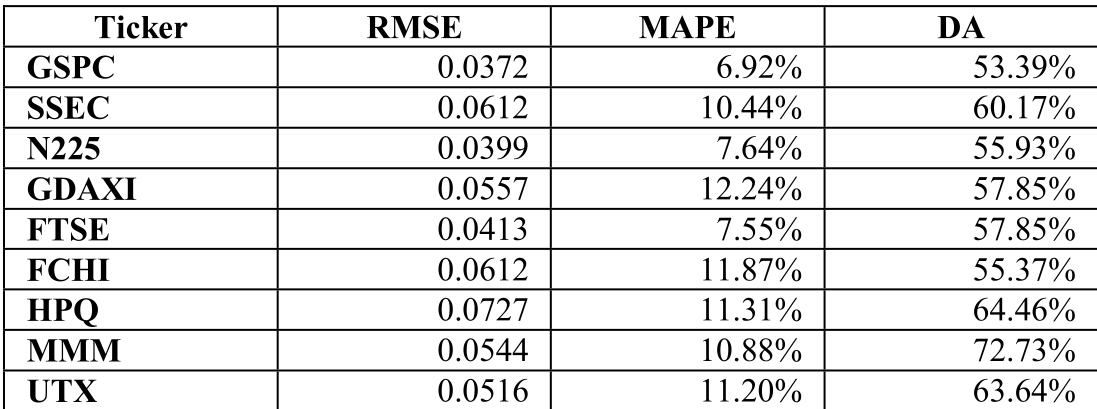
- ARIMA + SOFNN achieved the highest Directional Accuracy (DA) of 58% on average.
- Averaging (Ensembling) several machine learning models (SVR, k-NN, ANN) also showed improvements in RMSE compared to standalone models.
- The hybrid models were more robust to "shocks" in the data compared to pure statistical benchmarks.
Critical Analysis & Conclusion
Takeaway
The study proves that financial markets are not purely random. There is a non-linear signal buried in the residuals of linear models. Hybridizing statistical rigor with machine learning flexibility (specifically fuzzy systems) provides a superior path for trend prediction.
Limitations
- Transaction Costs: A 58% accuracy is high, but the authors note that real-world profitability depends on trade execution costs which were not modeled.
- Stationarity: While log returns are more stationary than prices, they still undergo regime shifts that may require even more frequent model recalibration than the 1,120-day training window used here.
Future Outlook
The move toward Online Learning—where the model updates its weights with every new data point—is the logical next step. Applying these hybrid SOFNN models to the cryptocurrency market, characterized by extreme non-linearity and volatility, could be a highly lucrative area for future research.