
Forecasting Price Shocks: Combining Social Influence with Sentiment Intelligence
Forecasting price shocks with social attention and sentiment analysis
The paper introduces a price shocks forecasting framework that integrates social influence modeling and sentiment analysis. By proposing a new metric called Sentiment-DSA (Degree of Social Attention), the authors predict stock abnormal returns using multiple classifiers, achieving high performance on Chinese stock market data.
TL;DR
Predicting "Price Shocks"—market movements that defy traditional financial models—is a holy grail in quantitative finance. This paper proposes a forecasting framework that uses a refined metric: Sentiment-DSA. By weighing the influence of social media users and the sentiment of their posts, the model significantly outperforms traditional market-only indicators, particularly when using Random Forest classifiers.
Background & Positioning
In the world of asset pricing, Abnormal Returns (AR) represent the gap between actual returns and what risk models (like CAPM) predict. While it is known that investor attention drives these shocks, most models focus on "what" is said (sentiment) or "how much" is said (volume), often ignoring "who" is saying it. This paper sits at the intersection of Social Network Analysis and Financial Engineering, moving from simple volume metrics to an influence-weighted sentiment approach.
The Core Problem: The Blind Spots of DSA
Prior work introduced the Degree of Social Attention (DSA), but it suffered from two critical flaws:
- Directional Blindness: It tracked how much attention a stock got but didn't account for whether that attention was bullish or bearish.
- Static Assumptions: It often failed to account for how influence decays over time or how different users' social "authority" scales.
Methodology: The Sentiment-DSA Framework
The authors formalize price shock forecasting as a three-class classification problem: Negative, Near-Zero, and Positive.
1. Social Influence Modeling
Instead of treating all users as equal, the model uses a recursive influence function. A user's influence is a product of how much they are "trusted" or reacted to (likes, reposts, comments) within their local network.
2. The Sentiment-DSA Equation
The traditional DSA is enhanced by a sentiment factor : This formula effectively says: The total social attention for stock is the sum of all posts, weighted by the Sentiment Score of the content AND the Social Influence of the author.
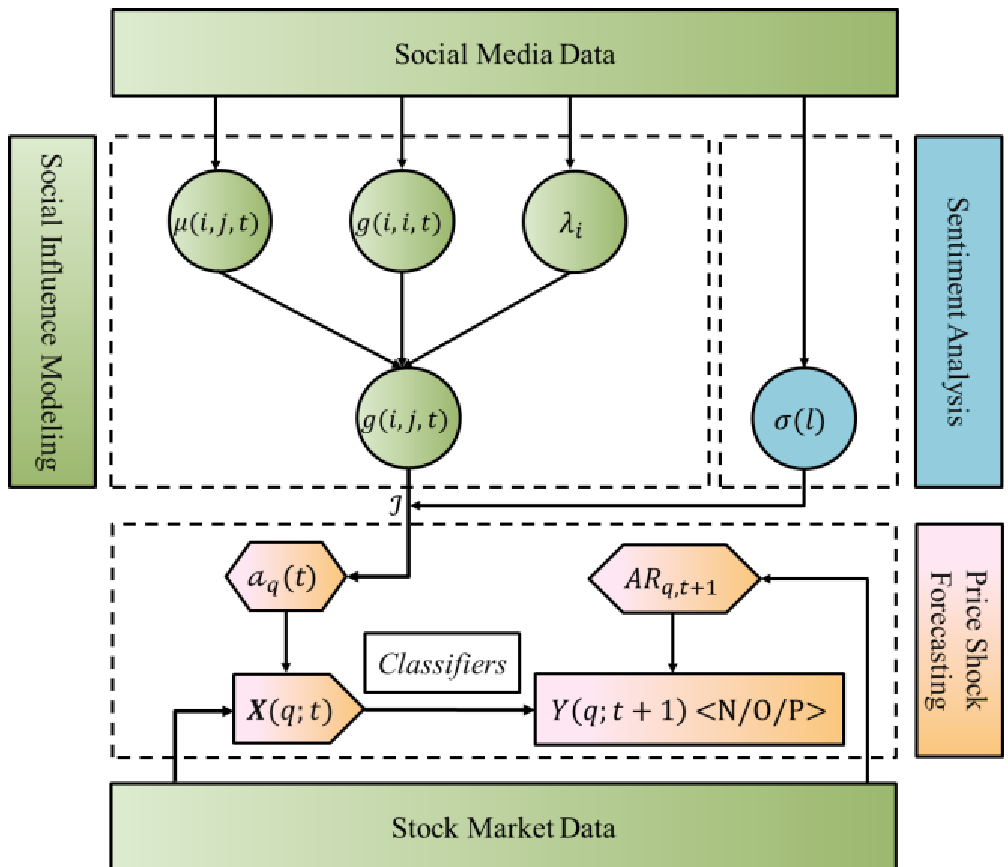 Fig 1: The framework of DSA-based approach for price shock forecasting, showing the pipeline from influence modeling to classification.
3. Time Effect Propagation
Information isn't eternal. The authors use a Gamma Distribution to model how the "jumps" of attention diffuse and eventually decay over a trading session.
Experiments and Results
The study tested the framework on 34 highly active Chinese stocks over a six-month period.
- Classifiers: Random Forest, Decision Trees (J48), and Naive Bayes were the top performers. Random Forest achieved a total F-measure of 0.82.
- Ablation Study: The impact of the "Sentiment-DSA" term was massive. When predicting non-zero price shocks, the F-measure jumped from ~0.52 (without DSA) to ~0.70 (with Sentiment-DSA).
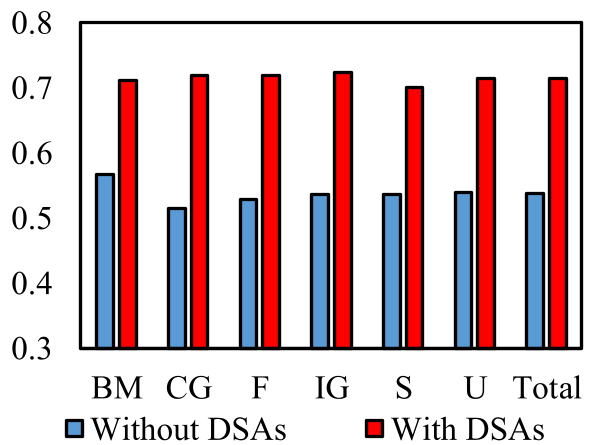 Fig 2: Comparison showing significant improvements in F-measure when Sentiment-DSA terms are included across different sectors.
The "Negativity" Insight
A fascinating finding in the results is that Negative attention has higher predictive power than positive attention. This aligns with behavioral finance theories suggesting that investors react more strongly and predictably to bad news than to good news.
Critical Insight & Conclusion
Takeaway
The integration of influence propagation is what makes this paper stand out. By treating social media as a directed graph where information value is filtered through user authority, the authors successfully extracted a "cleaner" signal for financial markets.
Limitations
- Matrix Complexity: High-dimensional matrix computation remains a challenge, although the authors mitigated this with a "stock-based" sub-sampling approach.
- Platform Specificity: The model was tuned for Weibo and the Chinese market; the dynamics of influence on platforms like X (Twitter) or Reddit might require different decay parameters.
Future Outlook
The next step for this research is likely the application of Deep Learning (LSTMs or Transformers) to capture the temporal dependencies of these shocks more fluidly than traditional classifiers can.