
Unmasking Digsby: Forensic Artifacts and the Fallacy of Application Security
Forensic Analysis of Digsby Log Data to Trace Suspected User Activities
This paper presents a comprehensive digital forensic analysis of Digsby, a multi-protocol IM and social networking client. The authors identify key artifacts in the Windows Registry and file system, and successfully reverse-engineer the RC4-based password encryption mechanism to develop a decryption tool.
TL;DR
In the landscape of digital forensics, multi-protocol clients like Digsby present a goldmine of evidence. This paper deconstructs how Digsby stores sensitive user data—ranging from unencrypted chat logs to weakly encrypted passwords—within the Windows environment. The researchers not only mapped the file system for "digital breadcrumbs" but also developed a tool to bypass Digsby's RC4 password encryption.
Academic Context: This work functions as a "SOTA artifact mapping" study, filling a gap in the forensic knowledge base for unified communication tools that predate the widespread adoption of Signal-style encryption.
Problem & Motivation: The Complexity of Unified Logs
Digsby's primary draw is its versatility: it merges Facebook, AIM, Yahoo, and email into a single interface. However, from a forensic standpoint, this creates a "many-to-one" identity problem.
The authors identified two major gaps in the existing literature:
- Persistence: Does the data survive uninstallation? (Spoiler: It does).
- Security: How robust is the encryption protecting the local "identity vault"?
The motivation was clear: if a suspect uses an alias-heavy tool like Digsby, can an investigator reconstruct their social graph?
Methodology: Mapping the Digital Footprint
The researchers employed a rigorous workflow involving Windows Registry Analysis, File System Auditing, and Cryptographic Reversal.
1. Artifact Mapping
The study reveals that Digsby is surprisingly "loud." While the Registry stores execution paths, the real evidence resides in the local app data.
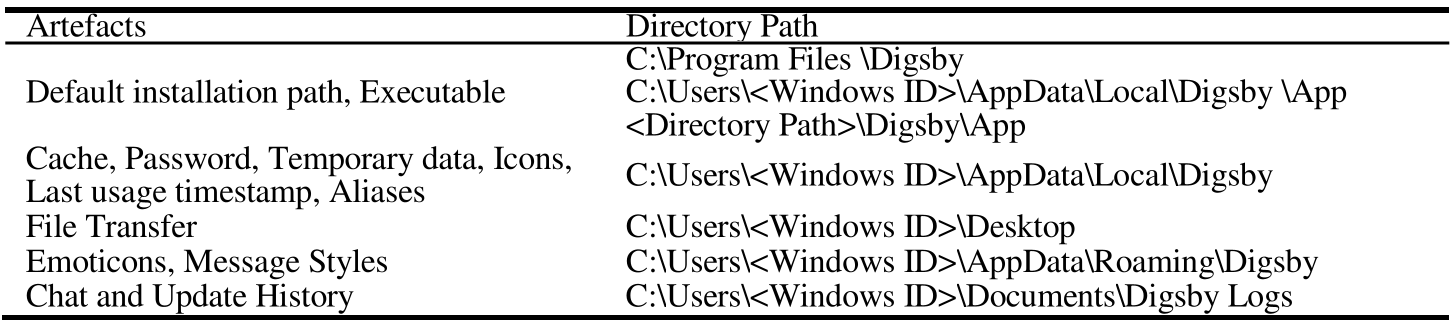 Table 1: Key locations for Digsby artifacts in Windows Systems.
2. The Password Decryption Breakthrough
The core technical achievement is the breaking of the logininfo.yaml security. The authors discovered that Digsby's "security" is merely obfuscation. The encryption key for the RC4 algorithm is a SHA-1 hash of:
- System Product ID (Found in Registry)
- Install Date (Found in Registry)
- Digsby ID (Found in the YAML file itself)
Since all these variables are readily available to any user (or malware) with access to the machine, the encryption is effectively neutralized.
Experiments & Results: Evidence that Lingers
The authors performed "Live vs. Post-Uninstall" comparisons. They found that while uninstallation removes its Registry uninstall key, the "MUICache" often retains recent usage timestamps, and the entire Digsby Logs folder (containing HTML chat history) remains untouched.
 Figure 4: Snapshot of the 'logininfo.yaml' file showing the stored metadata.
Key Metrics:
- Chat Logs: 100% recovery of daily communication in plaintext HTML format.
- Contact Identification: Using the
iconhashes.datandalias cache, investigators can link numeric Facebook IDs to real-world names. - Password Success: 100% success rate in decrypting 31-character strings using their custom tool.
Critical Analysis & Conclusion
The "Insider Attack" Insight
The paper introduces a provocative theory on insider attacks. While Digsby stores password hashes on their servers, the authors argue that if an employee (or intruder) gains the hash, they could use rainbow tables to find the plaintext password, which then allows them to decrypt all other local credentials (IM, Email, Social) because the local RC4 key is so easily derived.
Conclusion
This research is a stark reminder that convenience is often the enemy of security. Digsby’s failure to implement proper hashing for local logs or unique, user-provided salt for encryption turns a user's PC into an open book for forensic examiners.
Future Work: The authors are pivoting toward RAM Forensics (identifying volatile traces in swap files) and analysis of Portable Installations, which are increasingly used by suspects to bypass standard OS footprints.